What Are the Differences Between -ed and -ing Adjectives?
TL;DR
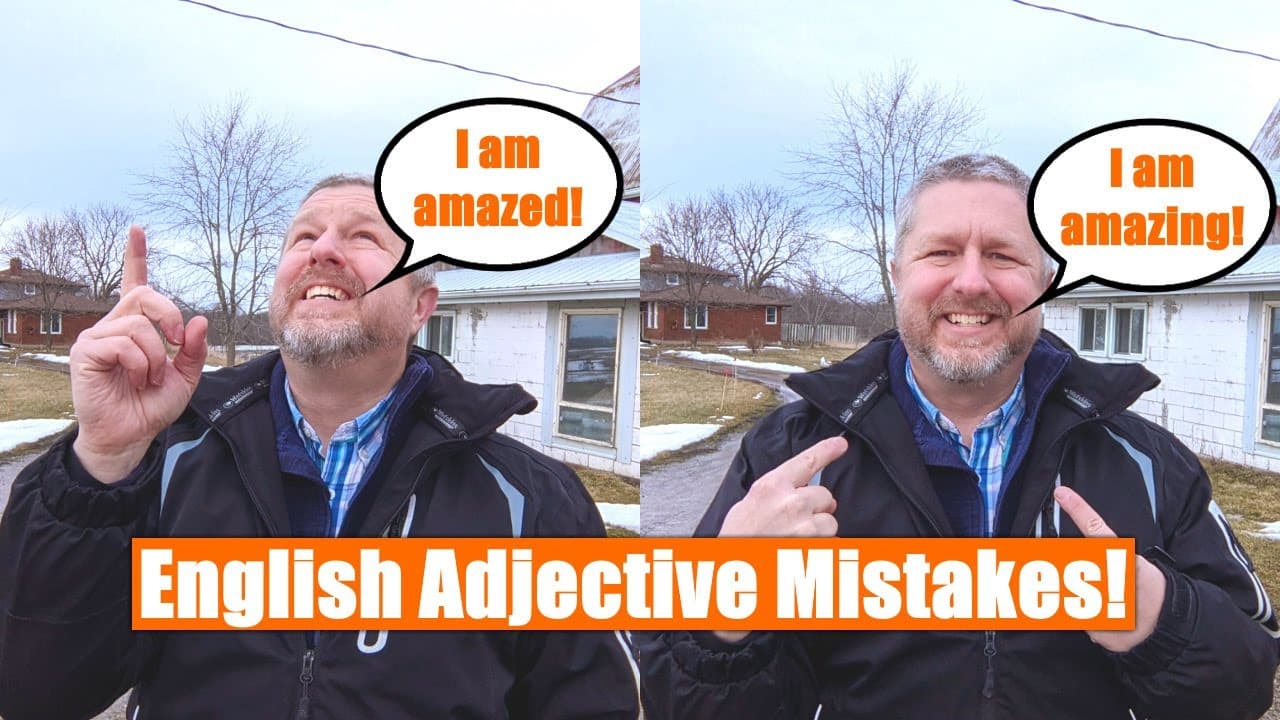
Adjectives ending in -ed express emotions or feelings, while those ending in -ing describe characteristics. For example, 'bored' means feeling uninterested, while 'boring' describes something that causes that feeling. Correct usage prevents misunderstandings and allows clear communication.
Transcript
There is a mistake that I make quite often when I am speaking French, and it makes me laugh at myself. And I've noticed that people who are learning English, people who are learning to speak English, sometimes make the same mistake, even though it's a different language. And that mistake is this. When they are using adjectives that end in -ed or -i... Read More
Key Insights
- 😑 The difference between -ed and -ing adjectives lies in expressing emotions/feelings versus characteristics.
- 💁 Misusing these forms can result in humorous misunderstandings.
- 😕 Examples of -ed adjectives: bored, excited, interested, frustrated, confused, overwhelmed, etc.
- ❓ Examples of -ing adjectives: boring, exciting, interesting, frustrating, confusing, overwhelming, etc.
- 💁 By using the correct form, speakers can convey their emotions or describe characteristics more accurately.
- 💁 Both -ed and -ing forms can be used in the same sentence to illustrate the relationship between the speaker's feeling and the characteristic being described.
Install to Summarize YouTube Videos and Get Transcripts
Explore YouTube Video Summarizer or Get YouTube Transcript Extractor
Questions & Answers
Q: What does it mean when an adjective ends in -ed?
When an adjective ends in -ed, it describes the emotions or feelings of the speaker. For example, "bored" means the speaker feels bored.
Q: How are adjectives ending in -ing different?
Adjectives ending in -ing describe the characteristics of something or someone. For example, "boring" means that something or someone is not interesting.
Q: Why is it important to use the correct form?
Using the incorrect form can lead to misunderstandings and change the meaning of a sentence. It's essential to use the appropriate form to express the intended emotion or characteristic accurately.
Q: Can both -ed and -ing adjectives be used in the same sentence?
Yes, it is possible to use both forms in the same sentence. For example, "Sometimes when I read a story, I'm confused because the story is confusing."
Summary & Key Takeaways
-
Adjectives ending in -ed describe emotions or feelings, while those ending in -ing describe characteristics of someone or something.
-
Using the wrong form can lead to humorous misunderstandings, as exemplified by the speaker's experience in learning French and observing English learners.
-
Examples of -ed and -ing adjectives include bored and boring, excited and exciting, interested and interesting, frustrated and frustrating, etc.
Read in Other Languages (beta)
Share This Summary 📚
Summarize YouTube Videos and Get Video Transcripts with 1-Click
Try YouTube Summary with ChatGPT & Claude or YouTube Transcript Generator
Explore More Summaries from Learn English with Bob the Canadian 📚





Summarize YouTube Videos and Get Video Transcripts with 1-Click
Try YouTube Summary with ChatGPT & Claude or YouTube Transcript Generator