Imaging techniques to analyze molecular mechanics for cell migration and axon guidance
TL;DR
Webinar discusses imaging techniques for analyzing cell migration and axon guidance.
Transcript
thank you thank you everyone for joining us today my name is Ron Myers I'm the director of editorial here at Joe um and today we're going to have a webinar on Imaging techniques of cell migration and axonal guidance so Dr innagaki is joining us today to present he's a professor at the um the Nora Institute of Science and Technology um so he publish... Read More
Key Insights
- Dr. Naoyuki Inagaki presented imaging techniques for analyzing molecular mechanics related to cell migration and axon guidance, focusing on traction force microscopy and speckle imaging.
- Traction force microscopy measures the force exerted by growth cones on the environment, using fluorescent beads to track gel deformation.
- Speckle imaging analysis allows for the monitoring of molecular dynamics, specifically the movement of actin filaments and associated proteins in growth cones.
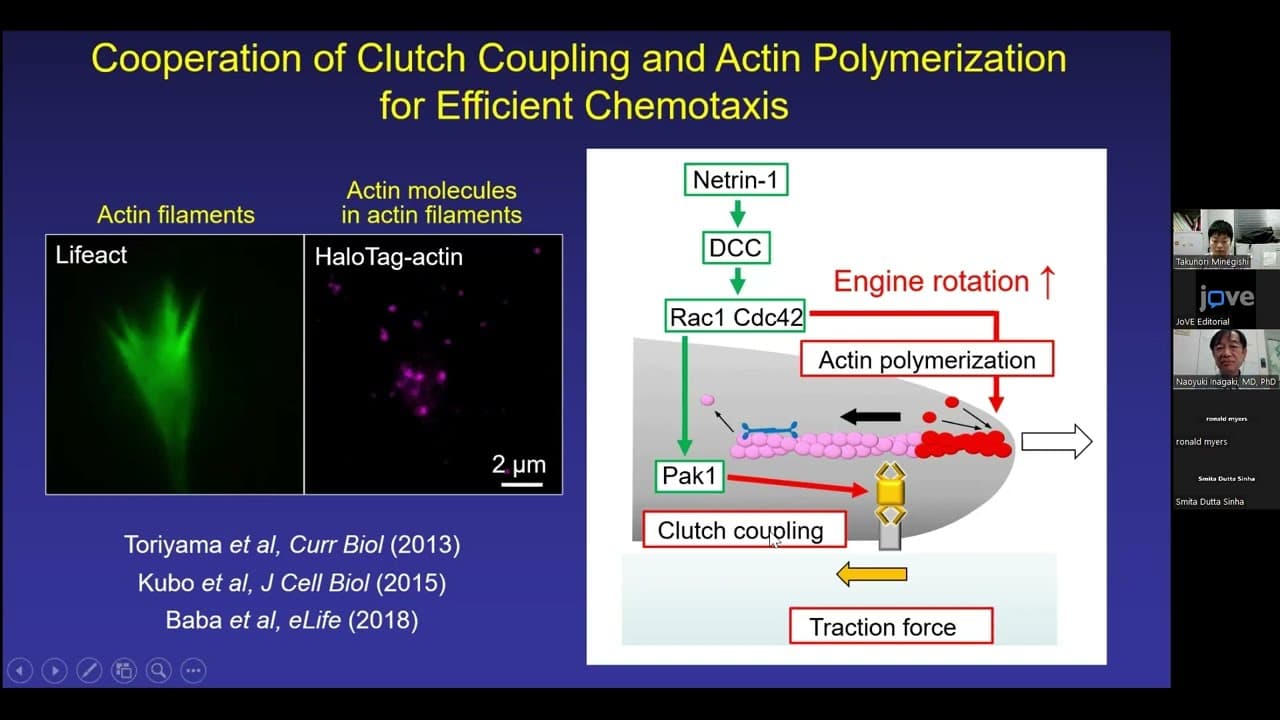
- The webinar highlighted the importance of clutch molecules, such as shootin, in linking actin flow and cell adhesion molecules to generate traction force.
- Neurons cultured on substrates of varying stiffness exhibit different axonal extension behaviors, illustrating the role of mechanical cues in cell motility.
- The presentation explained how actin polymerization and retrograde flow contribute to the propulsion of growth cones, aiding in axon guidance.
- Dr. Inagaki discussed the application of these techniques in both 2D and semi-3D cultures, enhancing the study of neural migration.
- The webinar concluded with a Q&A session addressing the feasibility of these studies in 3D cultures and factors affecting actin polymerization.
Install to Summarize YouTube Videos and Get Transcripts
Explore YouTube Video Summarizer or Get YouTube Transcript Extractor
Questions & Answers
Q: What are the main techniques discussed in the webinar?
The webinar focused on two main imaging techniques: traction force microscopy and speckle imaging analysis. Traction force microscopy measures the force exerted by growth cones on their environment using fluorescent beads embedded in a polyacrylamide gel. Speckle imaging allows for the visualization of actin filament dynamics and the behavior of clutch molecules, which are crucial for understanding the molecular mechanics underlying cell migration and axon guidance.
Q: How does traction force microscopy work?
Traction force microscopy involves culturing neurons on a polyacrylamide gel embedded with fluorescent beads. The movement of these beads, caused by the forces exerted by growth cones, is tracked to measure the deformation of the gel. By knowing the gel's elasticity, the direction and amplitude of the traction forces can be calculated. This method provides insights into the mechanical interactions between cells and their environment during migration and axon guidance.
Q: What is the role of clutch molecules in cell motility?
Clutch molecules, such as shootin, play a critical role in cell motility by linking actin retrograde flow to cell adhesion molecules. This linkage allows the transmission of forces generated by actin polymerization and flow to the substrate, enabling traction force generation. The clutch mechanism is essential for the propulsion of growth cones and the navigation of axons, as it facilitates the conversion of chemical and mechanical cues into directed cell movement.
Q: What are the applications of speckle imaging analysis?
Speckle imaging analysis is used to monitor the dynamics of actin filaments and clutch molecules within growth cones. By transfecting neurons with low amounts of labeled actin plasmids, researchers can visualize the movement of individual molecules. This technique provides detailed insights into the molecular interactions and mechanics that drive cell motility, allowing for the study of processes like actin polymerization, retrograde flow, and clutch coupling in response to various cues.
Q: Can these imaging techniques be applied in 3D cultures?
While the techniques discussed are primarily performed in 2D cultures, they can be adapted for semi-3D cultures. For traction force microscopy, neurons can be cultured on a polyacrylamide gel with additional gel layers added on top. This setup allows for the study of neural migration in a more physiologically relevant environment. However, fully 3D applications may require further methodological adaptations to account for the complexities of three-dimensional tissue structures.
Q: What factors influence actin polymerization in these studies?
Actin polymerization is influenced by various factors, including the presence of chemical cues like netrin, which can enhance polymerization rates. The expression levels of labeled actin, such as Lifeact and HaloTag actin, also affect visualization and analysis. It's important to maintain low expression levels to avoid overexpression artifacts. Additionally, clutch coupling efficiency and the mechanical properties of the substrate can impact actin filament dynamics and polymerization rates.
Q: How do mechanical cues affect axon guidance?
Mechanical cues, such as substrate stiffness, significantly influence axon guidance by affecting the behavior of growth cones. Neurons cultured on stiffer substrates tend to extend longer axons, as the increased stiffness promotes clutch coupling and traction force generation. These mechanical interactions are crucial for the proper navigation of axons to their target destinations, as they modulate the responsiveness of growth cones to chemical and physical environmental cues.
Q: What are the future implications of these imaging techniques?
The imaging techniques discussed have significant implications for advancing our understanding of cell migration and axon guidance. By providing detailed insights into the molecular mechanics of these processes, researchers can develop better strategies for studying neural development and regeneration. These techniques could also aid in identifying therapeutic targets for neurological disorders involving impaired cell motility and axon pathfinding, ultimately contributing to improved treatment outcomes.
Summary & Key Takeaways
-
Dr. Naoyuki Inagaki presented on imaging techniques for analyzing molecular mechanics in cell migration and axon guidance, focusing on traction force microscopy and speckle imaging. These methods allow for detailed analysis of forces and molecular interactions involved in neural growth and guidance.
-
Traction force microscopy measures the force exerted by growth cones on the environment by tracking fluorescent bead movement in a gel substrate. Speckle imaging monitors the dynamics of actin filaments and clutch molecules, crucial for understanding cell motility mechanisms.
-
The webinar covered the role of clutch molecules in linking actin flow to cell adhesion, and how mechanical cues from substrates influence axonal extension. The techniques are applicable in both 2D and semi-3D cultures, providing insights into neural migration processes.
Read in Other Languages (beta)
Share This Summary 📚
Summarize YouTube Videos and Get Video Transcripts with 1-Click
Try YouTube Summary with ChatGPT & Claude or YouTube Transcript Generator