How Can GANs Work With Fewer Labeled Examples?
TL;DR
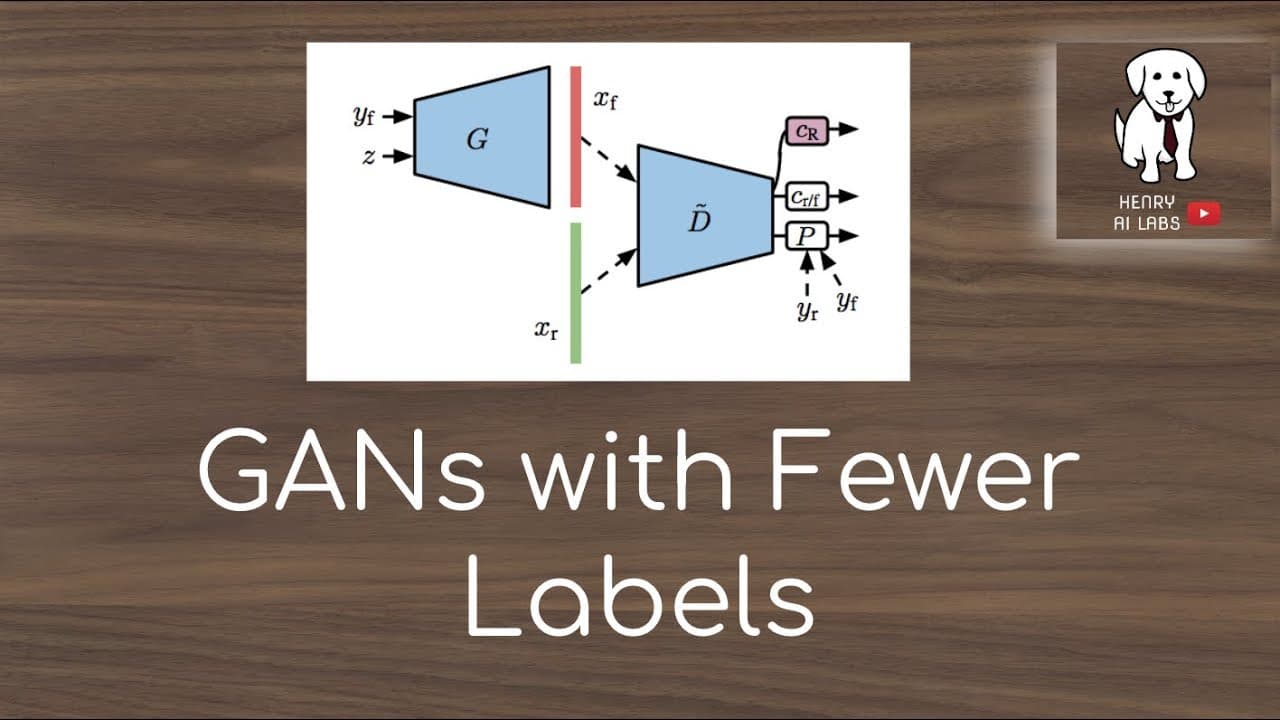
Generative adversarial networks (GANs) can achieve competitive performance utilizing only 10-20% of the usual labeled data through the integration of self-supervised and semi-supervised learning techniques. This approach reduces the reliance on extensive labeling, making it feasible to generate high-quality images with fewer labeled examples, which is critical for scaling AI models in real-world applications.
Transcript
this video will present a paper from Google AI research on making generative adversarial networks work with fewer labels so for a quick recap Darren of adversarial networks taken random noise and then produce images such that they can generate novel data points this works by being trained against a another deep neural network a discriminator which ... Read More
Key Insights
- ✋ GANs traditionally require significant labeled data to generate high-quality images, making them resource-intensive.
- 🤳 The introduction of self-supervised and semi-supervised learning techniques can efficiently reduce labeling requirements, enabling better performance with fewer labels.
- 👻 The video emphasizes that self-supervised learning could stabilize training in GANs, particularly by allowing prediction of transformations within the data.
- 🚂 Results show that GANs can still achieve competitive performance while training with only a fraction of the labeled data, indicating a shift towards more efficient data usage.
- 🏷️ The hybrid approach discussed utilizes both feature clustering and label prediction to improve the discriminator's effectiveness within GANs.
- 💗 The method promises expanded applications for GANs in various fields, as it addresses the bottleneck of labeling data in growing datasets.
- 🏛️ Future explorations could focus on normalizing unlabeled data further or incorporating additional augmented transformations to bolster class predictions.
Install to Summarize YouTube Videos and Get Transcripts
Explore YouTube Video Summarizer or Get YouTube Transcript Extractor
Questions & Answers
Q: What are generative adversarial networks (GANs) and how do they work?
Generative adversarial networks (GANs) consist of two core components: a generator and a discriminator. The generator creates synthetic data from random noise, while the discriminator evaluates whether a given data point is real or fake. This adversarial process iterates until the generator produces convincing outputs that the discriminator can no longer easily distinguish from real data.
Q: Why is reducing the number of labels important in training GANs?
Reducing the number of required labels is crucial as it allows for broader application of GANs in real-world scenarios. Labeling data is time-consuming and costly. By effectively leveraging vast amounts of unlabeled data on platforms like social media and search engines, researchers can enhance model training efficiency and scalability, ultimately fostering greater innovation in AI.
Q: What role does self-supervised learning play in the proposed method?
Self-supervised learning is used to normalize the features of the discriminator by predicting transformations like image rotations. This technique allows the model to learn useful representations without needing extensive labeled data, thus improving the GAN's performance by making it more robust even with limited supervision during training.
Q: How does the semi-supervised learning aspect contribute to the GANs' performance?
Semi-supervised learning enriches the GAN training process by incorporating both labeled and unlabeled data. By allowing the discriminator to predict class labels while still assessing real versus fake data, the model gains supplementary feedback. This multi-faceted training leads to improved classification accuracy and higher quality generated outputs, which is significant when labels are scarce.
Q: What evidence was shown in the video to support the effectiveness of the proposed method?
The video presented results demonstrating that the new technique could match or exceed state-of-the-art GAN performance using only 10% to 20% of the typical labeled data. Metrics such as inception scores and FID scores showed marked improvements, illustrating the viability of using fewer labels without sacrificing output quality.
Q: What potential improvements did the presenter suggest for future research?
The presenter proposed exploring additional methods to enhance the integration of self-supervised learning with GANs, such as incorporating further loss functions that leverage unlabeled data. This would aim to refine the class predictions and improve the model's ability to generalize from limited labeled information, potentially yielding even better outcomes in image generation tasks.
Summary & Key Takeaways
-
The video explores advancements in generative adversarial networks (GANs), highlighting a new method that reduces the requirement for labeled data while maintaining high performance.
-
Through the integration of self-supervised learning and semi-supervised techniques, the research demonstrates that GANs can generate images effectively using only 10-20% of typical labeled data.
-
The findings suggest a significant impact on representation learning for future AI models, particularly in scenarios where labeling data is impractical due to vast data availability online.
Read in Other Languages (beta)
Share This Summary 📚
Summarize YouTube Videos and Get Video Transcripts with 1-Click
Try YouTube Summary with ChatGPT & Claude or YouTube Transcript Generator
Explore More Summaries from Connor Shorten 📚
Summarize YouTube Videos and Get Video Transcripts with 1-Click
Try YouTube Summary with ChatGPT & Claude or YouTube Transcript Generator