Slip Test | Two reaction theory | Synchronous Machines | Lec-20
TL;DR
The two reaction theory explains reactances in synchronous machines based on rotor construction.
Transcript
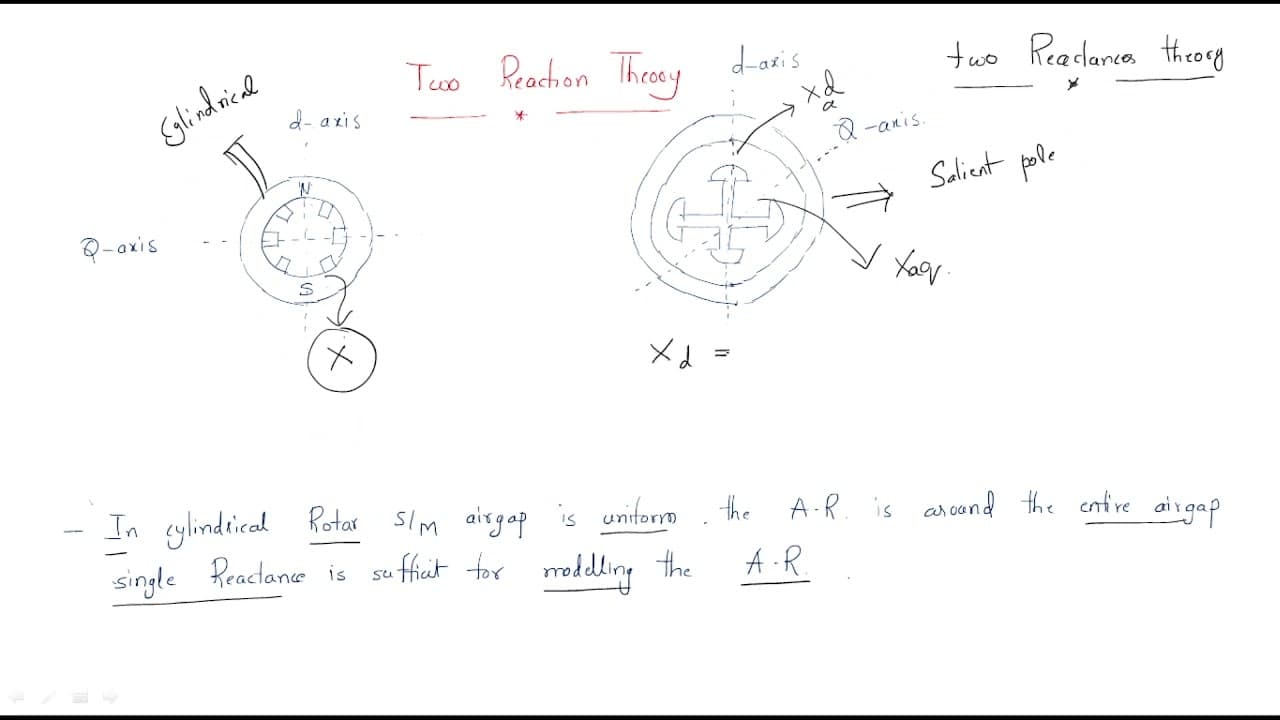
hello everyone in this session we will discuss about the two reaction Theory two reaction Theory we can give the another name that is the two reactances Theory another name is the two reactances theory that means we should discuss about the two reactances right so to understand these two reactances first we will look at the two types of rotar const... Read More
Key Insights
- 🎰 The two reaction theory is essential in understanding reactance in synchronous machines, focusing on rotor configurations.
- 👱 Reactance in the cylindrical rotor construction is represented as a single entity due to uniform air gaps, unlike the salient pole design.
- 🎰 In salient pole machines, distinct direct and quadrature axis reactances (XD and XQ) are critical for accurate modeling of machine performance.
- ❓ The provided equations for XD and XQ showcase their relationship with leakage reactance and provide insight into their operational dynamics.
- 💋 The slip test methodology can accurately determine the synchronous reactance values, shaping the performance metrics of synchronous machines.
- ⚡ Voltage and current behavior of synchronous machines differs significantly between the direct and quadrature axes, impacting operational efficiency.
- ✊ Understanding the minimum reluctance at the direct axis aids in optimizing machine performance to maximize power generation.
Install to Summarize YouTube Videos and Get Transcripts
Explore YouTube Video Summarizer or Get YouTube Transcript Extractor
Questions & Answers
Q: What are the two types of rotor constructions in synchronous machines?
The two types of rotor constructions in synchronous machines are cylindrical and salient pole constructions. The cylindrical construction exhibits a uniform air gap, resulting in a single reactance, while the salient pole construction has varying air gaps along the direct and quadrature axes, necessitating two distinct reactances.
Q: How does the air gap influence reactance in synchronous machines?
In synchronous machines, the air gap significantly affects reactance. A minimal air gap, as seen in the direct axis of a salient pole machine, results in lower reluctance and lower reactance, enhancing voltage generation, while a maximum air gap in the quadrature axis increases reluctance and reactance, leading to higher current demands.
Q: What is the significance of the slip test?
The slip test is vital for calculating the direct axis (XD) and quadrature axis (XQ) reactances in synchronous machines. By applying reduced voltage to the armature during the test, engineers can analyze the current and voltage responses to determine the machine's reactance characteristics effectively.
Q: Can you explain the difference in voltage and current at the direct and quadrature axes during testing?
During testing, when the armature is aligned with the direct axis, the voltage is maximized while the current is minimized. Conversely, alignment with the quadrature axis results in minimum voltage and maximum current. This distinction is crucial for understanding machine behavior under different operational conditions.
Summary & Key Takeaways
-
The two reaction theory highlights the different types of reactances in synchronous machines, namely the direct axis and quadrature axis reactance, which depend on rotor construction type.
-
Synchronous machines can have either cylindrical or salient pole rotor constructions, each affecting reactance differently, with cylindrical construction showing a single reactance and salient poles exhibiting two distinct reactances.
-
Slip tests are crucial for determining the direct axis and quadrature axis reactances, allowing engineers to calculate effective machine performance based on rotor alignment and corresponding voltage and current characteristics.
Read in Other Languages (beta)
Share This Summary 📚
Summarize YouTube Videos and Get Video Transcripts with 1-Click
Try YouTube Summary with ChatGPT & Claude or YouTube Transcript Generator