Richest 1% harm planet most: BBC News Review
TL;DR
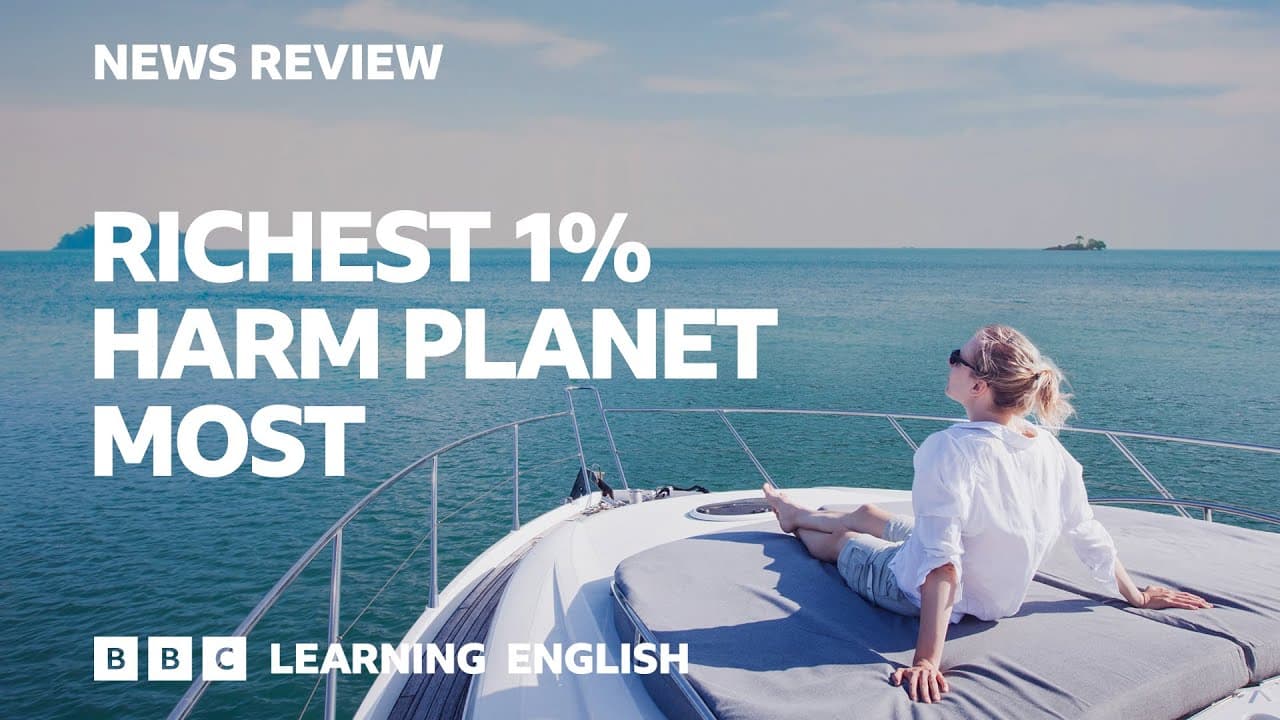
The wealthiest 1% contribute as much carbon as the poorest two-thirds.
Transcript
Frequent flying, big houses and luxury lifestyles. The world's richest are damaging the planet more than any other group of people. This is News Review from BBC Learning English where we help you understand news headlines in English. I'm Neil. And I'm Beth. Make sure you watch to the end to learn all the vocabulary you need to talk about this story... Read More
Key Insights
- The wealthiest 1% of the global population have a carbon footprint equivalent to that of the poorest two-thirds, highlighting the disproportionate environmental impact of their lifestyles.
- Oxfam's report emphasizes the connection between luxury lifestyles, such as frequent flying and dining out, and climate change, urging for systemic changes to address these issues.
- The term 'well-off' is used to describe the rich in a more polite manner, differentiating it from harsher terms like 'rich' or 'loaded'.
- The report uses the term 'plundering' to describe how the richest exploit resources, drawing a parallel with stealing, to emphasize the ethical concerns of their consumption habits.
- The expression 'clean up their acts' is used to suggest that the wealthy need to improve their behavior concerning environmental impact.
- The BBC segment introduces vocabulary to discuss wealth and environmental impact, aiming to enhance understanding of climate-related news in English.
- The discussion includes different expressions for wealth, highlighting nuances in language that reflect societal attitudes towards wealth and responsibility.
- The program encourages viewers to engage with climate change topics and improve their English language skills through related content and discussions.
Install to Summarize YouTube Videos and Get Transcripts
Explore YouTube Video Summarizer or Get YouTube Transcript Extractor
Questions & Answers
Q: What is the main finding of the Oxfam report discussed in the video?
The main finding of the Oxfam report is that the richest 1% of the global population are responsible for the same amount of carbon emissions as the poorest two-thirds. This highlights the significant environmental impact of the wealthy's luxury lifestyles, such as frequent flying and dining out, and calls for systemic changes to address these issues.
Q: How does the video explain the term 'well-off'?
The video explains 'well-off' as a term used to describe people who are rich, but in a more polite manner than simply calling them 'rich' or 'loaded'. It is an adjective that implies financial comfort without the negative connotations that can sometimes accompany the word 'rich'. The term is softer and more socially acceptable.
Q: What does the term 'plundering' imply in the context of the Oxfam report?
In the context of the Oxfam report, 'plundering' implies that the richest are exploiting resources in a way that is akin to stealing. The term suggests that their consumption habits are unethical and contribute to environmental degradation. It draws a parallel between the actions of the wealthy and the act of taking what does not rightfully belong to them.
Q: What does 'clean up their acts' mean in relation to the wealthy and climate change?
'Clean up their acts' means that the wealthy need to improve their behavior concerning their environmental impact. The expression suggests that the rich should take responsibility for their actions and make changes to reduce their carbon footprint. It is a call for them to adopt more sustainable practices and contribute positively to addressing climate change.
Q: How does the video aim to help viewers with English language learning?
The video aims to help viewers with English language learning by introducing vocabulary related to wealth and environmental impact. It provides definitions and examples of terms like 'well-off', 'plundering', and 'clean up their acts', enhancing viewers' ability to discuss climate-related news in English. The program also encourages engagement with climate change topics to improve language skills.
Q: What are some alternative words for 'steal' mentioned in the video?
The video mentions 'nick' and 'pinch' as alternative, informal words for 'steal'. These terms are used in casual conversations and imply taking something without permission. The discussion highlights the variety of expressions available in English to describe similar actions, reflecting different levels of formality and context.
Q: What role does language play in discussing wealth and environmental impact?
Language plays a crucial role in discussing wealth and environmental impact by shaping perceptions and attitudes. Terms like 'well-off', 'plundering', and 'clean up their acts' carry connotations that influence how people interpret the actions of the wealthy. Understanding these nuances helps in engaging in informed and respectful discussions about climate change and social responsibility.
Q: What additional resources does the video suggest for learning more about climate change?
The video suggests additional resources such as related episodes of News Review and other BBC Learning English programs focused on climate change. These resources provide further insights into environmental issues and help viewers improve their English skills. The program encourages subscribing to the channel and exploring content that discusses the intersection of language learning and global topics.
Summary & Key Takeaways
-
The BBC News Review discusses a report by Oxfam, highlighting that the richest 1% of the population contribute as much carbon as the poorest two-thirds. The report calls for systemic changes to address the environmental impact of luxury lifestyles.
-
The segment introduces vocabulary related to wealth and environmental impact, such as 'well-off', 'plundering', and 'clean up their acts', to help viewers understand the nuances of discussing climate change and wealth in English.
-
The program aims to engage viewers in climate change discussions while improving their English skills, encouraging them to explore related content on the BBC Learning English platform.
Read in Other Languages (beta)
Share This Summary 📚
Summarize YouTube Videos and Get Video Transcripts with 1-Click
Try YouTube Summary with ChatGPT & Claude or YouTube Transcript Generator
Explore More Summaries from BBC Learning English 📚
Summarize YouTube Videos and Get Video Transcripts with 1-Click
Try YouTube Summary with ChatGPT & Claude or YouTube Transcript Generator