L08.7 Cumulative Distribution Functions
TL;DR
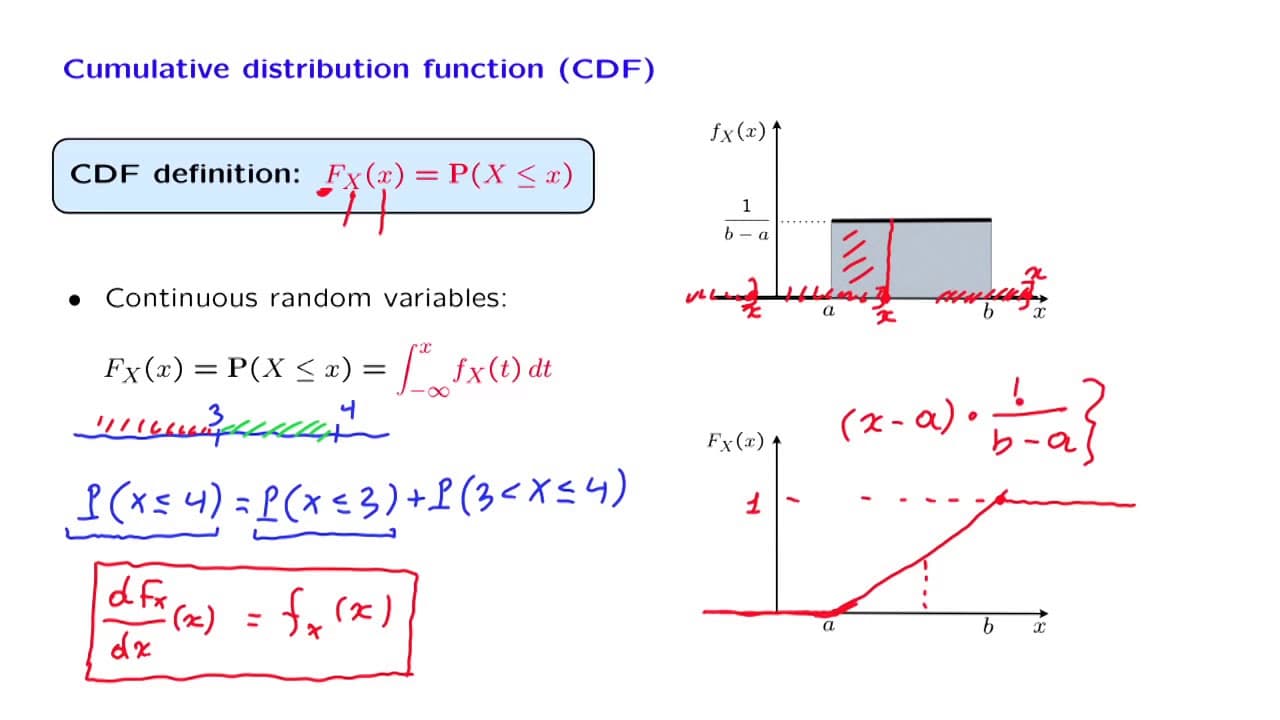
CDFs provide a way to describe the distribution of random variables, whether discrete or continuous, by calculating the probability that the random variable takes a value less than or equal to a particular value.
Transcript
We have seen that several properties, such as, for example, linearity of expectations, are common for discrete and continuous random variables. For this reason, it would be nice to have a way of talking about the distribution of all kinds of random variables without having to keep making a distinction between the different types-- discrete or conti... Read More
Key Insights
- 💨 CDFs provide a way to describe the distribution of random variables without the need to distinguish between discrete and continuous variables.
- 🍹 For continuous random variables, the CDF can be calculated by integrating the PDF, while for discrete random variables, it is calculated by summing the probabilities of all possible values less than or equal to a specific value.
- 🚱 CDFs are non-decreasing functions and start at 0, reaching a value of 1 asymptotically as the random variable tends to infinity.
- 💁 CDFs contain all the probabilistic information about a random variable and can be used to calculate probabilities of specific intervals.
- ❓ The CDF can be differentiated to obtain the PDF, and the PDF can be integrated to obtain the CDF.
Install to Summarize YouTube Videos and Get Transcripts
Explore YouTube Video Summarizer or Get YouTube Transcript Extractor
Questions & Answers
Q: What is a cumulative distribution function (CDF)?
A CDF is a function that gives us the probability that a random variable takes a value less than or equal to a particular value. It is a way to describe the distribution of random variables, regardless of whether they are discrete or continuous.
Q: How is the CDF calculated for continuous random variables?
For continuous random variables, the CDF is calculated by integrating the probability density function (PDF) over the range from minus infinity up to the specific value. This gives us the probability that the random variable takes a value less than or equal to that specific value.
Q: How is the CDF calculated for discrete random variables?
For discrete random variables, the CDF is calculated by summing the probabilities of all possible values less than or equal to the specific value. This gives us the probability that the random variable takes a value less than or equal to that specific value.
Q: What are some properties of CDFs?
CDFs are non-decreasing functions, meaning that as the value of the random variable increases, the value of the CDF also increases. CDFs start at 0 and can only go up asymptotically, reaching a value of 1 as the random variable tends to infinity.
Summary & Key Takeaways
-
CDFs are a new way to describe the distribution of random variables, without the need to distinguish between discrete and continuous variables.
-
CDFs are defined as the probability that a random variable takes a value less than or equal to a specific value, and they can be used for both continuous and discrete random variables.
-
For continuous random variables, the CDF can be calculated by integrating the probability density function (PDF) over a specific range, while for discrete random variables, it is calculated by summing the probabilities of all possible values less than or equal to the specific value.
Read in Other Languages (beta)
Share This Summary 📚
Summarize YouTube Videos and Get Video Transcripts with 1-Click
Try YouTube Summary with ChatGPT & Claude or YouTube Transcript Generator
Explore More Summaries from MIT OpenCourseWare 📚


Summarize YouTube Videos and Get Video Transcripts with 1-Click
Try YouTube Summary with ChatGPT & Claude or YouTube Transcript Generator