9. Geodesics.
TL;DR
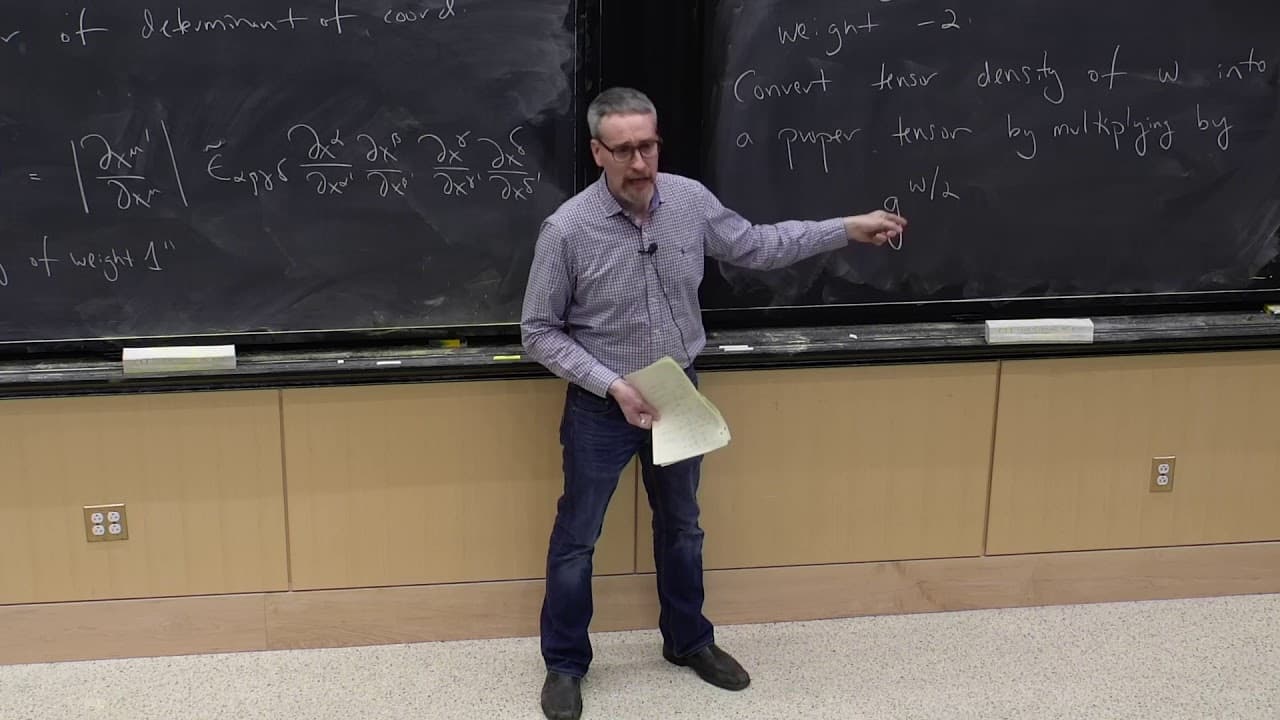
The geodesic equation describes the motion of a test body in curved spacetime, with the trajectory of maximum proper time corresponding to a straight line.
Transcript
[SQUEAKING] [RUSTLING] [CLICKING] SCOTT HUGHES: So let me just do a quick recap of what we did last time. So today, we're going to move into things that are a little bit more physics. Last time we were really doing some things that allows us to establish some of the critical mathematical concepts we need to study the tensors that are going to be us... Read More
Key Insights
- 🫥 The geodesic equation describes the motion of a test body in curved spacetime, with the trajectory of maximum proper time corresponding to a straight line.
- 😑 The geodesic equation can be expressed in covariant form or in terms of an affine parameterization, where an observer ages the most.
- 👻 The geodesic equation is a fundamental equation in general relativity and allows for the calculation of trajectories in a gravitational field.
Install to Summarize YouTube Videos and Get Transcripts
Explore YouTube Video Summarizer or Get YouTube Transcript Extractor
Questions & Answers
Q: What is the significance of the geodesic equation in understanding the motion of a test body in curved spacetime?
The geodesic equation allows us to calculate the trajectory of a test body in curved spacetime, taking into account the effects of gravity. It corresponds to the path of maximum proper time and provides a way to describe the motion of a freely-falling object in a gravitational field.
Q: How does the geodesic equation connect to the notion of proper time?
The geodesic equation is derived from the requirement that the tangent vector of a test body remains parallel as it moves along its trajectory. This corresponds to the trajectory of maximum proper time, meaning that an observer following this path will experience the most time elapse.
Q: Does the geodesic equation apply to all types of bodies, including charged or extended bodies?
The geodesic equation is derived for test bodies without charge or spatial extent. However, it can be modified to incorporate the effects of electromagnetic fields and the spatial extent of bodies if necessary. For example, charged bodies will deviate from geodesics due to their interaction with electromagnetic fields.
Q: How can the geodesic equation be applied to light or null trajectories?
The geodesic equation can also be used to describe the motion of massless particles, such as light, which move along null trajectories. In this case, proper time is not defined, but the equation can still be modified to account for the behavior of light in curved spacetime.
Summary & Key Takeaways
-
The geodesic equation is derived to describe the motion of a test body in curved spacetime, with the trajectory of maximum proper time corresponding to a straight line.
-
Geodesics are paths along which the tangent vector is parallel transported, and they represent the motion of a body under gravity in a freely-falling frame.
-
The geodesic equation can be expressed as a covariant form or in terms of an affine parameterization, where an observer ages the most.
Read in Other Languages (beta)
Share This Summary 📚
Summarize YouTube Videos and Get Video Transcripts with 1-Click
Try YouTube Summary with ChatGPT & Claude or YouTube Transcript Generator
Explore More Summaries from MIT OpenCourseWare 📚
Summarize YouTube Videos and Get Video Transcripts with 1-Click
Try YouTube Summary with ChatGPT & Claude or YouTube Transcript Generator