What Are the Best Communication Topologies for Multicore Chips?
TL;DR
The best communication topologies for multicore chips include mesh networks, which offer an orderly layout and consistent hardware costs with modest latency. Other options like ring networks and complete graphs vary in throughput and cost, with complete graphs providing high performance but at a higher price. Point-to-point links are commonly used to enhance speed and reliability across systems.
Transcript
Let's wrap up our discussion of system-level interconnect by considering how best to connect N components that need to send messages to one another, e.g., CPUs on a multicore chip. Today such chips have a handful of cores, but soon they may have 100s or 1000s of cores. We'll build our communications network using point-to-point links. In our analys... Read More
Key Insights
- 🔺 Point-to-point links are widely used for system-level interconnect, leading to faster, more reliable, more energy-efficient, and smaller systems.
- 🧑💼 Different interconnect topologies have different trade-offs in terms of throughput, latency, and hardware cost.
- 💯 Mesh networks are popular for current multi-core processors due to their orderly layout, constant hardware costs, and modest worst-case latency.
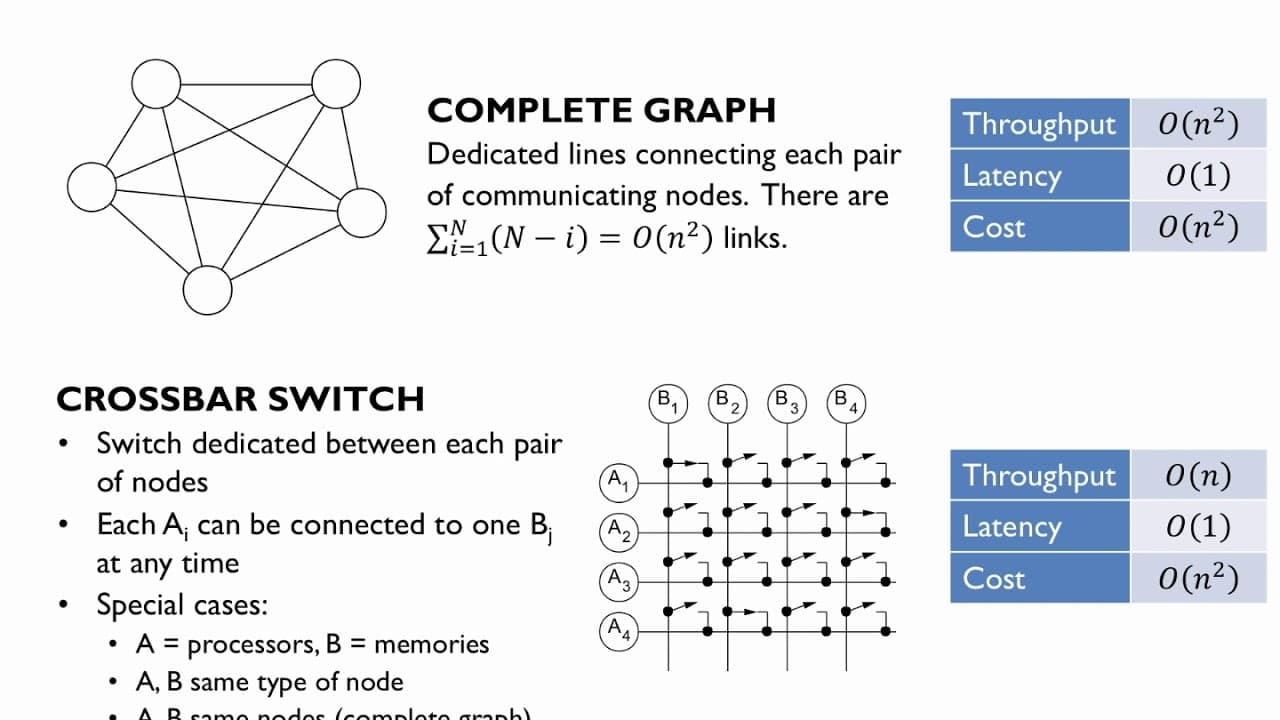
- ✋ Complete graphs offer high throughput and low latency but come at a higher cost.
- 🌲 Hypercube and tree networks offer logarithmic latencies and have been used in Connection Machines.
- 🚗 Wireless connections are commonly used for mobile devices to connect to nearby components.
Install to Summarize YouTube Videos and Get Transcripts
Explore YouTube Video Summarizer or Get YouTube Transcript Extractor
Questions & Answers
Q: What is the baseline for system-level interconnect?
The baseline is the backplane bus where all components share a single communication channel, resulting in a throughput of 1 message per unit time and a total hardware cost of O(n).
Q: What is the advantage of ring networks?
Ring networks are useful when message latency is not important or when most messages are to the component that's immediately downstream. They have a throughput and cost of O(n) and a worst-case latency of O(n).
Q: Why are complete graphs expensive but offer high throughput and low latency?
Complete graphs have O(N2) links, resulting in high throughput and low latency. However, the cost is also O(N2) due to the large number of links.
Q: What are the characteristics of mesh networks?
Mesh networks connect components to a fixed number of neighboring components and have a total number of links proportional to the number of components. They offer O(n) throughput and cost, with worst-case latencies of O(sqrt n) for 2D meshes and O(cube root n) for 3D meshes.
Q: Why are mesh networks considered an attractive alternative for high-capacity communication networks?
Mesh networks avoid the need for longer wires as the number of connected components grows. They are suitable for connecting thousands of processors and offer a combination of high communication bandwidth and low latency.
Summary & Key Takeaways
-
Point-to-point links are commonly used in system-level interconnect to connect components that need to send messages to each other.
-
Different interconnect topologies, such as ring networks, complete graphs, crossbar switches, mesh networks, hypercube networks, and tree networks, offer varying levels of throughput, latency, and hardware cost.
-
Mesh networks are a popular choice for current multi-core processors due to their orderly layout, constant per-node hardware costs, and modest worst-case latency.
Read in Other Languages (beta)
Share This Summary 📚
Summarize YouTube Videos and Get Video Transcripts with 1-Click
Try YouTube Summary with ChatGPT & Claude or YouTube Transcript Generator
Explore More Summaries from MIT OpenCourseWare 📚


Summarize YouTube Videos and Get Video Transcripts with 1-Click
Try YouTube Summary with ChatGPT & Claude or YouTube Transcript Generator