Heeding the Lessons of the Cold War (with Hal Brands & Bill Kristol)
TL;DR
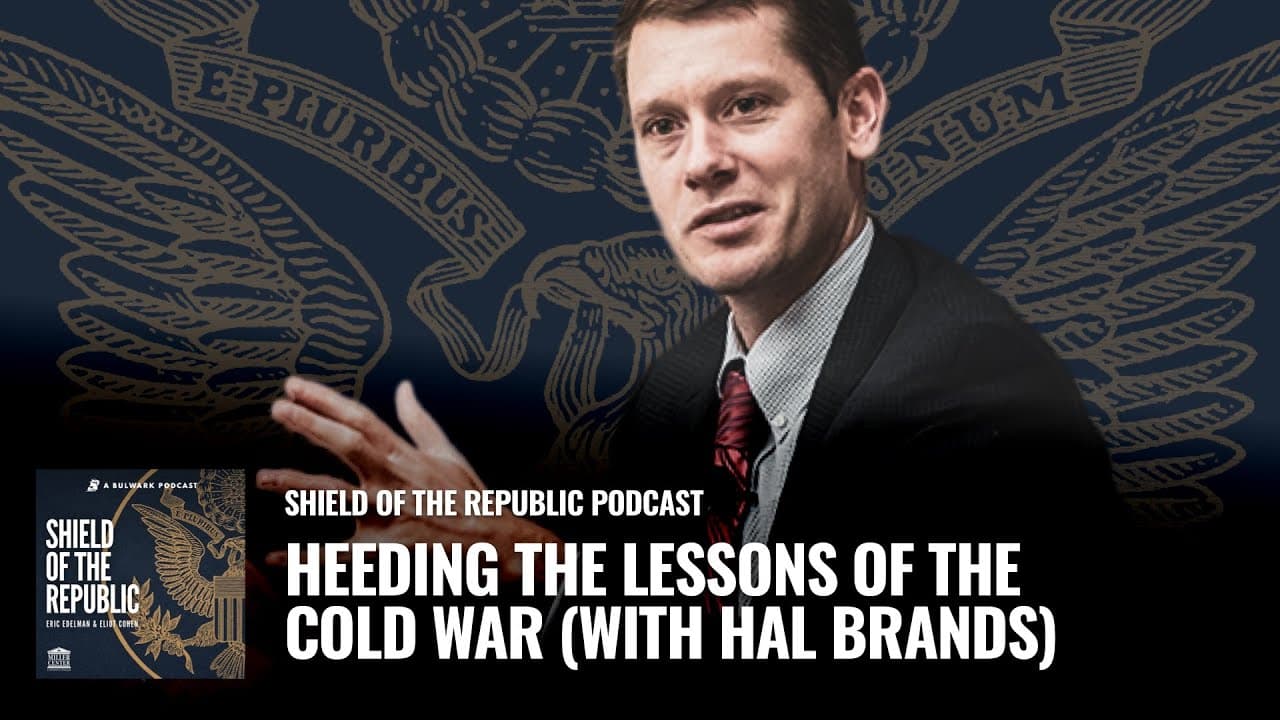
In this podcast episode, host Eric Edelman is joined by Bill Crystal and guest Hal Brands to discuss the lessons learned from the Cold War and how they can be applied to current U.S. foreign policy.
Transcript
welcome to shield of the republic a podcast sponsored by the bulwark and the miller center of public affairs at uva and dedicated to the proposition articulated by walter lippmann during world war ii that u.s foreign policy and national security policy is the shield of our democratic republic i'm eric edelman i'm counselor at the center for strateg... Read More
Key Insights
- 🛟 The Cold War was a period of long-term strategic competition with the Soviet Union, requiring an expansive view of American security to preserve the American way of life.
- ⌛ Containment strategy varied over time and administration, but the threat of nuclear escalation was central to extended deterrence and military strategy.
- 🛟 Diplomacy and cooperation with rivals can serve different purposes, from addressing common interests to managing and steering competition to prevent escalation or chaos.
- 🌍 The Cold War experience highlights the importance of investing in society, infrastructure, and democracy, as competition spurs nations to improve and compete effectively.
Install to Summarize YouTube Videos and Get Transcripts
Explore YouTube Video Summarizer or Get YouTube Transcript Extractor
Questions & Answers
Q: What was the main objective of competition with the Soviet Union during the Cold War?
The main objective was to prevent the Soviet Union from reshaping the world in a way that would be detrimental to American security and the preservation of the American way of life.
Q: How did the concept of containment evolve throughout the Cold War?
Initially, containment focused on key centers of industrial power in Western Europe and Japan. Over time, it expanded to address causes of instability, such as economic and political measures. The threat of nuclear escalation also became a central component of containment strategy.
Q: How did the Cold War leaders navigate the tension between desired behavioral change versus regime change?
There was an unresolved debate throughout the Cold War regarding whether a lasting change in behavior required a change in the nature of the regime itself. The answer varied depending on the administration and the era, from seeking a change in behavior to pursuing competitive coexistence.
Q: How does the Cold War experience inform the current competition with China and Russia?
The Cold War experience highlights the importance of preserving a concept of international order that is conducive to American security, prosperity, and freedom. The goal is to prevent aggressive authoritarian regimes from reshaping the world in detrimental ways.
Summary & Key Takeaways
-
Hal Brands describes his forthcoming book, "The Twilight Struggle," which examines the Cold War and its lessons for contemporary great power rivalry.
-
Brands emphasizes the importance of competition with authoritarian rivals to preserve a concept of international order that is conducive to the American way of life.
-
The discussion focuses on the end goals and point of strategic competition with countries like Russia and China, drawing on historical insights.
Read in Other Languages (beta)
Share This Summary 📚
Summarize YouTube Videos and Get Video Transcripts with 1-Click
Try YouTube Summary with ChatGPT & Claude or YouTube Transcript Generator
Explore More Summaries from The Bulwark 📚

Summarize YouTube Videos and Get Video Transcripts with 1-Click
Try YouTube Summary with ChatGPT & Claude or YouTube Transcript Generator