What Is The Best Shape For A Farm?
TL;DR
The shapes of farm fields are influenced by geography, history, and farming practices, resulting in a wide variety of patterns and formations.
Transcript
Airplane travel is kind of the worst. But also, kind of the best, because farms. Hi, I’m Kate and this is MinuteEarth. Seriously, one of my favorite things about being on a plane – assuming I’m not stuck on the aisle – is that I have a literal window onto all the amazing shapes farm fields take. Like, in Hokkaido, the entire landscape is a... Read More
Key Insights
- 💦 Farm field shapes are influenced by history, geography, farming practices, and water availability.
- 🧑🌾 Planned development and organic growth contribute to the diversity in farm field shapes.
- 🏑 Regular shapes are more common in crop fields due to efficiency in farming operations.
- 👻 Animal grazing allows for more irregular shapes in farm fields.
- ❓ Slopes require terracing, while contour planting prevents erosion on less-slopey slopes.
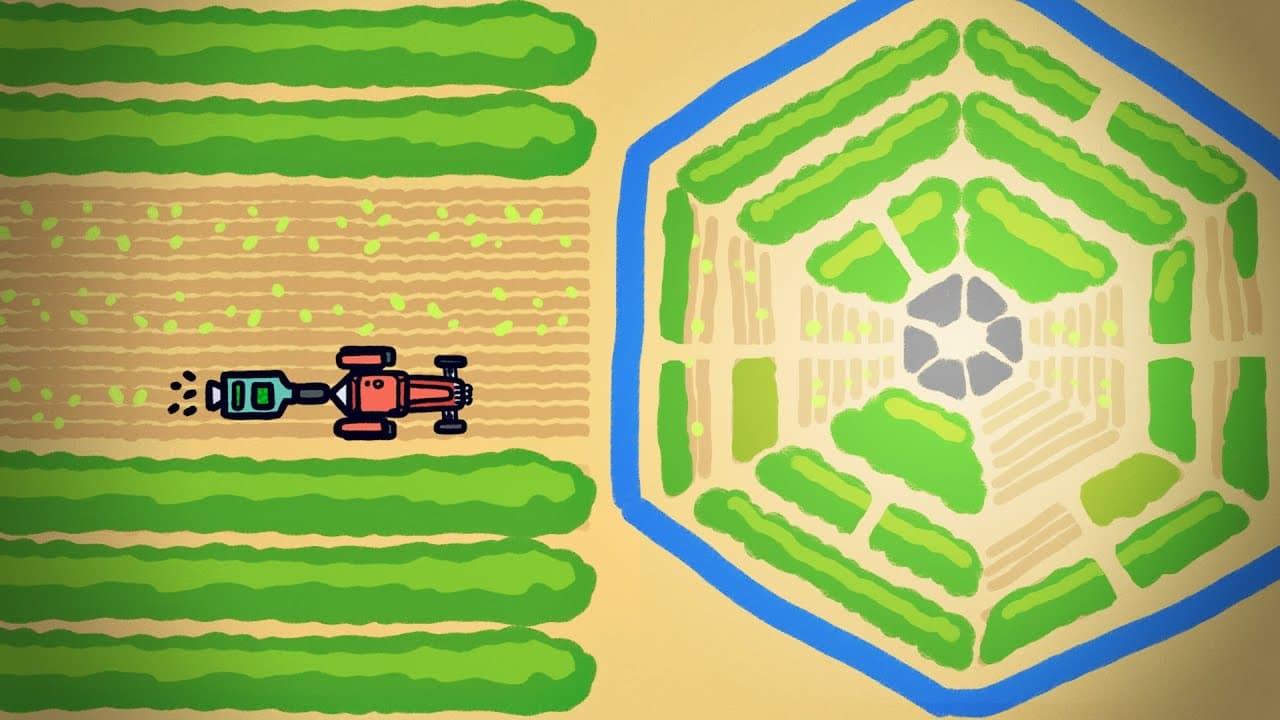
- 💝 Irrigation methods shape the radial fields and hexagons, while water sources influence ribbon farms.
- 🧑🌾 Farm field shapes can foster tight-knit communities by clustering homes together.
Install to Summarize YouTube Videos and Get Transcripts
Explore YouTube Video Summarizer or Get YouTube Transcript Extractor
Questions & Answers
Q: What factors contribute to the different shapes of farm fields?
Multiple factors influence farm field shapes, including history, farming practices, geography, and water availability. The way a farm was planned or developed, whether it is used for crops or grazing, the terrain, and the water source all play a role in determining the shape of farm fields.
Q: How does history impact the shapes of farm fields?
History influences the planned or organic development of farmland. Some areas have carefully designed shapes, such as pie pieces, while others feature irregular puzzle-like formations. Historical factors, like land usage and settlement patterns, contribute to the diverse shapes of farm fields.
Q: Why do some farm fields have more regular shapes than others?
Farm fields used for crops often have more regular shapes to facilitate efficient farming practices. Regular shapes enable easier tilling, planting, and harvesting, especially when using large machinery. In contrast, fields for grazing animals don't have the same constraints, resulting in more irregular shapes.
Q: How does geography affect the shapes of farm fields?
Geographical features like slopes and water sources impact farm field shapes. On steep slopes, farmers construct flat terraces to farm effectively, resulting in ridged shapes. Contour planting helps prevent erosion on less-slopey slopes, leading to striped fields. Close proximity to rivers can also create long, thin strips known as "ribbon farms."
Summary & Key Takeaways
-
Farm fields come in various shapes and patterns, including squares, irregular puzzle pieces, pie pieces, long skinny threads, curvy stripes, dots, hexagons, and fingerprint-like ridges.
-
Geography plays a crucial role, with slopes requiring terraces and less-slopey slopes leading to contour planting and striped fields.
-
Farming practices differ for crops and grazing animals, leading to more regular shapes for crops and irregular shapes for grazing.
-
Water availability and irrigation methods also influence farm field shapes, with radial fields for irrigation and ribbon farms near water sources fostering tight-knit communities.
Read in Other Languages (beta)
Share This Summary 📚
Summarize YouTube Videos and Get Video Transcripts with 1-Click
Try YouTube Summary with ChatGPT & Claude or YouTube Transcript Generator
Explore More Summaries from MinuteEarth 📚






Summarize YouTube Videos and Get Video Transcripts with 1-Click
Try YouTube Summary with ChatGPT & Claude or YouTube Transcript Generator