How to Respond to 'What Are You Up To?' in English
TL;DR
To respond effectively to 'What are you up to?', tailor your answer based on the time frame: for past activities, say something like 'I've been reading a lot lately'; for present actions, use 'Not much, I'm just doing the dishes'; and for future plans, try 'Not much, I'm just going to go shopping.' Incorporating 'not much' and 'just' can help your responses sound more natural.
Transcript
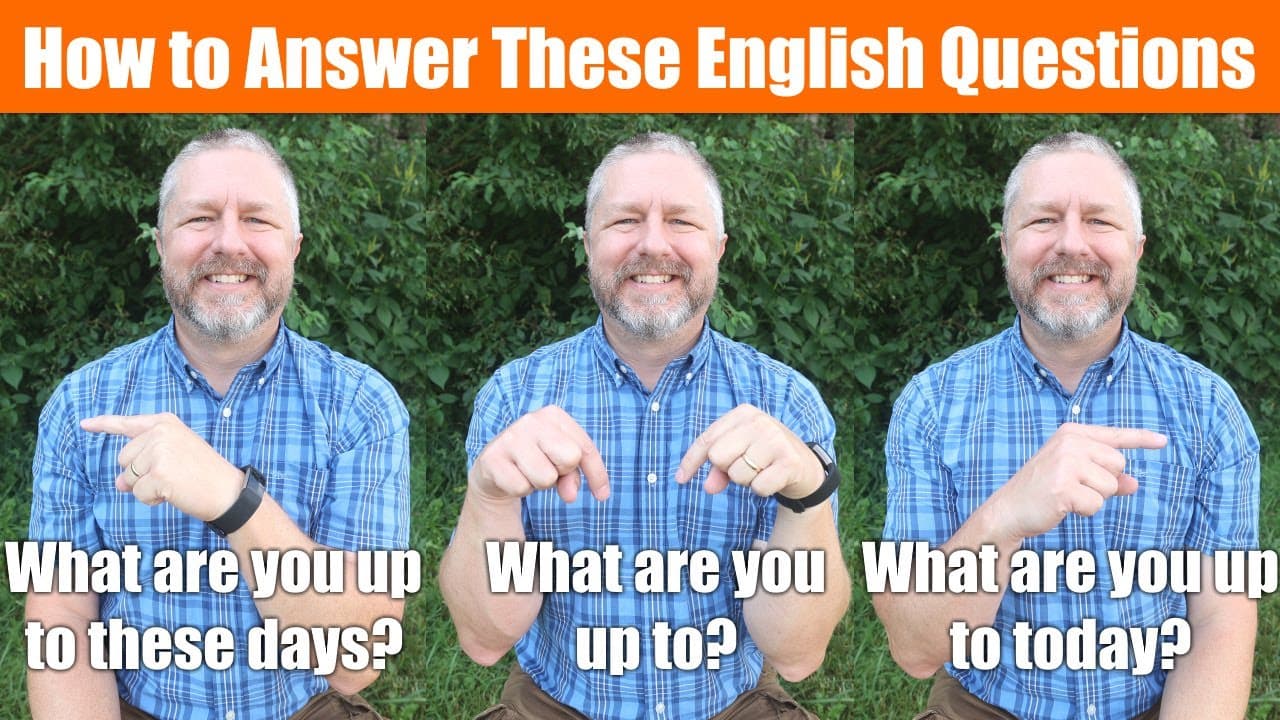
In this English lesson, I'm going to help you learn how to respond to three very common English questions. Those questions are, "What are you up to these days," "What are you up to," and, "What are you up to today?" Even though these questions look very similar, you need to answer each of these in a slightly different way, and in this lesson, I'll ... Read More
Key Insights
- 🍝 Different questions require different responses, focusing on the past, present, or future.
- 😒 Native English speakers often use the phrases "Not much" and "just" to start their answers.
- 💨 Responding in a more complex way by discussing different time periods is possible and adds depth to your conversation.
- 🐎 The speed at which you respond can affect the level of formality in your answer.
- 😯 Adding contractions like "I've" and "I'm" is common in informal speech.
- 🔇 Starting with "Not much" even when you're busy is a quirk of English speakers.
- 🔑 Using the word "just" can indicate simplicity or recentness of an activity.
Install to Summarize YouTube Videos and Get Transcripts
Explore YouTube Video Summarizer or Get YouTube Transcript Extractor
Questions & Answers
Q: What does the question "What are you up to these days?" ask about?
This question asks about the period of time from the past up until the present. It requires responses that talk about past activities or experiences, like "I've been reading a lot lately."
Q: How would you answer the question "What are you up to?"?
This question is asking about what you are currently doing. You can respond with present activities, such as "I'm doing the dishes." Adding "Not much" and "just" is common, like "Not much, I'm just doing the dishes."
Q: What does the question "What are you up to today?" inquire about?
This question is about future plans or tasks for the day. You can mention upcoming activities, like "I'm going to go shopping." Adding "Not much" and "just" is also common, such as "Not much, I'm just going to go shopping."
Q: Can you provide a more detailed answer encompassing past, present, and future when asked any of these questions?
Yes, you have the freedom to talk about different time periods in your response. For example, you can mention what happened yesterday, what you're currently doing, and what you plan to do tomorrow.
Summary & Key Takeaways
-
There are three common English questions: "What are you up to these days?", "What are you up to?", and "What are you up to today?"
-
Each question requires a different type of response: the first asks about the past, the second asks about the present, and the third asks about the future.
-
Native English speakers often start their answers with "Not much" and add the word "just" to sound more natural.
Read in Other Languages (beta)
Share This Summary 📚
Summarize YouTube Videos and Get Video Transcripts with 1-Click
Try YouTube Summary with ChatGPT & Claude or YouTube Transcript Generator
Explore More Summaries from Learn English with Bob the Canadian 📚



Summarize YouTube Videos and Get Video Transcripts with 1-Click
Try YouTube Summary with ChatGPT & Claude or YouTube Transcript Generator