Radius of convergence using Ratio Test
TL;DR
The video discusses the convergence of an infinite series using the ratio test and determines the interval of convergence for the given function.
Transcript
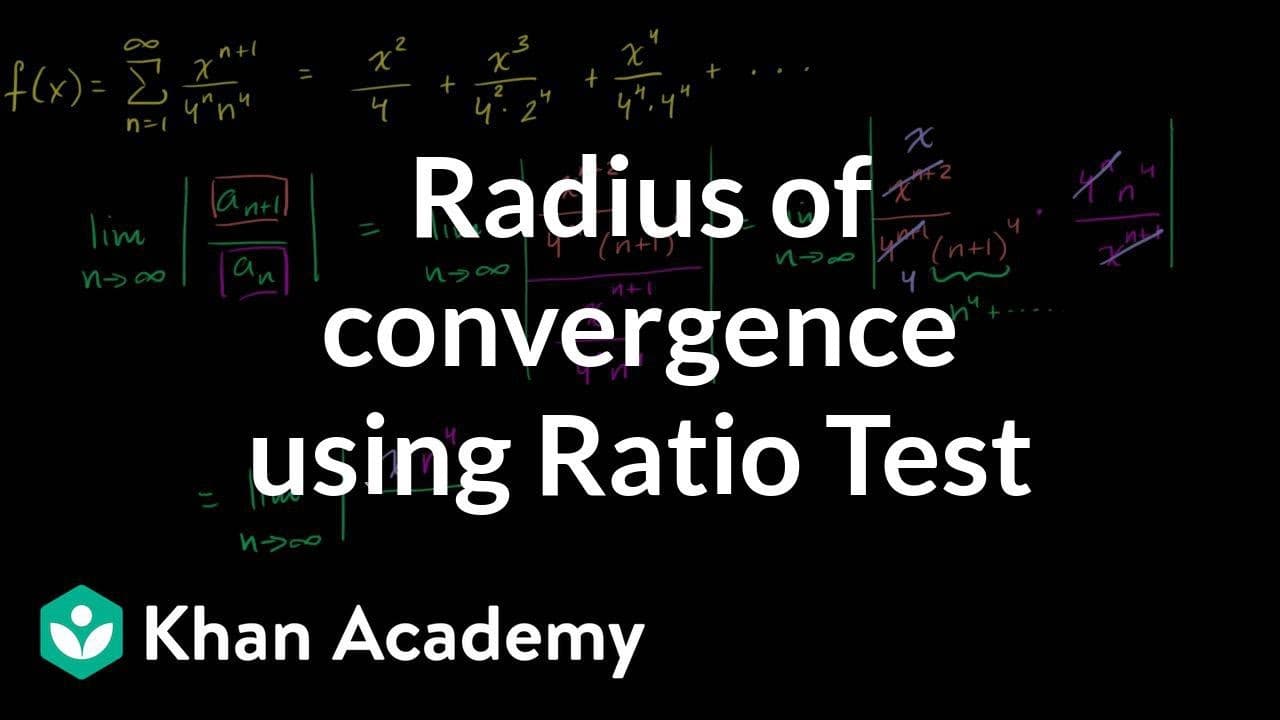
- [Voiceover] Let's say that we had a function defined by the infinite series so we're going to from N equals one to infinity and each term is going to be X to the N plus one over four to the N times N to the fourth and we could even expand this out. When N is equal to one this is going to be X squared over four times one to the fourth so which is ... Read More
Key Insights
- 🥳 The video focuses on determining the convergence of an infinite series using the ratio test.
- 🥳 The ratio test involves calculating the limit of the ratio of consecutive terms in the series.
- ☺️ The absolute value of X needs to be less than four for the function to converge to finite values.
- ☺️ The interval of convergence for the function is X < 4 or X > -4.
- 🥳 The ratio test is a useful tool in determining the convergence of functions defined by infinite series.
- ☺️ Understanding the interval of convergence helps identify the range of X values for which the function will converge.
- ❓ The convergence of the function is dependent on the absolute value of X.
Install to Summarize YouTube Videos and Get Transcripts
Explore YouTube Video Summarizer or Get YouTube Transcript Extractor
Questions & Answers
Q: How is the convergence of the infinite series determined using the ratio test?
The convergence of the infinite series is determined by calculating the limit of the ratio of consecutive terms in the series. If the limit is less than one, the series will converge to finite values.
Q: What does the absolute value of X need to be for the function to converge?
The absolute value of X needs to be less than four for the function defined by the infinite series to converge to finite values.
Q: Can you provide an example of applying the ratio test to determine the convergence of the series?
Sure! Let's take the series where each term is (X^N+1) / (4^N * N^4). By calculating the limit of the ratio of consecutive terms, we can determine the convergence of the series for a specific value of X.
Q: How can the interval of convergence be expressed for the given function?
The interval of convergence for the function is given by X < 4 or X > -4. In other words, the function will converge for X values less than four or greater than negative four.
Summary & Key Takeaways
-
The video explores the convergence of a function defined by an infinite series using the ratio test.
-
The ratio test calculates the limit of the ratio of consecutive terms in the series to determine convergence.
-
The video concludes by stating that the function will converge to finite values when the absolute value of X is less than four.
Read in Other Languages (beta)
Share This Summary 📚
Summarize YouTube Videos and Get Video Transcripts with 1-Click
Try YouTube Summary with ChatGPT & Claude or YouTube Transcript Generator
Explore More Summaries from Khan Academy 📚





Summarize YouTube Videos and Get Video Transcripts with 1-Click
Try YouTube Summary with ChatGPT & Claude or YouTube Transcript Generator