Occlusion for Prosthodontics
TL;DR
This content discusses the confusion surrounding the language and definitions of occlusion in dentistry and provides an overview of the concepts and terminology related to dental occlusion.
Transcript
the subject of occlusion can be very confusing for dental students today we will discuss the possible reasons for this confusion and we will attempt to demystify this very important subject let's begin with the discussion of language in general language evolves and changes to suit changes in the society definitions of words will also evolve to keep... Read More
Key Insights
- 💡 Language evolution and changing definitions of terms in dentistry can create confusion and difficulties in communication between dental professionals.
- 💭 Understanding the concepts and applying judgment in dentistry is just as important as memorizing terminology and definitions.
- 🦷 Occlusion in dentistry takes into account the movement and position of the temporomandibular joint (TMJ) and the relationship between teeth during these movements.
- 🦴 The natural inclination of teeth, such as mesial migration, may be influenced by factors like diet and genetics, leading to the eruption of third molars that may not fit the arch.
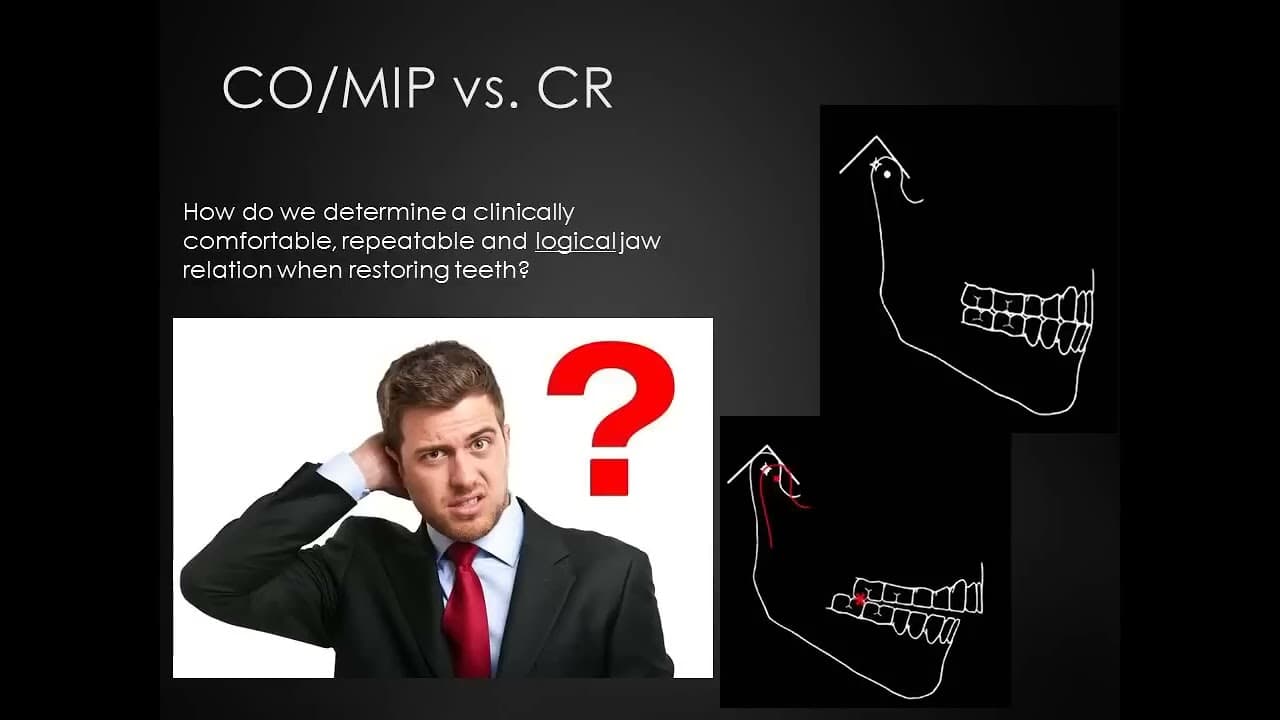
- 🌈 Different terms like Centric Occlusion (CO), Maximum Intercuspal Position (MIP), and Centric Relation (CR) are used interchangeably but have specific definitions and uses in dentistry.
- 🗄 The occlusal plane and the curves of speed and Wilson play a role in determining the alignment and functionality of the maxillary and mandibular teeth.
- 🤔 Various occlusal schemes, such as canine-guided occlusion and group function, exist, but neither has been proven to be superior to the other.
- 🦷 Maintaining balanced occlusion is important for complete dentures, while mutually protected occlusion is ideal for fixed prosthodontics, and conforming to an established occlusal pattern is key for removable partial dentures.
Install to Summarize YouTube Videos and Get Transcripts
Explore YouTube Video Summarizer or Get YouTube Transcript Extractor
Questions & Answers
Q: What are the possible reasons for confusion in the language of occlusion?
The confusion in the language of occlusion can arise due to changing definitions, different terminology usage, and varying interpretations of terms by different individuals. This can lead to communication challenges and arguments when discussing occlusion.
Q: How does the mesial inclination of teeth relate to mesial migration?
The mesial inclination of teeth may play a role in mesial migration. Some theories suggest that rough diets and interproximal wear caused by eating abrasive foods may lead to mesial migration, closing gaps and allowing space for third molars to erupt.
Q: What is the difference between Centric Occlusion (CO) and Maximum Intercuspal Position (MIP)?
CO and MIP are often used interchangeably, but they have different definitions. CO is related to the position of the condyle in the glenoid fossa, while MIP refers to the complete intercuspation of opposing teeth, regardless of condylar position. CO is a ligament-guided position, while MIP is a tooth-guided position.
Q: How can occlusion be determined in fully dentate patients?
In fully dentate patients with no TMJ dysfunction, MIP is reproducible and clearly defined. Therefore, MIP can be used as a reference for determining occlusion in these patients.
Q: Why is mutually protected occlusion important in complete dentures?
Mutually protected occlusion in complete dentures prevents tipping or rotating of the denture bases during function. It involves simultaneous contacting of upper and lower teeth on both sides during lateral excursions and in the anterior and posterior occlusal areas during protrusion.
Q: What are the different types of articulators used in dentistry?
There are non-adjustable, semi-adjustable, and highly adjustable articulators. Non-adjustable articulators have fixed anatomical relationships, while semi-adjustable and highly adjustable articulators allow for adjustments to reproduce mandibular movements.
Q: How is occlusion determined in removable partial dentures?
The determination of occlusion in removable partial dentures involves analyzing existing occlusion, recording centric relation or MIP occlusion using byte registration, recording vertical dimension of occlusion, considering the number and distribution of remaining teeth, the existing periodontal conditions, and the type of occlusion in the opposing arch.
Summary & Key Takeaways
-
Language and definitions in dentistry can create confusion when discussing occlusion.
-
Occlusion is influenced by the temporomandibular joint (TMJ) and tooth relationships.
-
Understanding concepts like CR, MIP, and different occlusal schemes is important in dentistry.
Read in Other Languages (beta)
Share This Summary 📚
Summarize YouTube Videos and Get Video Transcripts with 1-Click
Try YouTube Summary with ChatGPT & Claude or YouTube Transcript Generator
Explore More Summaries from Edilia Marshall, DMD, MAGD, AAACD 📚
Summarize YouTube Videos and Get Video Transcripts with 1-Click
Try YouTube Summary with ChatGPT & Claude or YouTube Transcript Generator