Energy Method - Free Undamped Single Degree of Freedom Vibration System - Dynamics of Machinery
TL;DR
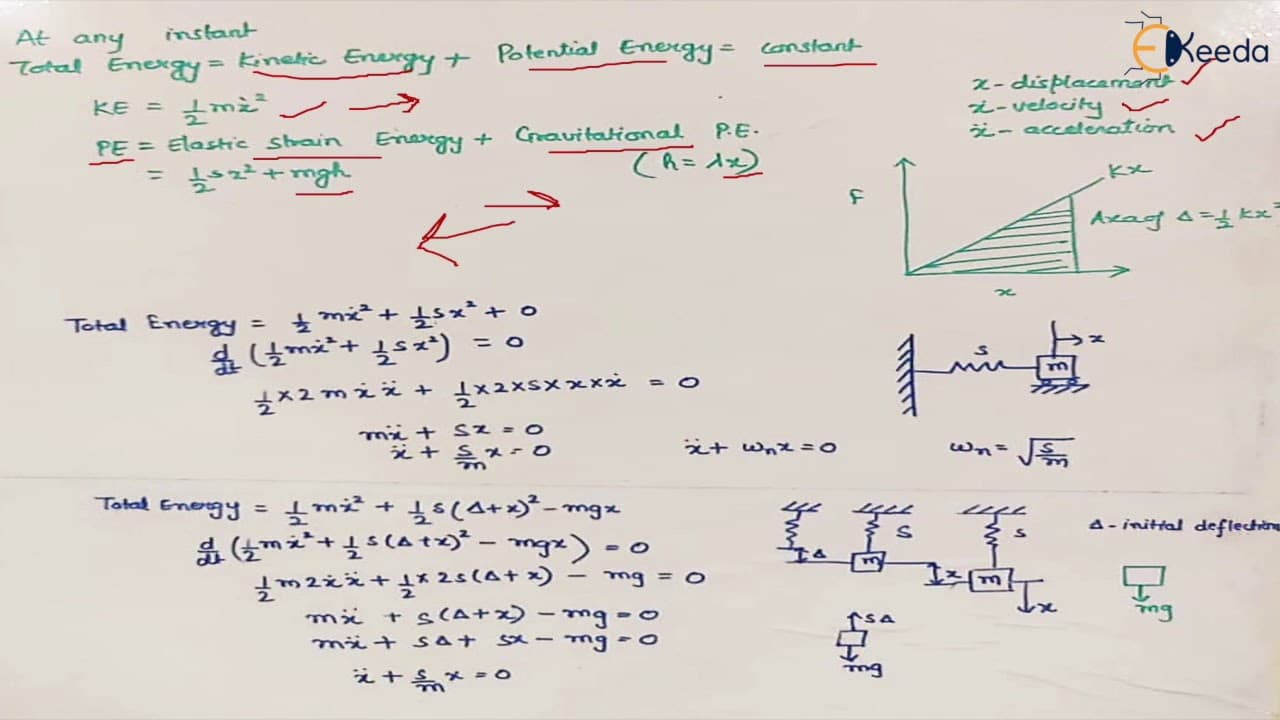
The energy method in mechanics is based on the conservation of energy, where the total mechanical energy of a system (kinetic energy + potential energy) remains constant. This method is used to derive equations for free vibrations without damping.
Transcript
hello everyone in this video we'll discuss about energy method so energy method as the name suggest is based on the conservation of energy which says that for a system at any instant total mechanical energy is constant which is the sum of potential energy and the kinetic energy now we are deriving the equation for single degree of freedom free vibr... Read More
Key Insights
- 😌 The energy method in mechanics relies on the conservation of energy principle.
- 🦾 Kinetic energy and potential energy are the two components of total mechanical energy.
- 🥡 In a horizontal system, only elastic potential energy is considered, while in a vertical system, both gravitational potential energy and elastic potential energy are taken into account.
- 🥺 The derived equations for total energy in horizontal and vertical systems are identical and lead to the natural frequency of the system.
Install to Summarize YouTube Videos and Get Transcripts
Explore YouTube Video Summarizer or Get YouTube Transcript Extractor
Questions & Answers
Q: What is the basis of the energy method in mechanics?
The energy method in mechanics is based on the conservation of energy, where the total mechanical energy of a system remains constant. It considers both kinetic and potential energy.
Q: What components make up the potential energy in the energy method?
The potential energy in the energy method consists of gravitational potential energy, which depends on the height of the system, and elastic strain energy, which is stored in a spring when it resists deformation.
Q: How is the equation for total energy derived for a horizontal system?
For a horizontal system, the equation for total energy is half the mass multiplied by the velocity squared, plus half the spring stiffness multiplied by the displacement squared.
Q: How is the equation for total energy derived for a vertical system?
For a vertical system, the equation for total energy is the kinetic energy plus half the spring stiffness multiplied by the displacement squared, minus the gravitational potential energy.
Summary & Key Takeaways
-
The energy method in mechanics is based on the conservation of energy, with the total mechanical energy of a system being the sum of kinetic and potential energy. This method is applied to systems with no damping.
-
Kinetic energy is calculated as half the mass multiplied by the velocity squared, while potential energy includes both gravitational potential energy and elastic strain energy.
-
The equation for total energy is derived for a horizontal system with no gravitational potential energy and for a vertical system with gravitational potential energy. The natural frequency of the system is obtained by comparing the equations with the general equation for simple harmonic motion.
Read in Other Languages (beta)
Share This Summary 📚
Summarize YouTube Videos and Get Video Transcripts with 1-Click
Try YouTube Summary with ChatGPT & Claude or YouTube Transcript Generator
Explore More Summaries from Ekeeda 📚



Summarize YouTube Videos and Get Video Transcripts with 1-Click
Try YouTube Summary with ChatGPT & Claude or YouTube Transcript Generator