4.2 Newton's Third Law
TL;DR
Newton's third law states that forces come in equal and opposite pairs, and this law is explained through examples and equations.
Transcript
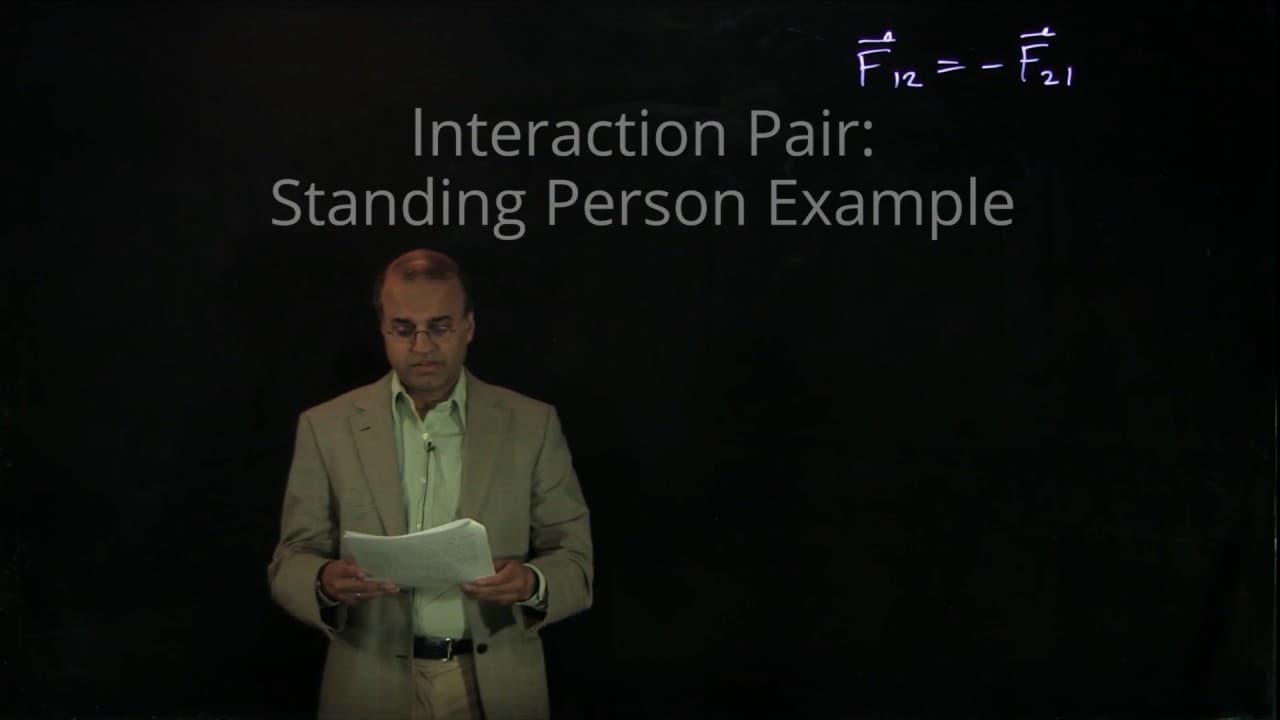
Newton's third law states that forces always come in equal and opposite pairs. One way we can write that is if you imagine two objects, object one and object two, the force exerted by object one on object two is equal and opposite to the force exerted by object two on object one. This makes explicit that real forces always arise from a physical int... Read More
Key Insights
- 👮 Newton's third law states that forces always come in equal and opposite pairs, emphasizing the importance of physical interactions.
- 💆 The motion and acceleration of objects can differ significantly even if the forces experienced are identical, due to differences in mass.
- 👮♂️ The acceleration of an object depends on the force applied as well as its mass, as described by Newton's second law (F=ma).
Install to Summarize YouTube Videos and Get Transcripts
Explore YouTube Video Summarizer or Get YouTube Transcript Extractor
Questions & Answers
Q: What does Newton's third law state?
Newton's third law states that forces always come in equal and opposite pairs, meaning that the force exerted by one object on another is equal and opposite to the force exerted by the second object on the first. It emphasizes that real forces arise from physical interactions.
Q: How do forces and accelerations differ between objects with different masses?
Even though the forces experienced by two objects are identical in an interaction pair, their accelerations can be vastly different due to differences in mass. The object with a smaller mass will experience a larger acceleration compared to the object with a larger mass.
Q: Are forces in an interaction pair exerted on the same object?
No, forces in an interaction pair always involve two different objects. They never act on the same object. Newton's third law emphasizes the importance of identifying the object that exerts the force in order to understand the interaction pair.
Q: How does Newton's third law apply to gravity and the normal force?
In the case of gravity, the Earth exerts a force on a person (mg), and the person exerts an equal and opposite force on the Earth (mg in the opposite direction). Similarly, for the normal force exerted by the ground on a person, the person must exert an equal and opposite force on the ground.
Summary & Key Takeaways
-
Newton's third law states that forces always come in equal and opposite pairs, meaning that the force exerted by one object on another is equal and opposite to the force exerted by the second object on the first.
-
Despite forces being equal in pairs, the motion and acceleration of objects can differ significantly due to differences in mass.
-
For any force in a problem, it is important to identify the other member of the interaction pair.
Read in Other Languages (beta)
Share This Summary 📚
Summarize YouTube Videos and Get Video Transcripts with 1-Click
Try YouTube Summary with ChatGPT & Claude or YouTube Transcript Generator
Explore More Summaries from MIT OpenCourseWare 📚


Summarize YouTube Videos and Get Video Transcripts with 1-Click
Try YouTube Summary with ChatGPT & Claude or YouTube Transcript Generator