What Are the Key Properties of Perfect Squares?
TL;DR
Perfect squares can only end in the digits 0, 1, 4, 5, 6, or 9. This pattern holds true for all perfect squares, regardless of their size, as determined by the units digit when squaring a number.
Transcript
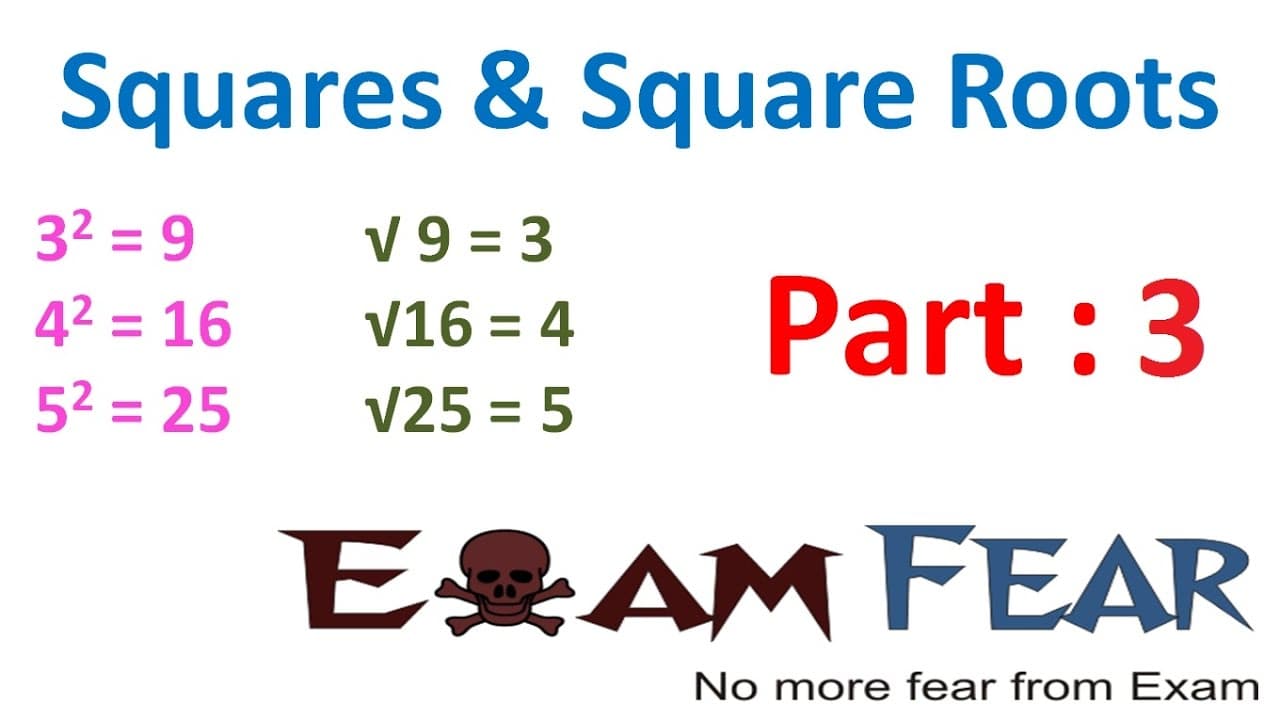
Hello friends this video on squares and square roots part three is brought to you by exam fear.com no more fear from exam so now let's talk about properties of perfect squares so these perfect squares also exhibit some special properties they also show some special patterns so let's talk about their properties the first property is if a number ends... Read More
Key Insights
- ❤️🩹 Perfect squares always end in 0, 1, 4, 5, 6, or 9.
- 🥇 The units place of a perfect square determines the units place of its square root.
- ⬛ Larger perfect squares also follow the pattern of having a units digit of 0, 1, 4, 5, 6, or 9.
- 🇦🇪 The units digit is significant in determining the units digit of a perfect square.
- ⬛ The properties of perfect squares can be observed by examining the squares of the first 10 natural numbers and larger numbers.
- ❎ The result of squaring any number will always be a perfect square with a units digit of 0, 1, 4, 5, 6, or 9.
- 💯 The properties of perfect squares can be used in mathematical calculations and manipulations.
Install to Summarize YouTube Videos and Get Transcripts
Explore YouTube Video Summarizer or Get YouTube Transcript Extractor
Questions & Answers
Q: What are some properties of perfect squares?
Perfect squares have a units digit of 0, 1, 4, 5, 6, or 9. The units digit of the square determines the units digit of its square root.
Q: How can we trust that all perfect squares have these properties?
By observing the squares of the first 10 natural numbers and larger numbers, we can see that all perfect squares indeed follow the pattern of having a units digit of 0, 1, 4, 5, 6, or 9.
Q: How can the units place of a perfect square be determined?
When multiplying two numbers to find the square, the units place of the result is obtained by multiplying the units places of the original numbers. This applies to perfect squares as well.
Q: What is the significance of the units digit in a perfect square?
The units digit in a perfect square determines the units digit of the result when the square is calculated. This digit will be 0, 1, 4, 5, 6, or 9.
Summary & Key Takeaways
-
Numbers that end in 0, 1, 4, 5, 6, or 9 are perfect squares.
-
The units place of a perfect square determines the units place of its square root.
-
Squaring any number always results in a perfect square with a units digit of 0, 1, 4, 5, 6, or 9.
Read in Other Languages (beta)
Share This Summary 📚
Summarize YouTube Videos and Get Video Transcripts with 1-Click
Try YouTube Summary with ChatGPT & Claude or YouTube Transcript Generator
Explore More Summaries from LearnoHub - Class 11, 12 📚




Summarize YouTube Videos and Get Video Transcripts with 1-Click
Try YouTube Summary with ChatGPT & Claude or YouTube Transcript Generator