What Is the Unit Step Response of a First-Order System?
TL;DR
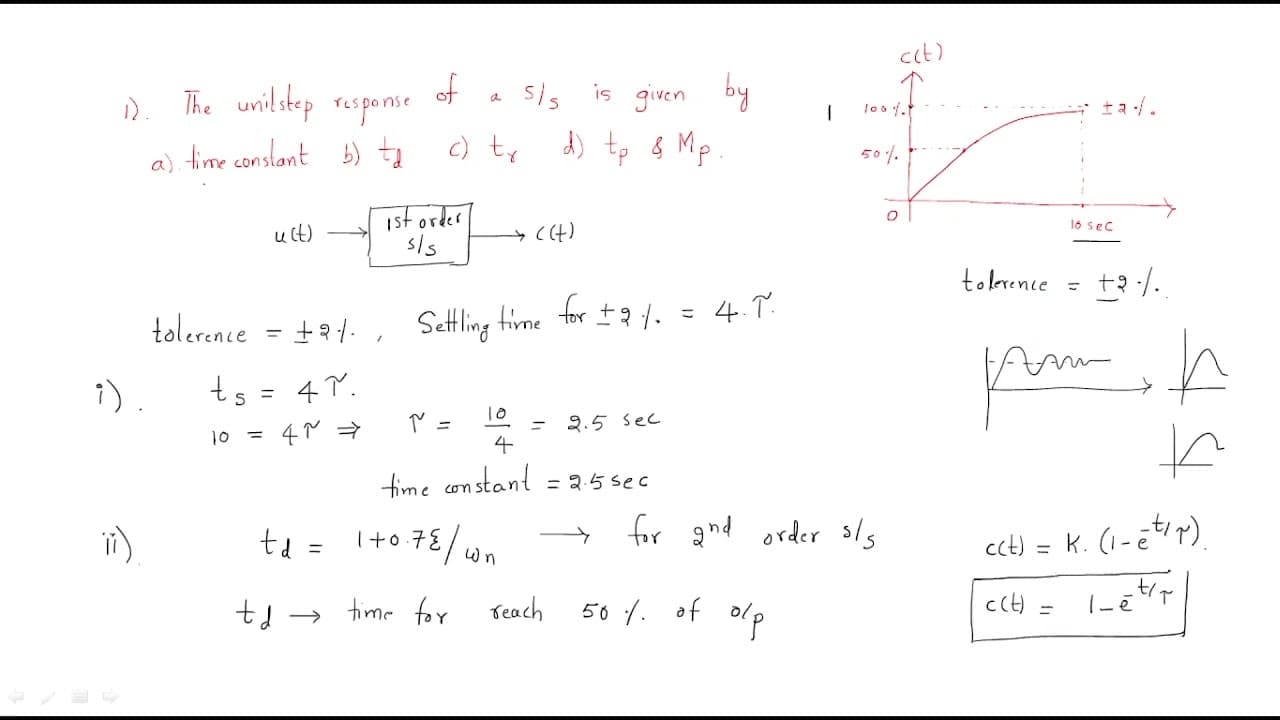
The unit step response of a first-order system can be characterized by key time constants, such as a time constant of 2.5 seconds, a settling time of 10 seconds, and a delay time of approximately 1.73 seconds. First-order systems do not display peak time or overshoot, making their response more predictable compared to second-order systems.
Transcript
hello everyone in this session we will discuss problem regarding the previous theory topics the first problem is the unit step response of a system is given by this is the unistep response of the system in this find out time constant b 3d means delay time tr means rise time the tp means peak time mp means peak overshoot this is percentage of peak p... Read More
Key Insights
- ⌛ A first-order system's unit step response can be analyzed through time constants, helping to understand its dynamic behavior.
- ⌛ The settling time for a first-order system is typically four times the time constant, providing a straightforward method for analysis.
- ⌛ Delay time and rise time are critical metrics in characterizing the speed of the system's response to a unit step input.
- 🪈 First-order systems do not exhibit oscillatory behavior, making their response easier to predict compared to second-order systems.
- 🎮 Observations in system behavior, such as tolerances and output curves, provide insights into the physical limitations and performance of control systems.
- ⌛ The calculations for various time constants enable engineers to design systems with desired responsiveness and stability.
- ⌛ Understanding the relationships between different time parameters is essential in optimizing system performance and control strategies.
Install to Summarize YouTube Videos and Get Transcripts
Explore YouTube Video Summarizer or Get YouTube Transcript Extractor
Questions & Answers
Q: What is the significance of the unit step response in system analysis?
The unit step response is crucial as it indicates how a system reacts to a sudden change in input. It helps to characterize system behavior in terms of stability, time response, and the system's ability to track inputs, revealing important dynamics like overshoot, settling time, and the overall response curve.
Q: How is the time constant of a first-order system determined from a unit step response?
The time constant τ is determined from the settling time, which is the time taken to reach within a specified tolerance of the final output value. For a first-order system, if the settling time is observed to be 10 seconds, then dividing this by 4 gives τ as 2.5 seconds, indicating how quickly the system responds.
Q: Why does a first-order system not show peak overshoot?
A first-order system does not exhibit peak overshoot because its response is characterized by a smooth, exponential curve without oscillations. Unlike second-order systems, which can overshoot due to their oscillatory nature, first-order systems asymptotically approach their final value without exceeding it.
Q: What formulas can be used to calculate delay time and rise time in a first-order system?
Delay time can be calculated as the time it takes to reach 50% of the final output. Rise time is defined as the difference between the time required to reach 90% and 10% of the final value. For a first-order system with a time constant τ, specific calculations yield the times required based on observed output values.
Q: What observations were made when comparing first-order and second-order systems?
The analysis showed that the output characteristics of first-order systems can closely resemble those of over-damped second-order systems, particularly in terms of how they rise to their final values without oscillations. Notably, their settling and response behaviors share similar characteristics under certain conditions.
Q: What is settling time and how does it relate to time constant in this context?
Settling time is defined as the duration required for the system output to remain within a specified tolerance level of the final value. For a first-order system, it is calculated as four times the time constant, thereby linking the settling time directly to the response time of the system.
Summary & Key Takeaways
-
This content discusses the unit step response of a first-order system, examining various time constants such as delay time, rise time, and settling time.
-
It clarifies the concepts of settling time and tolerance, calculating them based on given parameters, concluding that the time constant is 2.5 seconds.
-
The analysis includes methods to determine rise time and notes that first-order systems do not exhibit peak time or overshoot.
Read in Other Languages (beta)
Share This Summary 📚
Summarize YouTube Videos and Get Video Transcripts with 1-Click
Try YouTube Summary with ChatGPT & Claude or YouTube Transcript Generator