What is Parity Violation in Particle Physics?
TL;DR
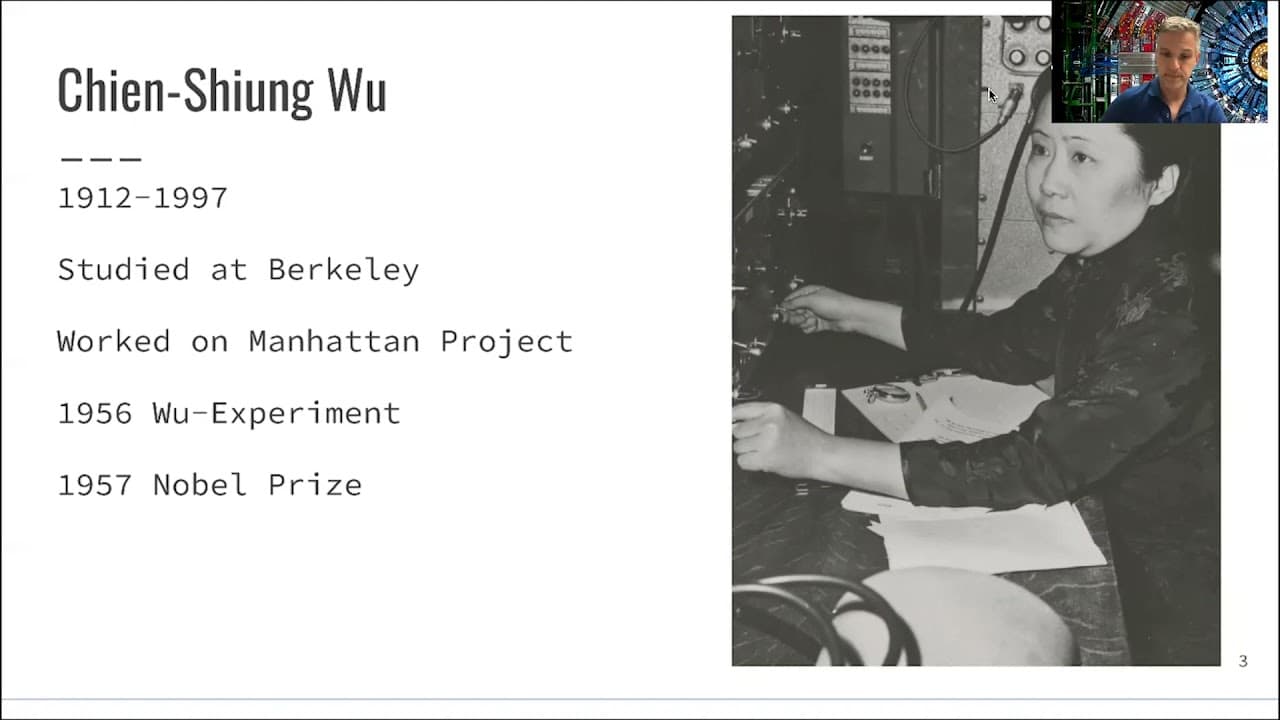
Parity violation occurs in weak interactions, as demonstrated by Madame Wu's groundbreaking experiment. Her work with cobalt-60 decay revealed an asymmetry in beta decays, confirming that parity is not conserved in weak interactions, unlike in electromagnetic and strong interactions. This pivotal finding greatly influenced our understanding of fundamental symmetries in particle physics.
Transcript
PROFESSOR: Hello. In this lecture, we talk about parity and parity violation. So we talk about a discrete symmetry. A little bit of history in particle physics-- Lee and Yang in the 1950s wondered if there's any experiment testing parity invariance. There are many tests which had to do with a strong interaction and the electromagnetic interaction. ... Read More
Key Insights
- 🍆 Lee and Yang proposed testing parity invariance in the weak interaction due to the tau-theta puzzle.
- ❓ Madame Wu's experiment confirmed parity violation in weak interactions through the observation of an asymmetry in beta decays.
- 💪 Parity is conserved in electromagnetic and strong interactions but not in the weak interaction.
- ❓ Madame Wu's experiment had significant implications for our understanding of fundamental symmetries in particle physics.
- ❓ The notion of a parity operator can be used to describe the inversion of direction under parity transformation.
- ❓ Madame Wu's experiment provided further confirmation of the Standard Model of particle physics.
- ❓ The Wu experiment solidified Madame Wu's contributions to physics and earned her a Nobel Prize.
Install to Summarize YouTube Videos and Get Transcripts
Explore YouTube Video Summarizer or Get YouTube Transcript Extractor
Questions & Answers
Q: What motivated Lee and Yang to test parity invariance?
Lee and Yang were motivated by the tau-theta puzzle, where kaon decays into different articles with the same lifetime but different spin states, leading them to wonder if there was a way to test parity invariance in the weak interaction.
Q: How did Madame Wu conduct her experiment to test parity violation?
Madame Wu aligned the spin of cobalt 60 nuclei with a magnetic field and observed the number of electrons coming out in beta decays, finding an asymmetry when reverting the magnetic field, indicating parity violation.
Q: What was the significance of Madame Wu's experimental findings?
Madame Wu's experiment provided the first experimental evidence of parity violation in beta decays, showing that the weak interaction does not conserve the symmetry of parity.
Q: In which interactions is parity conserved?
Parity is conserved in the electromagnetic and strong interactions but is violated in the weak interaction, as demonstrated by Madame Wu's experiment.
Summary & Key Takeaways
-
Lee and Yang proposed testing parity invariance in the weak interaction, as it had never been tested before.
-
Madame Wu conducted the Wu experiment using cobalt 60 decay to nickel, which showed an asymmetry in beta decays, indicating parity violation in weak interactions.
-
Parity is conserved in electromagnetic and strong interactions but is violated in weak interactions.
Read in Other Languages (beta)
Share This Summary 📚
Summarize YouTube Videos and Get Video Transcripts with 1-Click
Try YouTube Summary with ChatGPT & Claude or YouTube Transcript Generator
Explore More Summaries from MIT OpenCourseWare 📚


Summarize YouTube Videos and Get Video Transcripts with 1-Click
Try YouTube Summary with ChatGPT & Claude or YouTube Transcript Generator