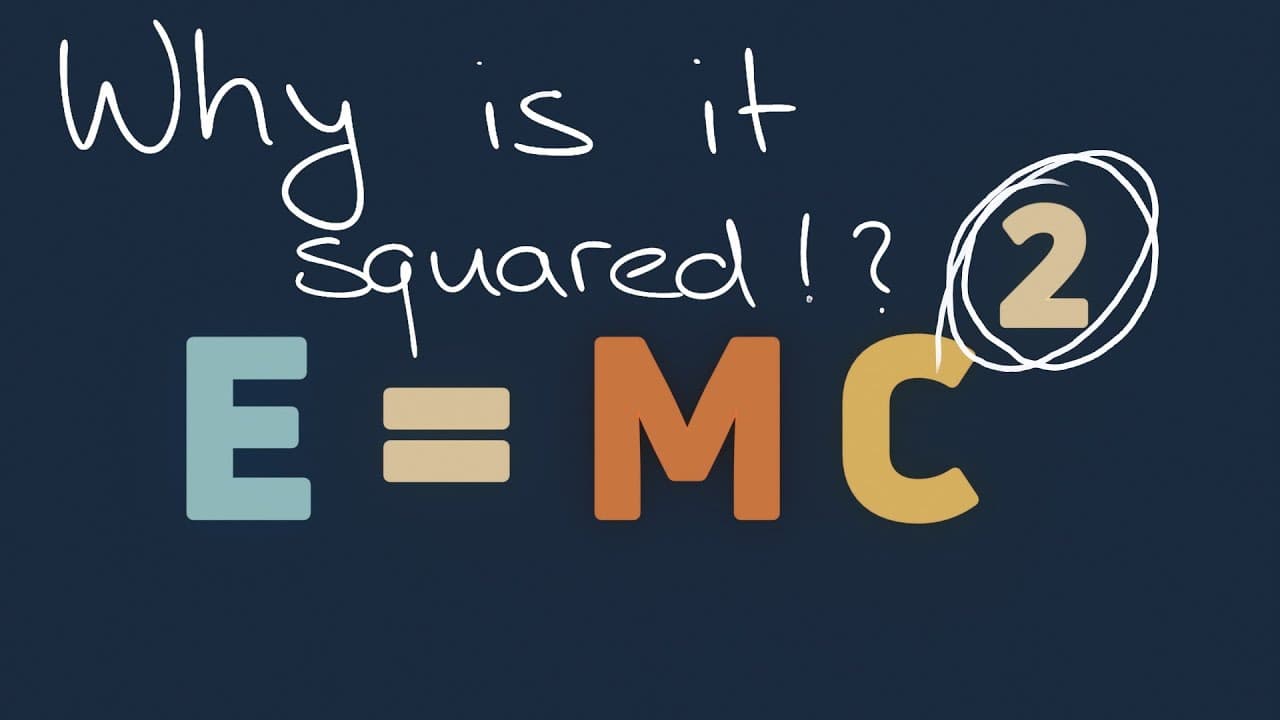
Why does E=MC²?
TL;DR
Explains why E=MC² relates mass to energy in space-time.
Transcript
at some point in every person's life you'll come across this equation right here and for almost every one of us we just go I I'm gonna take your word on that because I can't imagine ever really needing to understand that but for a select few it weighs on them well take my hand inhale and I'm gonna lead you th... Read More
Key Insights
- Momentum is a fundamental concept in physics, and its conservation is a universal truth, although the reasons behind this are unknown.
- The equation E=MC² describes the energy equivalent of mass when fully converted into a massless form like light or photons.
- Momentum is always present because there's no such thing as absolute zero velocity; motion is relative to different observers.
- The speed of light remains constant regardless of motion, leading to the understanding of a four-dimensional space-time reality.
- Space-time or Minkowski space describes a reality where objects move at a constant speed through a four-dimensional continuum.
- The directionless nature of momentum in space-time helps explain energy conservation across different frames of reference.
- Relativity ensures the conservation of energy by accounting for the relativistic mass and velocities of particles in reactions.
- E=MC² reflects the conversion of mass into energy, emphasizing the invariant nature of energy in space-time, regardless of observer perception.
Install to Summarize YouTube Videos and Get Transcripts
Explore YouTube Video Summarizer or Get YouTube Transcript Extractor
Questions & Answers
Q: Why is momentum considered a fundamental truth in physics?
Momentum is considered a fundamental truth because it is universally conserved in physical interactions, although the underlying reasons for its conservation are not fully understood. This conservation law is a cornerstone of classical and modern physics, ensuring that the total momentum of isolated systems remains constant over time.
Q: What does E=MC² represent in terms of mass and energy?
E=MC² represents the equivalence of mass and energy, indicating that mass can be converted into energy and vice versa. It quantifies the amount of energy (E) that would be released if a given mass (m) were entirely converted into energy, with the speed of light (c) acting as the conversion constant.
Q: How does the video explain the concept of motion and velocity?
The video explains that motion and velocity are relative concepts, meaning there is no absolute zero velocity. An object's motion is always relative to an observer's frame of reference, leading to the conclusion that different observers may perceive different velocities for the same object, depending on their respective positions and motions.
Q: What is the significance of the speed of light in the video?
The speed of light is significant because it remains constant regardless of the observer's motion, a key insight that led to the development of the theory of relativity. This constancy implies a unique relationship between space and time, forming the basis for understanding space-time as a four-dimensional continuum where objects move at a constant speed.
Q: How does space-time relate to E=MC²?
Space-time relates to E=MC² by providing a framework where mass and energy are viewed as interchangeable. In this four-dimensional continuum, objects move at a constant speed, and the equation describes the energy potential of mass when converted into a massless form, such as light, within this invariant space-time structure.
Q: What role does relativity play in energy conservation?
Relativity ensures energy conservation by accounting for the relativistic effects of mass and velocity. It explains how energy is conserved across different frames of reference, even when observers perceive varying kinetic energies due to their relative motion, thus preserving the laws of thermodynamics in a relativistic context.
Q: Why is directionless momentum important in the video?
Directionless momentum is important because it allows for the conservation of momentum across different frames of reference. By considering momentum as directionless in space-time, the video explains how energy conservation is maintained even when the direction of motion changes, ensuring that the total momentum remains invariant.
Q: How does the video address the perception of kinetic energy?
The video addresses the perception of kinetic energy by explaining that observers may perceive different kinetic energies due to relativistic velocities. It highlights how relativity resolves potential discrepancies by ensuring that energy conservation is maintained across frames of reference, despite differing perceptions of motion and energy.
Summary & Key Takeaways
-
The video delves into the famous equation E=MC², explaining its significance in relating mass to energy through the principles of space-time. It discusses how momentum is always conserved and how the equation represents the energy potential of mass when converted into a massless form like light.
-
The concept of momentum is explored, highlighting that it is always present due to the relative nature of motion. The video explains how the speed of light remains constant, leading to the understanding of a four-dimensional space-time where objects move at a constant speed.
-
Relativity plays a crucial role in ensuring energy conservation across different frames of reference. The video elucidates how E=MC² describes the conversion of mass into energy, emphasizing the invariant nature of energy in space-time, regardless of observer perception.
Read in Other Languages (beta)
Share This Summary 📚
Summarize YouTube Videos and Get Video Transcripts with 1-Click
Try YouTube Summary with ChatGPT & Claude or YouTube Transcript Generator
Explore More Summaries from But Why? 📚

Summarize YouTube Videos and Get Video Transcripts with 1-Click
Try YouTube Summary with ChatGPT & Claude or YouTube Transcript Generator