How to Estimate the Bias of a Coin Using LLMS
TL;DR
To estimate the bias of a coin based on the number of observed heads, use the linear least mean squares estimator derived from the expected values, variance, and covariance of coin flips. This estimator is a function of the number of heads and considers the prior distribution of the coin's bias, ensuring an optimal calculation for understanding the coin's bias.
Transcript
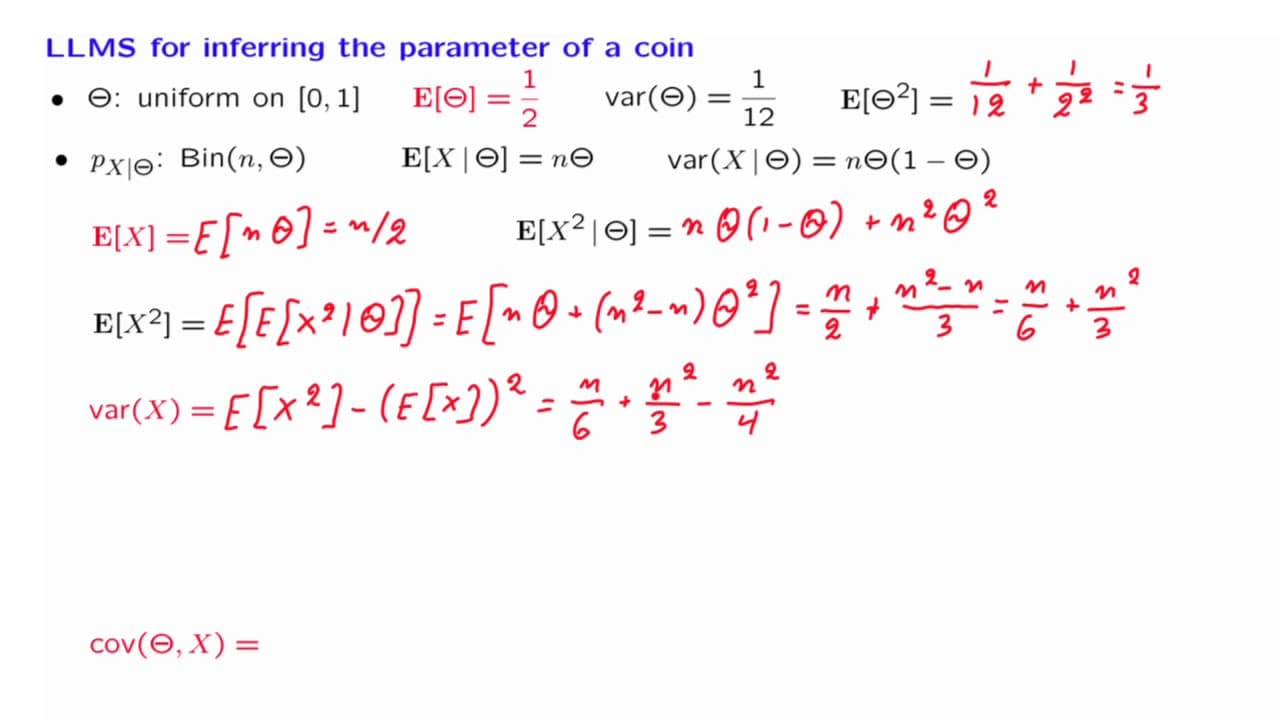
Let's now go through another example, which will be a little more challenging. We're going to revisit an old problem. We have a coin that has an unknown bias, Theta. And we have a prior distribution on this Theta. We fix some positive integer, n, we flip a coin n times, that has this unknown bias. And we record the number of heads. On the basis of ... Read More
Key Insights
- 🤕 The linear least mean squares estimator is a function of the observed number of heads and the prior distribution on the coin bias.
- 🤕 The calculation of the estimator involves determining the expected values, variances, and covariances of the observed number of heads and the bias of the coin.
- 🗂️ The coefficients in the estimator are obtained by dividing the covariance by the variance.
Install to Summarize YouTube Videos and Get Transcripts
Explore YouTube Video Summarizer or Get YouTube Transcript Extractor
Questions & Answers
Q: What is the objective of this analysis?
The objective is to calculate the linear least mean squares estimator for estimating the bias of a coin based on the observed number of heads in coin flips.
Q: How is the linear least mean squares estimator calculated?
The estimator is calculated using the formula that incorporates expected values, variances, and covariances of the observed number of heads. The coefficients in the estimator are determined by dividing the covariance by the variance.
Q: What distribution is assumed for the prior bias of the coin?
The prior distribution for the bias of the coin is assumed to be uniform on the unit interval.
Q: Why is the linear least mean squares estimator considered optimal?
The linear least mean squares estimator is considered optimal within the class of linear estimators. It is derived based on the properties of expected values and variances, providing the best estimation of the coin bias.
Summary & Key Takeaways
-
The problem involves estimating the bias of a coin (Theta) based on the number of heads observed in N coin flips.
-
The linear least mean squares estimator is a function of the observed number of heads (X) and can be calculated using expected values, variances, and covariances.
-
The estimator is derived using the formula for the linear least mean squares estimator and its coefficients are determined based on the covariance and variance of X.
Read in Other Languages (beta)
Share This Summary 📚
Summarize YouTube Videos and Get Video Transcripts with 1-Click
Try YouTube Summary with ChatGPT & Claude or YouTube Transcript Generator
Explore More Summaries from MIT OpenCourseWare 📚


Summarize YouTube Videos and Get Video Transcripts with 1-Click
Try YouTube Summary with ChatGPT & Claude or YouTube Transcript Generator