How to Solve CFA Issues in AMOS
TL;DR
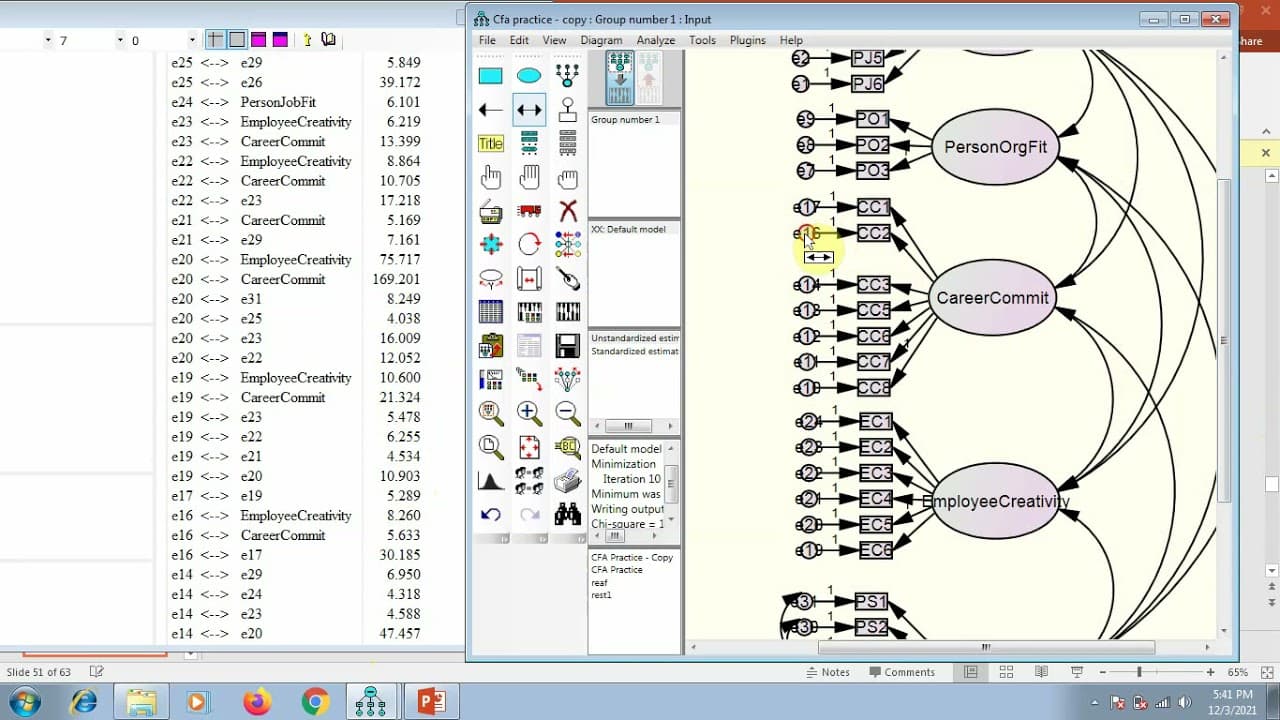
To address common issues in Confirmatory Factor Analysis (CFA) using AMOS, start by identifying and removing items with low factor loadings. Next, create covariances between error terms within the same construct based on modification indices. This approach helps improve model fitness, reliability, and validity, enabling more accurate analysis and reporting.
Transcript
welcome everyone in this previous week video i showed you how to conduct confirmatory factor analysis using smart using mos in that video in that example we had very neat and clean confirmatory factor analysis and we did not encounter many problems but usually this is not the case most of the time when you conduct confirmatory factor analysis you c... Read More
Key Insights
- Confirmatory Factor Analysis often encounters problems like low factor loadings and poor model fitness.
- The first step to improve model fitness is to remove items with factor loadings below 0.5.
- Model fitness indicators include RMR, GFI, CFI, and RMSEA, which have specific acceptable thresholds.
- Creating covariances between error terms of the same construct can reduce errors and improve model fit.
- Modification indices guide which covariances to create, focusing on values above 20.
- Improving model fitness precedes checking for reliability and validity issues.
- Composite reliability should be above 0.70, and AVE should exceed 0.50 for all constructs.
- After achieving model fitness, the analysis can proceed to hypothesis testing and further steps.
Install to Summarize YouTube Videos and Get Transcripts
Explore YouTube Video Summarizer or Get YouTube Transcript Extractor
Questions & Answers
Q: How to improve model fitness in CFA using AMOS?
Improving model fitness in CFA using AMOS involves removing items with low factor loadings, typically below 0.5. Additionally, creating covariances between error terms of the same construct, guided by modification indices above 20, can help reduce errors. Ensure key fitness indicators like RMR, GFI, CFI, and RMSEA meet their acceptable thresholds for a well-fitted model.
Q: What are the acceptable thresholds for CFA model fitness indicators?
For CFA model fitness, RMR should be less than 0.05, GFI should be above 0.8 (ideally above 0.9), CFI should be above 0.9, and RMSEA should be less than 0.08. These thresholds ensure the model is well-fitted and reliable for further analysis, allowing for accurate hypothesis testing and conclusions.
Q: Why is it important to remove items with low factor loadings in CFA?
Removing items with low factor loadings, typically below 0.5, is crucial in CFA because they weaken the model's reliability and validity. These items contribute to poor model fitness, making it difficult to achieve accurate and meaningful analysis results. Eliminating them helps improve the overall model fit and ensures more robust findings.
Q: How does creating covariances between error terms improve CFA model fit?
Creating covariances between error terms of the same construct in CFA helps reduce model errors by addressing shared variance not explained by the constructs. Guided by modification indices, this process improves model fit by decreasing error terms' impact, leading to more accurate and reliable model fitness indicators and overall analysis.
Q: What role do modification indices play in CFA using AMOS?
Modification indices in CFA using AMOS guide the creation of covariances between error terms within the same construct. They indicate which covariances will most effectively reduce errors, typically focusing on indices above 20. This targeted approach helps improve model fitness, making the analysis more reliable and valid.
Q: How to ensure reliability and validity in a CFA model?
To ensure reliability and validity in a CFA model, check that composite reliability exceeds 0.70 and AVE is above 0.50 for all constructs. Achieving these standards confirms the model's constructs are consistently measured and valid, providing a strong foundation for further analysis and hypothesis testing.
Q: What is the significance of composite reliability and AVE in CFA?
Composite reliability and AVE are critical in CFA for assessing the consistency and validity of constructs. Composite reliability above 0.70 indicates that the constructs are reliably measured, while AVE above 0.50 ensures that the constructs capture sufficient variance. Meeting these criteria is essential for a robust and valid CFA model.
Q: What steps follow achieving model fitness in CFA?
Once model fitness is achieved in CFA, the next steps include verifying reliability and validity, ensuring composite reliability and AVE meet standards. After confirming these aspects, the analysis can proceed to hypothesis testing, leveraging the well-fitted model to draw meaningful and accurate conclusions from the data.
Summary & Key Takeaways
-
Confirmatory Factor Analysis using AMOS can present issues like low factor loadings and model fitness problems. To address these, remove items with low factor loadings and create covariances between error terms within the same construct based on modification indices. This process helps improve model fitness and ensures reliability and validity, facilitating accurate analysis.
-
Key model fitness indicators include RMR, GFI, CFI, and RMSEA, each with specific acceptable thresholds. Removing items with low factor loadings and adjusting covariances can help meet these thresholds. Once model fitness is achieved, reliability and validity should be checked, ensuring composite reliability and AVE meet recommended standards.
-
Creating covariances between error terms of the same construct can significantly improve model fit. Focus on modification indices above 20 to decide which covariances to create. Once model fitness and validity are confirmed, the analysis can proceed to hypothesis testing, ensuring robust and reliable results for further research.
Read in Other Languages (beta)
Share This Summary 📚
Summarize YouTube Videos and Get Video Transcripts with 1-Click
Try YouTube Summary with ChatGPT & Claude or YouTube Transcript Generator