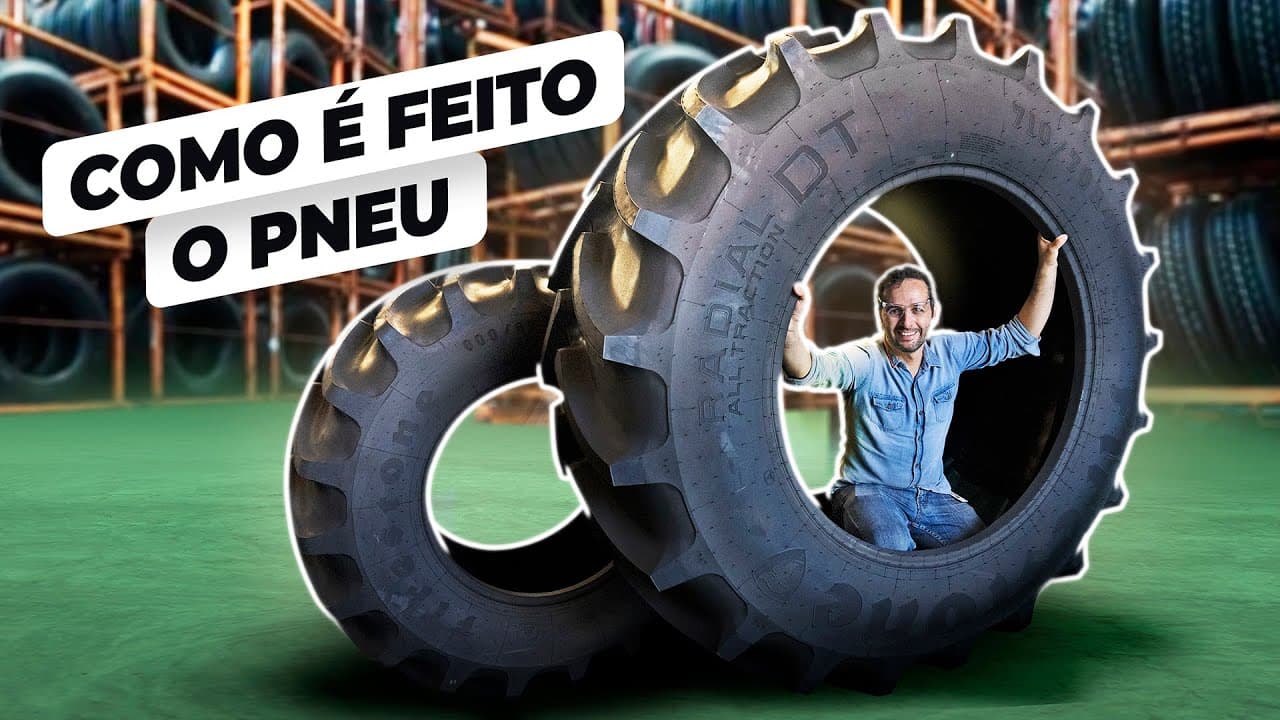
Como é FEITO o PNEU #Boravê
TL;DR
Tire production involves complex processes and materials beyond just rubber.
Transcript
Today we are going to find out how a tire is made. We came to a factory in Santo André, close to São Paulo, where more than 20,000 tires are produced a day. And I'm just letting you know that if you think a tire is just a piece of rubber, you're wrong. There are dozens of pieces that need to be fitted together to form it. Let's find out. We got a p... Read More
Key Insights
- Tire production is a complex process involving multiple materials and steps, starting up to three years before launch.
- The tread, body ply, bead, and inner liner are key components of a tire, each serving specific functions.
- Natural and synthetic rubbers are used in tire production, with additives like carbon black and silica enhancing performance.
- Vulcanization is a crucial process where sulfur bonds rubber molecules, increasing durability and elasticity.
- Tire assembly is automated, with robots handling the intricate layering and inflation of components.
- Quality control includes visual inspections, x-rays, and balance tests to ensure tire safety and performance.
- Tires undergo rigorous testing, including endurance tests under maximum load to identify weak points.
- The tire industry continuously innovates, adapting materials and processes to meet performance and environmental standards.
Install to Summarize YouTube Videos and Get Transcripts
Explore YouTube Video Summarizer or Get YouTube Transcript Extractor
Questions & Answers
Q: What materials are used in tire production?
Tire production utilizes both natural and synthetic rubbers, along with additives like carbon black, silica, and sulfur. Natural rubber is derived from latex, while synthetic rubber comes from petroleum. Carbon black enhances rubber resistance and gives tires their black color, while silica improves rolling resistance.
Q: What is the vulcanization process in tire manufacturing?
Vulcanization is a chemical process where sulfur is added to rubber at high temperatures to create cross-links between rubber molecules. This process increases the rubber's durability and elasticity, transforming it into a firmer and more resilient material suitable for tire production.
Q: How are tires assembled in the factory?
Tire assembly is an automated process managed by robots. It begins with the inner liner, followed by the layering of other components like the body ply and tread. The tire is inflated during assembly to maintain shape, and rollers apply pressure to ensure the rubber layers adhere properly.
Q: What quality control measures are used in tire manufacturing?
Quality control in tire manufacturing includes visual inspections to remove any burrs, x-ray machines to examine the metallic structure, and balance tests to ensure even mass distribution. Additionally, tires undergo endurance tests under maximum load conditions to identify potential weak points.
Q: Why is carbon black used in tire production?
Carbon black is a petroleum derivative used in tire production to enhance the rubber's resistance and durability. It also provides the characteristic black color of tires. Without carbon black, tires could potentially be produced in different colors, but their performance would be compromised.
Q: What role does silica play in tire manufacturing?
Silica, a major component of sand, is used in tire manufacturing to improve rolling resistance. This enhancement leads to better fuel efficiency for vehicles, as tires with improved rolling resistance require less energy to move, thereby reducing overall fuel consumption.
Q: How does the tire industry ensure safety and performance?
The tire industry ensures safety and performance through rigorous testing and quality control. Tires undergo visual inspections, x-rays, and balance tests. They are also tested for endurance under maximum load conditions. These measures help identify and rectify potential issues before tires reach the market.
Q: What innovations are present in modern tire manufacturing?
Modern tire manufacturing involves continuous innovations, such as the development of new rubber compounds, advanced vulcanization techniques, and automated assembly processes. These innovations aim to improve tire performance, safety, and environmental impact, keeping pace with evolving automotive and consumer needs.
Summary & Key Takeaways
-
The video explores the intricate process of tire manufacturing, highlighting the use of both natural and synthetic rubbers. It explains how different components like the tread, body ply, bead, and inner liner are assembled to create a functional tire.
-
Key materials include natural rubber, synthetic rubber, carbon black, silica, and sulfur, each contributing to the tire's performance. The vulcanization process is crucial for enhancing the rubber's durability and elasticity.
-
Tires undergo a series of quality control measures, including visual inspections, x-rays, and balance tests. The video emphasizes the complexity and precision involved in ensuring every tire meets safety and performance standards.
Read in Other Languages (beta)
Share This Summary 📚
Summarize YouTube Videos and Get Video Transcripts with 1-Click
Try YouTube Summary with ChatGPT & Claude or YouTube Transcript Generator
Explore More Summaries from Manual do Mundo 📚


Summarize YouTube Videos and Get Video Transcripts with 1-Click
Try YouTube Summary with ChatGPT & Claude or YouTube Transcript Generator