How Does Attention Improve Seq2Seq Models?
TL;DR
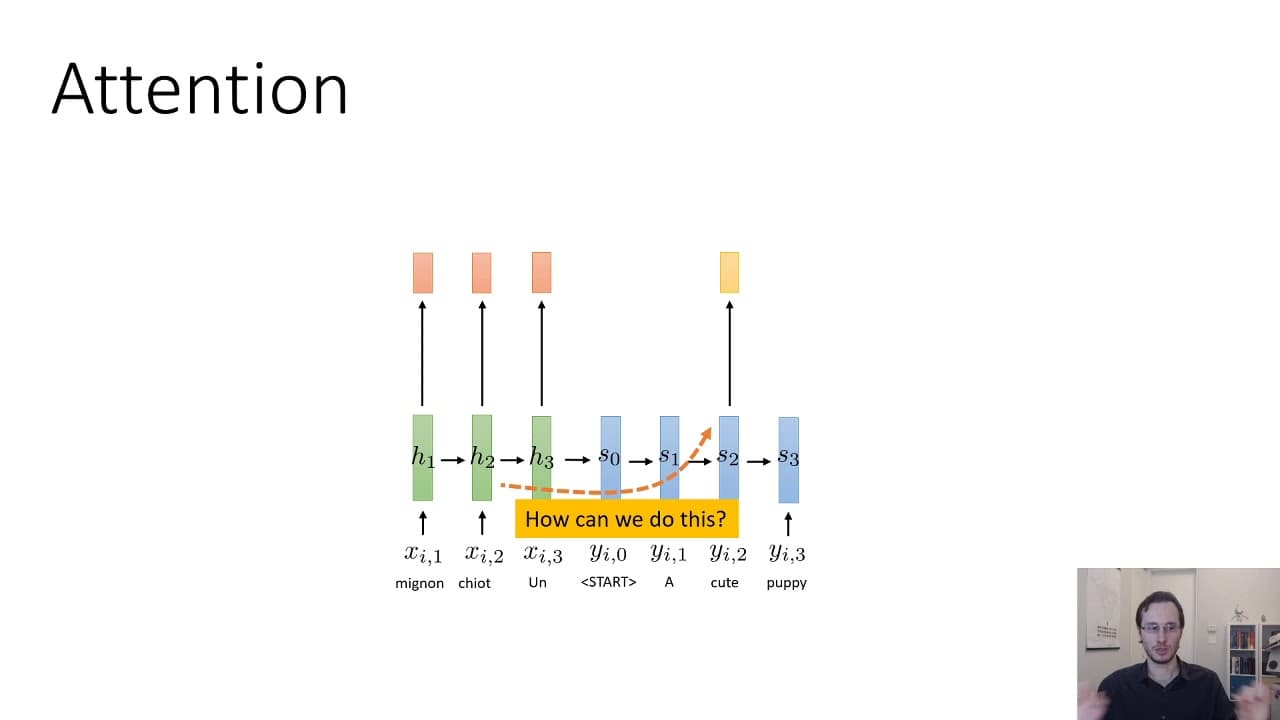
Attention mechanisms in sequence-to-sequence models address the bottleneck problem by allowing the decoder to access relevant parts of the input sequence during decoding. This reduces the dependency on the initial hidden state and improves handling of long input sequences. The attention process involves creating keys and queries to determine which input parts are most relevant at each decoding step.
Transcript
all right um the last topic i'm going to discuss in today's lecture is uh i'm going to serve as a little bit of a transition to the next next lecture so uh for the next lecture we'll talk a lot more about attention but i just want to introduce the notion of attention for seek to seek models all right so there's a problem with sequence to sequence m... Read More
Key Insights
- Attention mechanisms solve the bottleneck problem in seq2seq models by allowing the decoder to access the input sequence during decoding.
- The bottleneck problem arises when the encoder's hidden state must contain all information for the decoder, limiting sequence length handling.
- Attention uses keys and queries to determine relevant input parts for each decoding step, reducing reliance on the initial hidden state.
- Keys and queries are learned functions of the encoder and decoder states, respectively, enabling dynamic information retrieval.
- The attention score is calculated using the dot product of keys and queries, with a softmax function to ensure differentiability.
- Attention allows for O(1) connections between encoder and decoder steps, improving gradient propagation and training efficiency.
- Different attention mechanisms include identity functions, linear multiplicative attention, and key-value pairs for added flexibility.
- Attention significantly improves seq2seq model performance, especially for long sequences, by reducing the importance of the bottleneck.
Install to Summarize YouTube Videos and Get Transcripts
Explore YouTube Video Summarizer or Get YouTube Transcript Extractor
Questions & Answers
Q: How does attention solve the bottleneck problem in seq2seq models?
Attention solves the bottleneck problem by allowing the decoder to access relevant parts of the input sequence during decoding. This reduces the reliance on the initial hidden state to contain all necessary information, which is crucial for handling long input sequences. By using keys and queries, attention dynamically determines which input parts are most relevant at each decoding step, improving model performance.
Q: What is the bottleneck problem in sequence-to-sequence models?
The bottleneck problem in sequence-to-sequence models occurs when the encoder's hidden state must contain all the information needed for the decoder to generate the output. This limitation makes it challenging to handle long input sequences, as the initial hidden state may not adequately capture all relevant details, leading to poor performance and information loss.
Q: How are attention scores calculated in seq2seq models?
Attention scores in seq2seq models are calculated using the dot product of keys and queries. Each encoder step produces a key, while each decoder step produces a query. The dot product between these vectors indicates the relevance of each input step to the current decoding step. A softmax function is applied to these scores to ensure differentiability and to weight the relevance of each input step.
Q: Why is the softmax function used in attention mechanisms?
The softmax function is used in attention mechanisms to ensure that the attention scores are differentiable, allowing the model to be trained using gradient-based optimization methods. It converts raw attention scores into a probability distribution, ensuring they are positive and sum to one. This enables the model to focus on the most relevant parts of the input sequence while maintaining the ability to learn effectively.
Q: What are keys and queries in the context of attention mechanisms?
In the context of attention mechanisms, keys and queries are learned functions of the encoder and decoder states, respectively. Keys represent the type of information present at each encoder step, while queries represent the type of information needed at each decoder step. The similarity between keys and queries, determined by their dot product, helps identify which parts of the input sequence are most relevant for each decoding step.
Q: How does attention improve gradient propagation in seq2seq models?
Attention improves gradient propagation in seq2seq models by providing O(1) connections between encoder and decoder steps. This reduces the average path length for gradients, leading to better-behaved gradients and more efficient training. Unlike traditional RNN connections, which have O(n) propagation length, attention's direct connections facilitate easier training and better performance, especially for long sequences.
Q: What are some variants of attention mechanisms in seq2seq models?
Variants of attention mechanisms in seq2seq models include identity functions, linear multiplicative attention, and key-value pairs. Identity functions use the hidden states directly as keys and queries, while linear multiplicative attention applies linear transformations to these states. Key-value pairs provide additional flexibility by transforming encoder states into separate keys and values, allowing for more nuanced information retrieval during decoding.
Q: Why is attention particularly beneficial for long sequences in seq2seq models?
Attention is particularly beneficial for long sequences in seq2seq models because it reduces the importance of the bottleneck problem by allowing the decoder to access relevant input information directly. This alleviates the need for the initial hidden state to contain all necessary details, which is challenging for long sequences. Attention's efficient gradient propagation and dynamic information retrieval significantly enhance model performance on complex, lengthy sequences.
Summary & Key Takeaways
-
Attention mechanisms in seq2seq models address the bottleneck problem by allowing decoders to access relevant input sequence parts during decoding. This reduces dependency on the initial hidden state and improves handling of long input sequences. Keys and queries are learned functions that help determine relevant input parts, with attention scores calculated using their dot product.
-
The attention mechanism uses a softmax function to ensure differentiability and allows for O(1) connections between encoder and decoder steps, enhancing gradient propagation and training efficiency. Different attention mechanisms, such as linear multiplicative attention and key-value pairs, offer flexibility and improve model performance.
-
Attention significantly enhances seq2seq model performance, especially for long sequences, by reducing the bottleneck's importance. This improvement is achieved by dynamically retrieving information during decoding, leading to better handling of complex sequences and more efficient training.
Read in Other Languages (beta)
Share This Summary 📚
Summarize YouTube Videos and Get Video Transcripts with 1-Click
Try YouTube Summary with ChatGPT & Claude or YouTube Transcript Generator
Explore More Summaries from RAIL 📚

Summarize YouTube Videos and Get Video Transcripts with 1-Click
Try YouTube Summary with ChatGPT & Claude or YouTube Transcript Generator