How Does DBMS Work for BTech Students?
TL;DR
DBMS is a software that helps manage databases by allowing users to create, retrieve, update, and delete data efficiently. It provides a structured way to store and access data, ensuring data consistency, security, and backup. DBMS is essential in various applications like banking, universities, and online shopping, making it a crucial component in managing large datasets.
Transcript
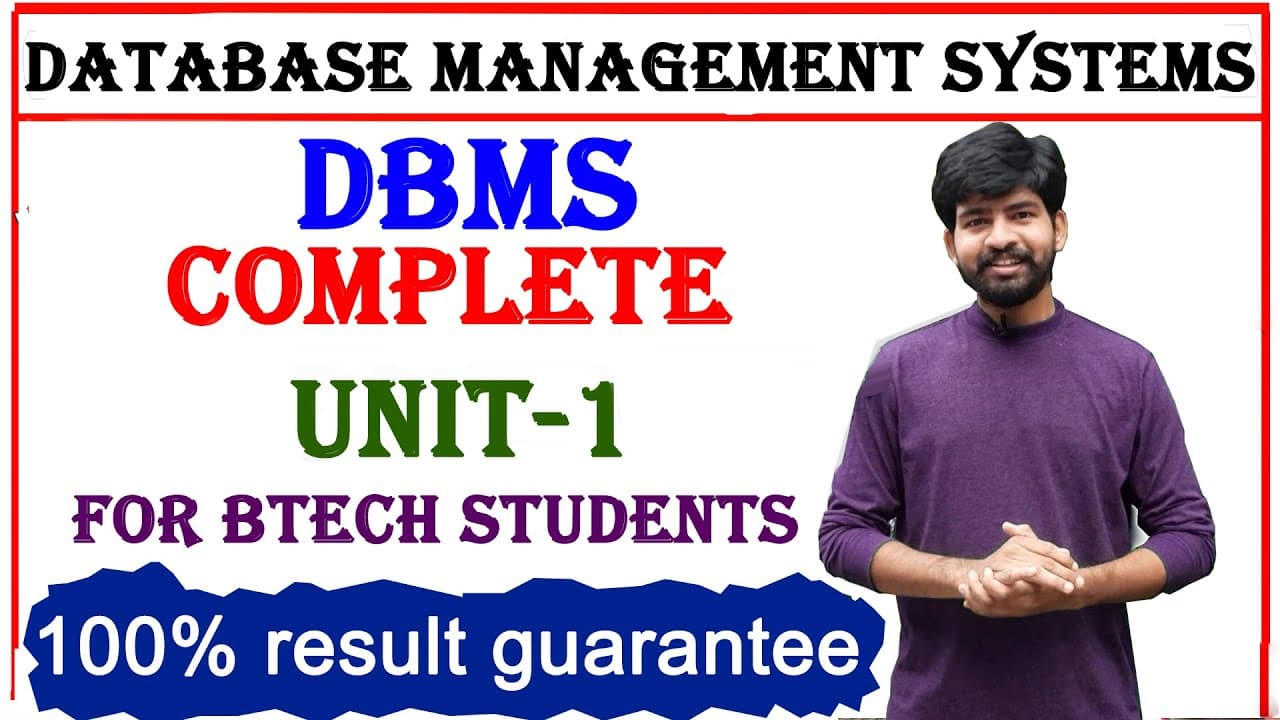
hi guys welcome to my channel in this video I'll be covering complete unit 1 and dbma subject I will explain all these topics in detail and whatever the topics that I am going to cover in this video I will provide all those topics and the timings in description so before starting this video please check in description guys I have uploaded complete ... Read More
Key Insights
- Data is raw, unorganized facts, while information is processed data with meaning.
- A database is an organized collection of structured information stored electronically.
- DBMS is software that facilitates the creation, manipulation, and management of databases.
- DBMS provides data consistency, security, and allows multiple users to access data concurrently.
- Normalization in DBMS reduces data redundancy and improves data integrity.
- SQL is a programming language used to communicate with databases for various operations.
- DBMS applications include railway reservation systems, library management, and online shopping.
- Three-tier architecture in DBMS separates user interface, application logic, and database storage for efficient data processing.
Install to Summarize YouTube Videos and Get Transcripts
Explore YouTube Video Summarizer or Get YouTube Transcript Extractor
Questions & Answers
Q: How to differentiate between data and information?
Data refers to raw, unorganized facts that lack context or meaning, such as numbers or text. Information, on the other hand, is data that has been processed, organized, and structured in a way that provides context and meaning, making it useful and understandable. For example, a list of numbers is data, but when these numbers are identified as student scores, they become information.
Q: What is the role of a DBMS?
A DBMS (Database Management System) is software that enables users to create, manage, and manipulate databases. It provides tools for data creation, retrieval, updating, and deletion, ensuring data consistency, security, and integrity. DBMS supports multiple users accessing data concurrently, making it essential for managing large datasets in various applications like banking, universities, and online shopping.
Q: Why is normalization important in DBMS?
Normalization in DBMS is essential because it reduces data redundancy and improves data integrity. By organizing data into tables and establishing relationships between them, normalization ensures that data is stored efficiently without unnecessary duplication. This process enhances data consistency and accuracy, preventing anomalies during data operations and making database management more effective.
Q: What is SQL, and how is it used in DBMS?
SQL (Structured Query Language) is a programming language designed for managing and manipulating relational databases. It provides a standardized way to interact with databases, allowing users to perform various operations such as creating, retrieving, updating, and deleting data. SQL is the primary language used in DBMS to execute queries, manage database structures, and control access to data.
Q: What are some common applications of DBMS?
DBMS is used in numerous applications across different fields. Common applications include railway reservation systems, where it manages ticket bookings and schedules; library management systems, which track book inventories and user transactions; banking, for handling transactions and customer accounts; and online shopping platforms like Amazon, which manage product inventories and customer orders efficiently.
Q: How does the three-tier architecture work in DBMS?
The three-tier architecture in DBMS separates the user interface, application logic, and database storage into three distinct layers. The user interface layer handles user interactions, the application logic layer processes user requests and business logic, and the database storage layer manages data storage and retrieval. This separation enhances data processing efficiency, security, and scalability, making it ideal for web-based applications.
Q: What is the difference between schema and instance in DBMS?
In DBMS, a schema represents the logical structure or design of a database, including tables, columns, and relationships. It defines how data is organized and stored. An instance, on the other hand, refers to the actual data stored in the database at a particular moment in time. While the schema remains constant, the instance can change as data is added, modified, or deleted.
Q: What are the advantages of using DBMS over a traditional file system?
DBMS offers several advantages over traditional file systems, including improved data consistency and integrity through normalization, enhanced data security with access controls, and efficient data retrieval using SQL. DBMS also supports concurrent access by multiple users, provides automatic backup and recovery options, and reduces data redundancy, making it a more robust and scalable solution for managing large datasets.
Summary & Key Takeaways
-
DBMS software allows users to efficiently manage databases by providing tools for data creation, retrieval, updating, and deletion. It ensures data consistency and security while supporting concurrent access by multiple users. DBMS applications are widespread, including in banking, universities, and online shopping.
-
Normalization is a key process in DBMS that reduces data redundancy and improves data integrity, ensuring that data remains consistent and accurate across the database. SQL is the primary language used for interacting with DBMS, enabling users to perform various database operations.
-
The three-tier architecture in DBMS separates the user interface, application logic, and database storage, enhancing data processing efficiency and security. This architecture is commonly used in web-based applications like Amazon and Facebook, where user data is managed securely and effectively.
Read in Other Languages (beta)
Share This Summary 📚
Summarize YouTube Videos and Get Video Transcripts with 1-Click
Try YouTube Summary with ChatGPT & Claude or YouTube Transcript Generator
Explore More Summaries from NS lectures 📚

Summarize YouTube Videos and Get Video Transcripts with 1-Click
Try YouTube Summary with ChatGPT & Claude or YouTube Transcript Generator