Products
Features
YouTube Video Summarizer
Summarize YouTube videos
Web & PDF Highlighter
Highlight web pages & PDFs
Chat with PDF
Ask any PDF questions with AI
Ask AI Clone
Chat with your highlights & memories
Audio Transcriber
Transcribe audio files to text
Glasp Reader
Read and highlight articles
Kindle Highlight Export
Export your Kindle highlights
Idea Hatch
Hatch ideas from your highlights
Integrations
Obsidian Plugin
Notion Integration
Pocket Integration
Instapaper Integration
Medium Integration
Readwise Integration
Snipd Integration
Hypothesis Integration
Apps & Extensions
Chrome Extension
Safari Extension
Edge Add-ons
Firefox Add-ons
iOS App
Android App
Discover
Discover
Ideas
Discover new ideas and insights
Articles
Curated articles and insights
Books
Book recommendations by great minds
Posts
Essays and notes from readers
Quotes
Inspiring quotes collection
Videos
Curated videos and summaries
Explore Glasp
Glasp Newsletter
Weekly insights and updates
Glasp Talk
Interview series with great minds
Glasp Blog
Latest news and articles
Glasp Use Cases
Learn how others use Glasp
Build & Support
Glasp API
Access Glasp's API for developers
MCP Connector
Connect Glasp to Claude & ChatGPT
Community
Glasp Reddit Community
Students
Student discount and benefits
FAQs
Frequently Asked Questions
AboutPricing
DashboardLog inSign up

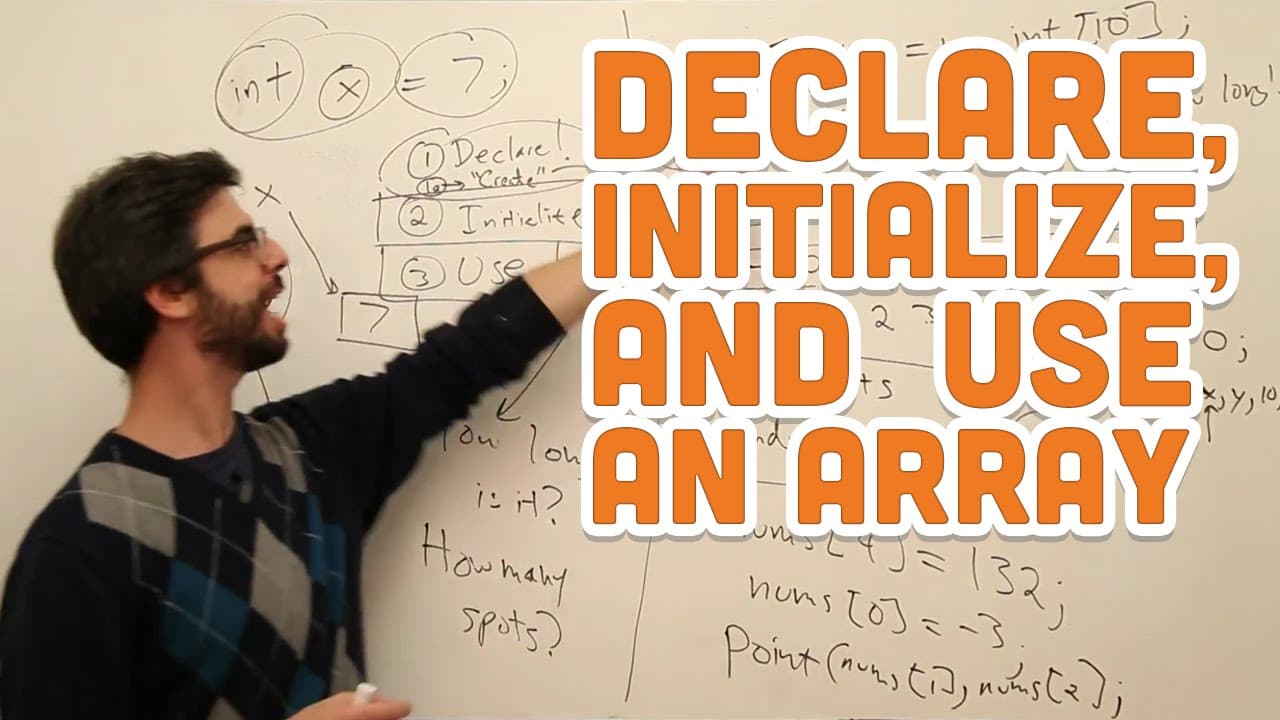
9.2: Declare, Initialize, and Use an Array - Processing Tutorial
170.7K views
•
July 24, 2015
by
The Coding Train
YouTube video player
9.2: Declare, Initialize, and Use an Array - Processing Tutorial

TL;DR

This video explains the steps to declare, initialize, and use arrays in programming, focusing on the importance of understanding index values.

Transcript

Okay. We're back. Okay, jumping jacks everybody. Okay, um, so. We kind of had a little bit of a little trip up there before but here we are, we've returned. This is the moment. This is the moment. We're going to actually use an array in our code. So here's the thing... Remember a while back? Video something... Link to it down here in the magic lin... Read More

Key Insights

  • ❓ Declaring and initializing arrays in programming follows a similar process to declaring and initializing variables.
  • 🪡 The length of an array needs to be specified during its creation.
  • 🫰 The index values of an array start at 0 and go up to the length of the array minus 1.
  • 👻 Arrays allow for the storage and manipulation of multiple values of the same data type in an organized manner.
  • 😫 Default values for array elements are set to 0 if no value is assigned.
  • ❓ Understanding arrays is essential for efficient programming and data management.
  • 👨‍💻 Arrays can be used to improve the efficiency and clarity of coding by reducing the need for repetitive code.

Install to Summarize YouTube Videos and Get Transcripts

Explore YouTube Video Summarizer or Get YouTube Transcript Extractor

Questions & Answers

Q: What are the steps involved in creating an array in programming?

The steps are declaring the array by specifying its name and type, initializing the array by assigning values to its elements, and using the array by accessing individual elements.

Q: Why is it important to know the index values of an array?

Understanding the index values allows programmers to access specific elements in the array. The index values start at 0, not 1, and go up to the length of the array minus 1.

Q: What is the default value of an integer array element?

The default value for an integer array element is 0. If no value is assigned to an element, it will automatically be set to 0.

Q: How can arrays be used to simplify programming tasks?

Arrays can be used to store multiple values of the same data type, making it easier to manipulate and access the data. They allow for more efficient and organized coding.

Summary & Key Takeaways

  • The video discusses the process of declaring and initializing arrays in programming, highlighting the need to specify the length of the array.

  • The default values of array elements are set to 0, and individual elements can be accessed using index values.

  • The index values of an array start at 0, not 1, and range from 0 to the length of the array minus 1.


Read in Other Languages (beta)

English

Share This Summary 📚

Summarize YouTube Videos and Get Video Transcripts with 1-Click

Download browser extensions on:

Try YouTube Summary with ChatGPT & Claude or YouTube Transcript Generator

Explore More Summaries from The Coding Train 📚

Coding Challenge #126: Toothpicks thumbnail
Coding Challenge #126: Toothpicks
The Coding Train
Classifying Poses with ml5.js Part 2 thumbnail
Classifying Poses with ml5.js Part 2
The Coding Train
8.1: Fractals - The Nature of Code thumbnail
8.1: Fractals - The Nature of Code
The Coding Train
9.4: Genetic Algorithm: Looking at Code - The Nature of Code thumbnail
9.4: Genetic Algorithm: Looking at Code - The Nature of Code
The Coding Train
Coding Challenge #116: Lissajous Curve Table thumbnail
Coding Challenge #116: Lissajous Curve Table
The Coding Train
ITP/IMA Winter Show 2019 thumbnail
ITP/IMA Winter Show 2019
The Coding Train

Summarize YouTube Videos and Get Video Transcripts with 1-Click

Download browser extensions on:

Try YouTube Summary with ChatGPT & Claude or YouTube Transcript Generator

Apps & Extensions

  • Chrome Extension
  • Safari Extension
  • Edge Add-ons
  • Firefox Add-ons
  • iOS App
  • Android App

Key Features

  • YouTube Video Summarizer
  • Web & PDF Summarizer
  • Web & PDF Highlighter
  • Chat with PDF
  • Ask AI Clone
  • Audio Transcriber
  • Glasp Reader
  • Kindle Highlight Export
  • Idea Hatch

Integrations

  • Obsidian Plugin
  • Notion Integration
  • Pocket Integration
  • Instapaper Integration
  • Medium Integration
  • Readwise Integration
  • Snipd Integration
  • Hypothesis Integration

More Features

  • APIs
  • MCP Connector
  • Blog & Post
  • Embed Links
  • Image Highlight
  • Personality Test
  • Quote Shots

Company

  • About us
  • Blog
  • Community
  • FAQs
  • Job Board
  • Newsletter
  • Pricing
Terms

•

Privacy

•

Guidelines

© 2026 Glasp Inc. All rights reserved.