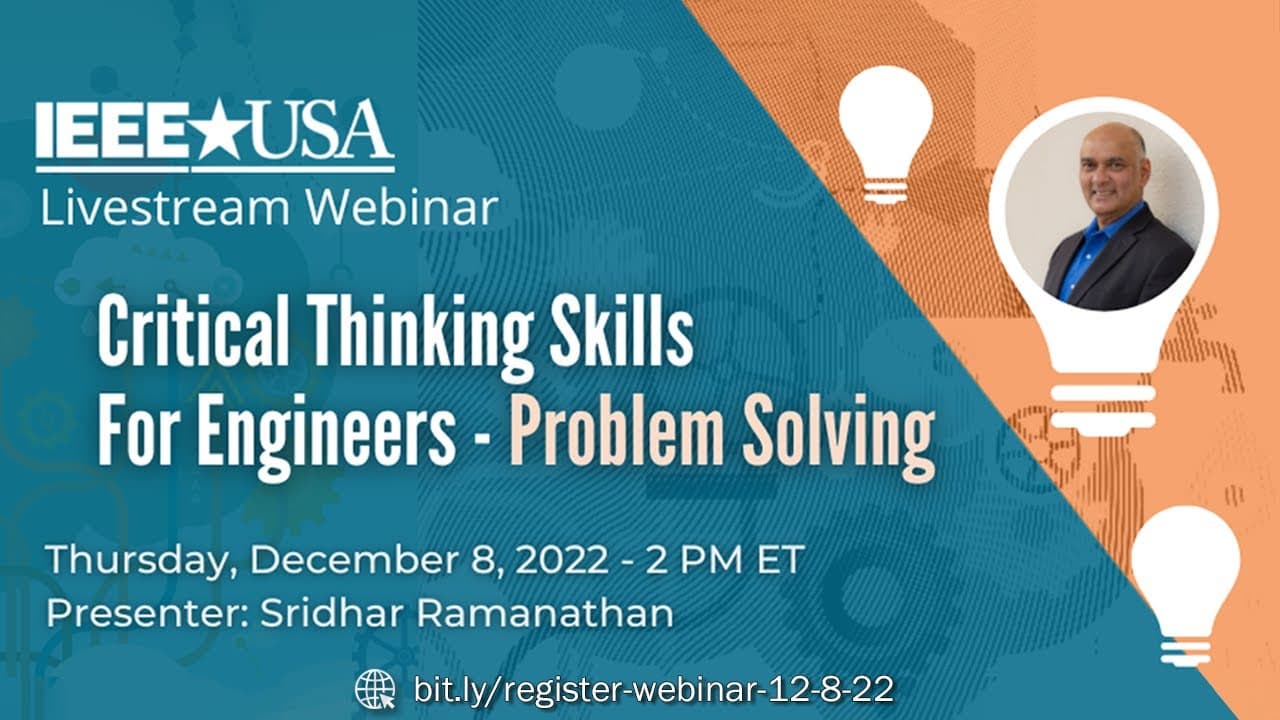
Livestream Webinar: Critical Thinking Skills for Engineers—Problem Solving
TL;DR
This analysis explores various problem-solving techniques, including problem statement definition, root cause analysis, abstraction, analogy, brainstorming, trial and error, divide and conquer, lateral thinking, and prioritization within a budget.
Transcript
foreign foreign I had the coolest job that any electrical engineer could ever have on the ground crew for solar impulse 2 the first solar-powered airplane to fly around the world only using the power of the sun IEEE USA has given me a Competitive Edge because of their support system it is so much easier doing something and being out of your comfort... Read More
Key Insights
- ❓ Defining the problem statement is crucial for effective problem-solving.
- 🫚 Root cause analysis helps identify the original trigger of a problem.
- 🤑 Abstraction involves creating models to solve problems based on existing ones in different disciplines.
- 🏑 Analogies can provide insights and solutions from different fields.
- 🤔 Brainstorming fosters diverse thinking and encourages creative problem-solving.
- 😘 Trial and error can be effective when the cost of failure is low and rapid testing is possible.
- 🍳 Divide and conquer involves breaking down complex problems into smaller, solvable chunks.
Install to Summarize YouTube Videos and Get Transcripts
Explore YouTube Video Summarizer or Get YouTube Transcript Extractor
Questions & Answers
Q: What is the first step in problem solving?
The first step in problem-solving is defining the problem statement, which involves setting the context, describing the current situation, identifying the impact, outlining the ideal state, and providing pointers for potential solutions.
Q: How can analogy be used in problem solving?
Analogy involves looking for similar problem-solving approaches in completely different fields or disciplines. By finding analogies, engineers can apply ideas or methods that have worked in other contexts to their current problem.
Q: Are these problem-solving techniques applicable in non-technical situations?
Yes, these problem-solving techniques can be applied to various situations, including non-technical ones. For example, lateral thinking and brainstorming can help in solving organizational or interpersonal issues within the workplace.
Summary & Key Takeaways
-
This content is a live stream webinar on critical thinking skills for engineers, presented by Sarita Ramanavan from IEEE USA.
-
The webinar covers eight problem-solving techniques, including problem statement definition, root cause analysis, abstraction, analogy, brainstorming, trial and error, divide and conquer, and lateral thinking.
-
Each technique provides insights into how engineers can effectively approach and solve complex problems in various fields.
Read in Other Languages (beta)
Share This Summary 📚
Summarize YouTube Videos and Get Video Transcripts with 1-Click
Try YouTube Summary with ChatGPT & Claude or YouTube Transcript Generator