Conventional tubes at microwave frequencies | Transit time Effect | Microwave Engineering | Lec-81
TL;DR
This video explains transit time effects and limitations in microwave tubes.
Transcript
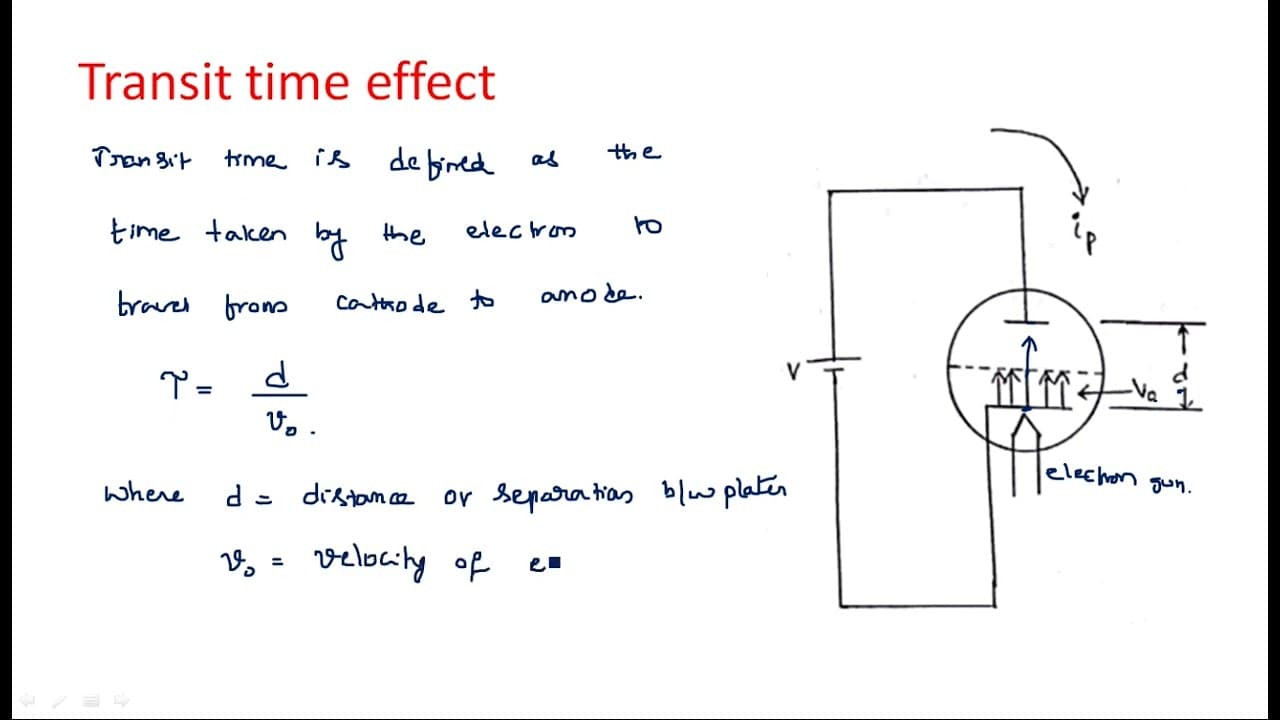
hi everyone in this video I am going to explain about Transit time effect as the limitations and losses of conventional tubes at microwave frequencies so now let us see what is the definition of Transit time Transit time is nothing but the time taken by the electron to travel from one electrode to another electrode nothing but cathode to anode see ... Read More
Key Insights
- ⌛ Transit time is critical for understanding electron behavior in microwave tubes and directly impacts performance.
- 👻 Low-frequency operations allow for immediate current flow, while high frequencies introduce delays due to comparable transit and signal periods.
- 🧑💼 Optimizing transit time may involve trade-offs, such as managing electrode capacitance while ensuring efficient electron transit.
- 🧪 The relationship between static and kinetic energies of electrons is a fundamental concept in analyzing microwave tube dynamics.
- ⌛ Voltage increases can enhance electron velocity, thus reducing transit time without altering distance.
- ⌛ Choosing the optimal distance between electrodes requires balancing transit time and capacitance effects for effective tube functioning.
- 💦 Understanding these dynamics is essential for engineers working with high-frequency microwave technologies.
Install to Summarize YouTube Videos and Get Transcripts
Explore YouTube Video Summarizer or Get YouTube Transcript Extractor
Questions & Answers
Q: What is the definition of transit time in microwave tubes?
Transit time is defined as the time taken for an electron to travel from the cathode to the anode in microwave tubes. It is determined by the distance between the electrodes and the velocity of the electron. The formula used is Tau = Distance / Velocity, where the distance is represented by D and the velocity by V₀.
Q: How does the behavior of plate current change at low frequencies?
At low frequencies, the time period of the signal is significantly greater than the transit time, allowing the plate current to flow almost immediately after the grid voltage is applied. This immediate response is crucial for efficient tube operation in low-frequency applications, facilitating effective electron movement across the electrodes.
Q: What occurs at high frequencies regarding transit time?
At high frequencies, the time period of the signal becomes comparable to the transit time, resulting in a lagged response in plate current after the application of grid voltage. This delay can lead to complexities in the transconductance value, which may become negative or complex, impacting performance.
Q: What measures can be taken to reduce transit time?
To reduce transit time, you can either decrease the distance between the electrodes or increase the voltage applied across them. These adjustments can effectively lower the transit time, but careful consideration is needed to balance impacts on electrode capacitance, as smaller distances increase capacitance.
Summary & Key Takeaways
-
The transit time defines the duration taken by electrons to move from the cathode to the anode in microwave tubes, crucial for understanding electron behavior.
-
At low frequencies, the time period of the signal is significantly higher than the transit time, allowing instantaneous current flow after grid voltage application.
-
In contrast, at high frequencies, transit time becomes comparable to the signal time period, resulting in delayed current flow and potential complexities in transconductance values.
Read in Other Languages (beta)
Share This Summary 📚
Summarize YouTube Videos and Get Video Transcripts with 1-Click
Try YouTube Summary with ChatGPT & Claude or YouTube Transcript Generator