How to Choose Machine Learning Models for Stock Prediction
TL;DR
LSTMs, RNNs, and Prophet are popular machine learning models for stock prediction, each with unique strengths. LSTMs excel in capturing temporal dependencies, RNNs are useful for sequence prediction, and Prophet is good for capturing seasonality. Understanding these models helps make informed investment decisions by predicting stock prices more accurately.
Transcript
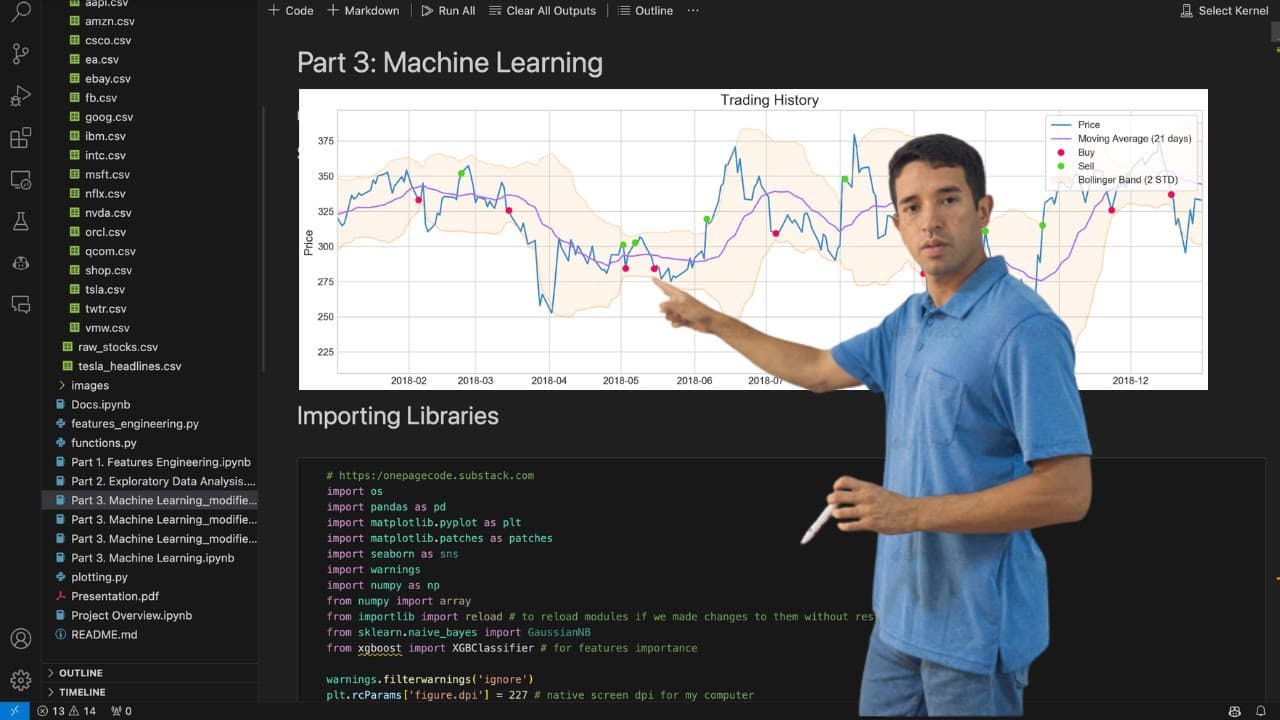
foreign this code Imports various necessary libraries such as OS pandas matplotlib Seabourn warnings numpy and others it filters out warning messages sets that b for the matplotlib plots and import specific modules like gaussian NB from sclerenan's classifier from boost one this code Imports various modules and functions from different libraries fo... Read More
Key Insights
- LSTMs are effective in capturing long-term dependencies in time series data, making them suitable for stock prediction.
- RNNs are useful for sequence prediction tasks, leveraging their ability to process sequential data efficiently.
- Prophet is a model that excels in capturing seasonality and trends in time series data, aiding in stock price forecasting.
- Bayesian optimization can enhance model performance by fine-tuning hyperparameters efficiently.
- Feature importance analysis helps identify the most influential factors in stock prediction models.
- Evaluating model performance using metrics like mean squared error and accuracy score is crucial for validation.
- Combining sentiment analysis with stock data can improve prediction accuracy by incorporating market sentiment.
- Visualizing prediction results aids in understanding model performance and identifying areas for improvement.
Install to Summarize YouTube Videos and Get Transcripts
Explore YouTube Video Summarizer or Get YouTube Transcript Extractor
Questions & Answers
Q: How to choose a machine learning model for stock prediction?
Choosing a machine learning model for stock prediction depends on the data characteristics and prediction goals. LSTMs are ideal for capturing temporal dependencies, RNNs are useful for sequence data, and Prophet is effective for modeling seasonality. Evaluating model performance using metrics like mean squared error and accuracy score can guide the selection process.
Q: What is the role of feature importance in stock prediction?
Feature importance analysis identifies the most influential factors in a stock prediction model, helping to improve model accuracy by focusing on significant predictors. This analysis can guide feature selection and model refinement, ensuring that the model captures critical aspects of the data that drive stock price movements.
Q: Why is Bayesian optimization used in stock prediction models?
Bayesian optimization is used to efficiently tune hyperparameters in stock prediction models, enhancing their performance. It balances exploration and exploitation by using probabilistic models to search the parameter space, leading to more accurate and robust model predictions without exhaustive trial-and-error methods.
Q: How does sentiment analysis improve stock prediction accuracy?
Sentiment analysis improves stock prediction accuracy by incorporating market sentiment into the model. By analyzing news headlines and social media sentiment, models can capture the psychological factors influencing stock prices, providing a more comprehensive view of market dynamics and enhancing prediction reliability.
Q: What are the benefits of using LSTMs for stock prediction?
LSTMs benefit stock prediction by effectively capturing long-term dependencies and patterns in time series data. Their architecture allows them to remember past information over extended periods, making them well-suited for predicting future stock prices based on historical trends and temporal sequences.
Q: How does Prophet model seasonality in stock data?
Prophet models seasonality in stock data by decomposing time series into trend, seasonality, and holiday components. It uses a flexible framework to capture recurring patterns and changes over time, allowing it to predict future stock prices by accounting for seasonal fluctuations and underlying trends.
Q: What is the significance of visualizing model predictions?
Visualizing model predictions is significant as it helps in assessing model performance, identifying patterns, and spotting discrepancies between predicted and actual values. It provides insights into model accuracy, guides improvements, and communicates results effectively to stakeholders, facilitating better decision-making.
Q: How can combining different models enhance stock prediction?
Combining different models can enhance stock prediction by leveraging their complementary strengths. For example, using LSTMs for capturing temporal dependencies and Prophet for seasonal trends can provide a more comprehensive prediction. Ensemble methods can further improve accuracy by aggregating predictions from multiple models.
Summary & Key Takeaways
-
LSTMs, RNNs, and Prophet are among the top machine learning models for predicting stock prices. Each model offers unique advantages: LSTMs capture temporal dependencies, RNNs handle sequences, and Prophet models seasonality.
-
Bayesian optimization is a powerful tool for tuning model hyperparameters, improving stock prediction accuracy. Feature importance analysis further refines model insights, highlighting key predictive factors.
-
Integrating sentiment analysis with stock data enhances prediction models by considering market sentiment. Visualizations of model predictions help in assessing performance and guiding future improvements.
Read in Other Languages (beta)
Share This Summary 📚
Summarize YouTube Videos and Get Video Transcripts with 1-Click
Try YouTube Summary with ChatGPT & Claude or YouTube Transcript Generator