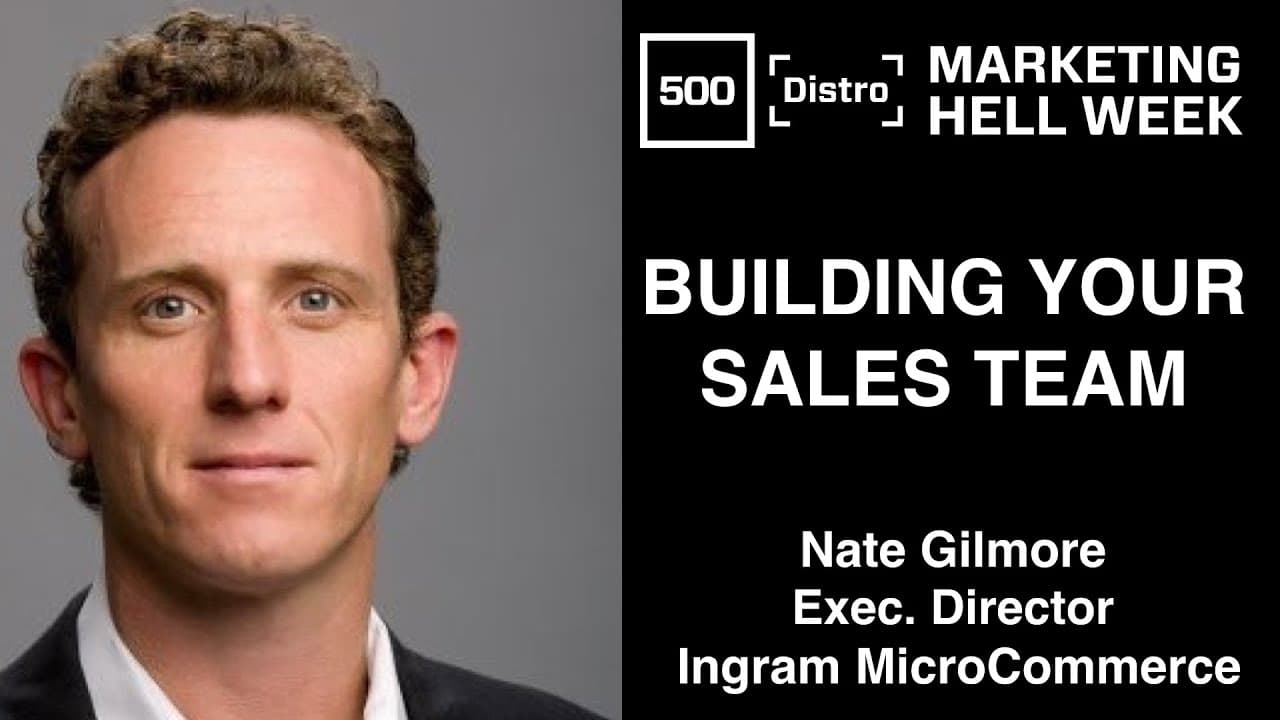
[500Distro] How to Build Your First Sales Team with Nate Gilmore
TL;DR
To build your first sales team, founders should first sell and deploy the product themselves, complete the first five deployments, and turn what works into a repeatable process. Nate Gilmore explains how Shipwire built inbound, outbound, enterprise sales, and account-management functions while using lead generation and opportunity value to guide growth. Read on for practical guidance on hiring, funnels, compensation, and scaling sales operations.
Transcript
so hi everybody they've asked me to come in and talk a little bit about assembling your first sales team and so I should probably just say a little bit about where I am now and why this why I actually experienced all of this stuff Shipwire we started in 2007 we had the audacious plan to compete with Amazon Fulfillment in a low funding environment s... Read More
Key Insights
- 🈂️ Founders should initially take charge of sales to understand the process and ensure product-market fit.
- 🪡 Hiring strategies should align with the company's growth stage and specific needs, such as player coaches or VP of Sales.
- 🥺 Sales teams should focus on lead generation, account management, and customer success to drive revenue growth.
- 🌱 Compensation plans should consider different types of sales growth and be structured to incentivize desired outcomes.
Install to Summarize YouTube Videos and Get Transcripts
Explore YouTube Video Summarizer or Get YouTube Transcript Extractor
Questions & Answers
Q: How should a startup build its first sales team?
Start with a founder personally handling sales and the first five customer deployments. After identifying the sticking points, tools, and repeatable steps, hire people to execute the proven process and later add managers as the operation grows.
Q: Why should founders handle sales before hiring salespeople?
Founders need firsthand experience selling and deploying the product to establish product-market fit and understand where deals get stuck. A salesperson should not be expected to discover the entire process before the founding team has successfully repeated it a few times.
Q: How did Shipwire build its initial sales operation?
For its first eight years, Shipwire did not use cold calling; it built an inbound marketing engine supported by sales-assisted onboarding. Prospects contacted the company or raised their hands on the website, and salespeople guided them through the onboarding process.
Q: How should a founder approach a new sales channel?
The founder should operate the new channel first, whether the company is moving from inbound to outbound, outbound to inbound, or into channel sales. Working through the process directly reveals what can be repeated before a team is hired to scale it.
Q: How did Shipwire scale outbound lead generation?
The team began by finding contacts through LinkedIn, determining email templates, and sending the messages themselves. It then outsourced the repeatable work to contractors at three to four dollars per hour, eventually scaling to about 30 contractors and adding multiple management tiers and KPIs.
Q: What role does lead generation play in sales growth?
Gilmore describes lead generation as a major sales lever because sufficient flow helps smooth out inconsistent conversion results. Shipwire evaluated that flow by total opportunity value rather than simply counting leads.
Q: What sales conversion benchmark did Shipwire use?
Shipwire used a rule that it would close 20% of its total opportunity value in a given quarter. The calculation was based on the dollar value of opportunities and their expected start timing, not merely the number of leads.
Q: How should sales compensation support account growth and renewals?
Compensation should distinguish between net-new sales and organic growth from the existing customer base. For account managers, a lower percentage on base growth can place more incentive on generating new sales.
Summary & Key Takeaways
-
The speaker shares his experience of building a sales team for Shipwire, a global e-commerce business. They focused on inbound marketing and sales-assisted onboarding to drive growth.
-
He emphasizes the importance of product-market fit and recommends founders to take charge of sales initially to understand the process and overcome hurdles.
-
The speaker advises hiring salespeople strategically at different stages, such as player coaches, sales managers, or VP of Sales based on their expertise and the company's needs.
-
He discusses the importance of a well-defined sales funnel, lead generation, account management, and customer success in driving revenue growth.
Read in Other Languages (beta)
Share This Summary 📚
Summarize YouTube Videos and Get Video Transcripts with 1-Click
Try YouTube Summary with ChatGPT & Claude or YouTube Transcript Generator
Explore More Summaries from 500 Global 📚
![[VC Unlocked] The Valuation Game, with UC Berkeley's Adam Sterling thumbnail](/_next/image?url=https%3A%2F%2Fi.ytimg.com%2Fvi%2F05r538Lm4zY%2Fhqdefault.jpg&w=750&q=75)

![[PreMoney SF 2016] What Should VCs Do to Prepare? Aileen Lee and Christine Tsai thumbnail](/_next/image?url=https%3A%2F%2Fi.ytimg.com%2Fvi%2F-9rJ2ty3P3E%2Fhqdefault.jpg&w=750&q=75)
Summarize YouTube Videos and Get Video Transcripts with 1-Click
Try YouTube Summary with ChatGPT & Claude or YouTube Transcript Generator