How the CIA Secretly Spied On Climate Change
TL;DR
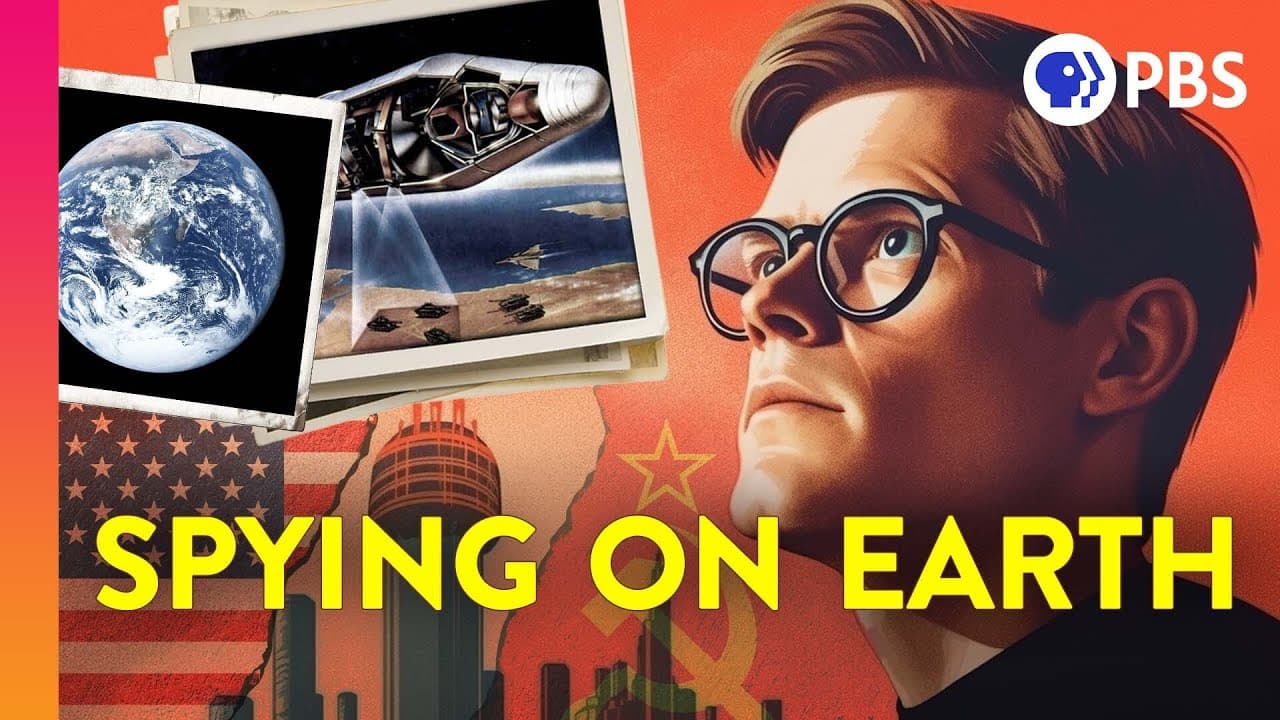
Spy satellites from the Cold War era were repurposed to study climate change and help scientists understand how our planet is changing.
Transcript
- Hey, Smart People! Joe here. In the late 1950s, just about every geopolitical decision on Earth revolved around one question: Would Western democracy or communism become the dominant force across the globe? Cold War tensions between the Soviet Union and the United States were getting increasingly hot. Ideological conflict threatened to spill over... Read More
Key Insights
- 💣 The Cold War tensions between the Soviet Union and the United States in the late 1950s were centered around the question of which ideology, democracy or communism, would dominate globally.
- 🚀 The Soviet Union's technological advancements, such as the development of their own hydrogen bomb and the launching of the first intercontinental ballistic missile (ICBM) and satellite (Sputnik 1), created a sense of fear and urgency in the US government and public.
- ♂️ The US and NATO intelligence agencies relied on the high-altitude U-2 spy plane for gathering information on Soviet activities, but after a U-2 was shot down over the USSR, the CIA and Air Force had to find new ways to gather intelligence.
- 📷 To tackle the challenge of gathering intelligence, the CIA and Air Force embarked on a first-of-its-kind program called CORONA, which involved putting cameras in space to conduct photo reconnaissance of the Soviet Union.
- 🌎 The CORONA spy satellite program, initially top-secret, became instrumental in gathering intelligence for the US during the Cold War. However, it was later repurposed to aid scientific research on climate change and environmental issues.
- 📸 The CORONA program introduced revolutionary technological advancements, such as developing new film and figuring out how to retrieve the film canisters by catching them mid-air with planes, enabling the US to recover valuable imagery.
- 🔎 The MEDEA Program, a collaboration between the CIA and civilian scientists initiated by Vice President Al Gore, utilized declassified CORONA spy satellite images to study climate change and environmental patterns.
- 🌊 The MEDEA Program, with the help of Russian data exchange, contributed to significant findings in understanding environmental change, including the declining thickness of Arctic ice and the impacts of climate change on the polar regions.
Install to Summarize YouTube Videos and Get Transcripts
Explore YouTube Video Summarizer or Get YouTube Transcript Extractor
Questions & Answers
Q: How did the launching of Sputnik 1 by the Soviet Union affect the United States during the Cold War?
The launch of Sputnik 1 created fear and concern in the US, as it signaled Soviet technological advancements and the possibility of nuclear attack, intensifying the Cold War tensions.
Q: How did the CORONA spy satellite program contribute to the space race?
The CORONA program helped the US take the lead in the space race by developing the technology to launch satellites successfully and recover film canisters sent back from orbit, beating the Soviet Union to achieve this milestone.
Q: How did the end of the Cold War lead to a collaboration between the US and Russia in environmental research?
Following the collapse of the Soviet Union, the US and Russia started cooperating on environmental research, using data from Russian submarine operations under the Arctic ice and sharing it with the CIA's MEDEA Program to enhance climate research.
Q: How did the declassification of CORONA images contribute to the understanding of climate change?
The declassification of CORONA images provided a vast amount of historical data, allowing scientists to compare past and present conditions of the Earth, and gain insights into the impacts of climate change, such as shrinking polar ice caps and increasing salinity in the Arctic Sea.
Q: What was the MEDEA Program, and how did it utilize the CORONA images?
The MEDEA Program was a collaboration between the intelligence community and civilian scientists, using declassified CORONA images to study Earth science and climate change. It expanded our understanding of the planet and contributed to various fields, including epidemiology, archaeology, and political science.
Q: Was the CORONA program ever made public during its operation?
No, the CORONA program was kept top-secret during its operation, and the public was unaware of its existence. The government created a cover story, presenting CORONA as a harmless scientific research program named Discoverer, to conceal its true purpose of spying on the Soviet Union.
Q: Is the cooperation between intelligence agencies and civilian scientists still ongoing today?
Although the MEDEA Program ended in 2001, its legacy continues through the Global Fiducials Program, where the CIA shares classified technology and data with Earth scientists. This ongoing collaboration aims to provide crucial information for understanding and addressing current environmental challenges.
Summary & Key Takeaways
-
During the Cold War, the United States feared Soviet superiority in technology and military capabilities, which led to the development of spy satellites, including the CORONA program.
-
CORONA was a top-secret initiative that used satellites equipped with cameras to gather intelligence on the Soviet Union, but the classified images turned out to be immensely valuable for studying climate change and environmental issues.
-
Decades later, the images were declassified and shared with a team of scientists, who formed the MEDEA Program to analyze the data and gain insights into the Earth's changing environment.
Read in Other Languages (beta)
Share This Summary 📚
Summarize YouTube Videos and Get Video Transcripts with 1-Click
Try YouTube Summary with ChatGPT & Claude or YouTube Transcript Generator
Explore More Summaries from Be Smart 📚


Summarize YouTube Videos and Get Video Transcripts with 1-Click
Try YouTube Summary with ChatGPT & Claude or YouTube Transcript Generator