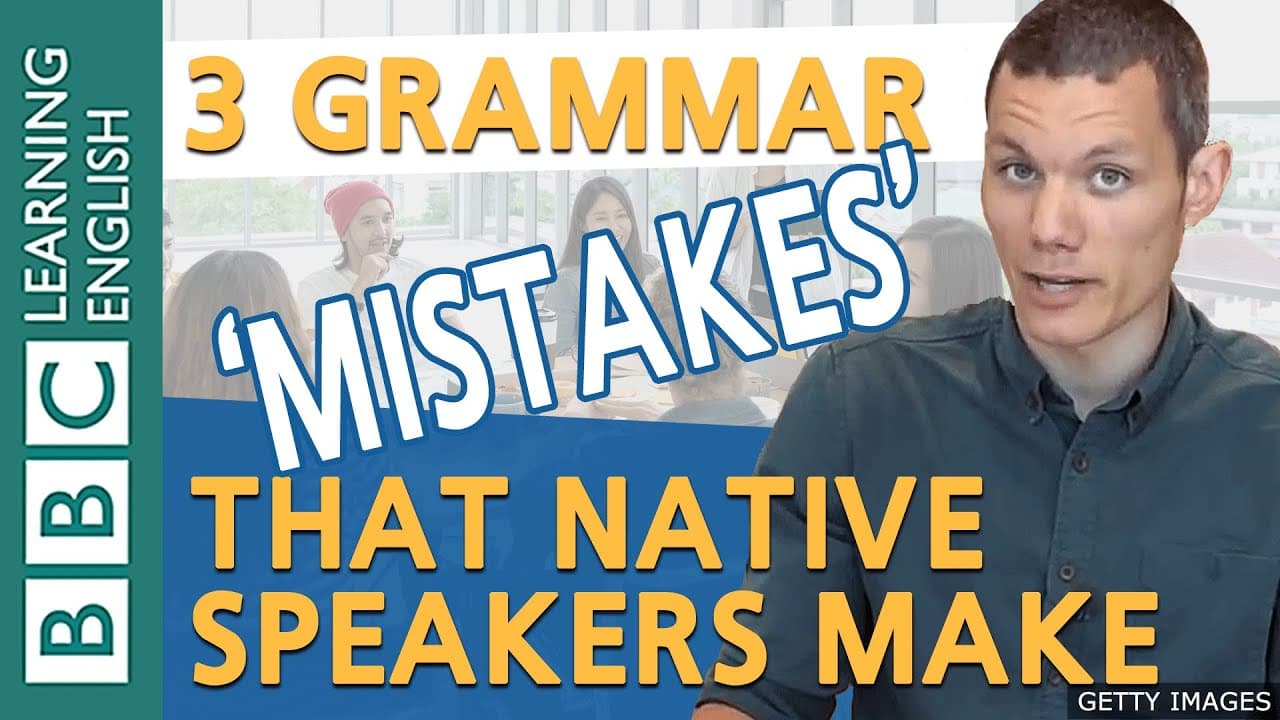
What Common Grammar Mistakes Do Native Speakers Make?
TL;DR
Native English speakers frequently make grammatical errors, such as using 'me' instead of 'I' and misusing past participles. These mistakes are often acceptable in informal speech, highlighting the difference between standard grammar rules and everyday conversation. Emphasizing clarity is key, as spoken communication tends to prioritize understanding over strict adherence to grammar.
Transcript
Hi guys. Dan for BBC Learning English here. In this Masterclass we'll be taking a look at 'mistakes' that native speakers commonly make. Are you ready? Here we go. Behold native speakers in their natural environment. Observe how they interact verbally - filled with deep and meaningful communication. They are social, verbose, articulate and always ... Read More
Key Insights
- Native English speakers often make grammar mistakes, which are sometimes acceptable due to regional variations, formality, and personal preference.
- Using past participles incorrectly is a common mistake, often replacing past simple verbs or omitting 'have' for present perfect tense.
- The misuse of 'me' instead of 'I' is prevalent, as 'me' is an object pronoun but often wrongly used as a subject pronoun.
- Splitting infinitives by inserting adverbs between 'to' and the verb is a debated grammatical issue, often corrected by repositioning the adverb.
- Spoken English tends to be more informal and flexible than written English, prioritizing clear communication over strict grammar adherence.
- The distinction between past simple and present perfect is crucial: past simple is for completed actions, while present perfect connects past actions to the present.
- Pronoun order is important in English, with 'I' typically placed after other subjects to maintain politeness and grammatical correctness.
- Grammar rules in English do not always account for informal spoken language, where clarity and understanding are more important than perfection.
Install to Summarize YouTube Videos and Get Transcripts
Explore YouTube Video Summarizer or Get YouTube Transcript Extractor
Questions & Answers
Q: What is a common mistake involving past participles?
A common mistake is using past participles as past simple verbs or omitting 'have' in present perfect constructions. For example, saying 'I done it' instead of 'I did it' or 'I have done it.' This error occurs when the past participle is used incorrectly to denote completed actions.
Q: Why is using 'me' instead of 'I' incorrect?
Using 'me' instead of 'I' is incorrect because 'me' is an object pronoun, not a subject pronoun. In sentences like 'Me and John went to the shops,' 'me' should be replaced with 'I' since the pronoun is part of the subject. Additionally, English etiquette suggests placing 'I' after other subjects.
Q: What is the issue with splitting infinitives?
Splitting infinitives involves placing an adverb between 'to' and the verb, such as in 'to quickly stop.' While some argue against splitting infinitives, others accept it in informal speech. The recommended correction is to place the adverb before or after the verb, maintaining the traditional 'to + verb' structure.
Q: How does spoken English differ from written English?
Spoken English is typically more informal and flexible than written English, prioritizing clarity and understanding over strict adherence to grammar rules. In conversation, regional variations and personal preferences often influence language use, allowing for deviations from standard grammar that would be less acceptable in formal writing.
Q: What is the importance of pronoun order in English?
Pronoun order in English is important for both grammatical correctness and politeness. In sentences with multiple subjects, 'I' should follow other subjects, as in 'John and I went to the store,' rather than 'Me and John.' This order respects the convention of not placing oneself before others in speech.
Q: Why are native speakers' mistakes considered acceptable?
Native speakers' mistakes are often considered acceptable due to the fluid nature of spoken language, where regional dialects, informal contexts, and personal preferences can override strict grammar rules. These variations reflect the dynamic and evolving use of English, emphasizing communication over perfection.
Q: How should learners approach grammar mistakes by native speakers?
Learners should approach grammar mistakes by native speakers with an understanding of context and flexibility in language use. Recognizing that spoken English often deviates from standard rules helps learners adapt to real-world communication, focusing on clarity and comprehension rather than rigid correctness.
Q: What is the main takeaway from the BBC English Masterclass?
The main takeaway from the BBC English Masterclass is that while grammar rules provide a framework for language use, effective communication often requires flexibility. Native speakers' mistakes illustrate the importance of understanding context and prioritizing clarity, showing that even imperfect language can be effective.
Summary & Key Takeaways
-
Native English speakers often make grammar mistakes, such as using past participles incorrectly or misplacing pronouns. These errors are considered mistakes by standard English rules but are common in informal speech. Understanding these nuances helps learners navigate real-world English usage.
-
Common mistakes include using 'me' instead of 'I' as a subject, and splitting infinitives by inserting adverbs. While these are technically incorrect, they frequently occur in spoken English, highlighting the difference between formal grammar rules and everyday language.
-
The BBC English Masterclass emphasizes that spoken communication should prioritize clarity over strict grammar adherence. Native speakers' mistakes illustrate the flexibility of English, where regional variations and personal preferences often override standard rules.
Read in Other Languages (beta)
Share This Summary 📚
Summarize YouTube Videos and Get Video Transcripts with 1-Click
Try YouTube Summary with ChatGPT & Claude or YouTube Transcript Generator
Explore More Summaries from BBC Learning English 📚
Summarize YouTube Videos and Get Video Transcripts with 1-Click
Try YouTube Summary with ChatGPT & Claude or YouTube Transcript Generator