What Are Causal and Reliabilist Knowledge Theories?
TL;DR
Alvin Goldman's causal theory of knowledge suggests that knowledge is a belief caused by the fact itself. However, it faces challenges like the fake barn scenario, leading Goldman to develop reliabilism, which emphasizes reliable belief-forming processes. Reliabilism addresses issues with causal theory but introduces new problems like the generality and lottery problems.
Transcript
my name is Jenifer Nagel I teach philosophy at the University of Toronto and today I want to talk to you about analyzing knowledge this video looks at causal and reliabilist theories of knowledge the causal theory of knowledge was proposed in 1967 by a philosopher named Alvin Goldman Goldman was convinced by gar that the Justified true belief analy... Read More
Key Insights
- Alvin Goldman's causal theory of knowledge posits that knowledge is a belief caused by the fact itself.
- The causal theory struggles with Gettier cases, where justified true beliefs lack knowledge due to causal disconnects.
- Goldman dropped the justification condition from the classical Justified True Belief (JTB) analysis in favor of causal connections.
- Reliabilism emerged from problems with the causal theory, focusing on reliable belief-forming processes.
- The fake barn scenario illustrates a key issue with the causal theory, where reliable processes fail in deceptive environments.
- Reliabilism's generality problem involves identifying the right belief-forming mechanism to determine reliability.
- The lottery problem questions whether high reliability alone can constitute knowledge in uncertain situations.
- Reliabilism's intuitions are debated, with differing opinions on whether scenarios like the fake barn provide knowledge.
Install to Summarize YouTube Videos and Get Transcripts
Explore YouTube Video Summarizer or Get YouTube Transcript Extractor
Questions & Answers
Q: What is Alvin Goldman's causal theory of knowledge?
Alvin Goldman's causal theory of knowledge proposes that knowing a fact involves having a belief caused by the fact itself. This means that for a belief to constitute knowledge, there must be an appropriate causal connection between the fact and the belief. However, this theory faces challenges, such as Gettier cases, where justified true beliefs may lack knowledge due to causal disconnects.
Q: Why did Goldman develop reliabilism?
Goldman developed reliabilism in response to problems with the causal theory of knowledge, particularly illustrated by the fake barn scenario. In this scenario, reliable belief-forming processes fail due to environmental deception. Reliabilism focuses on the reliability of belief-forming processes, emphasizing that a belief is knowledge if it is formed through a reliable process, even if it lacks traditional justification.
Q: What is the fake barn scenario?
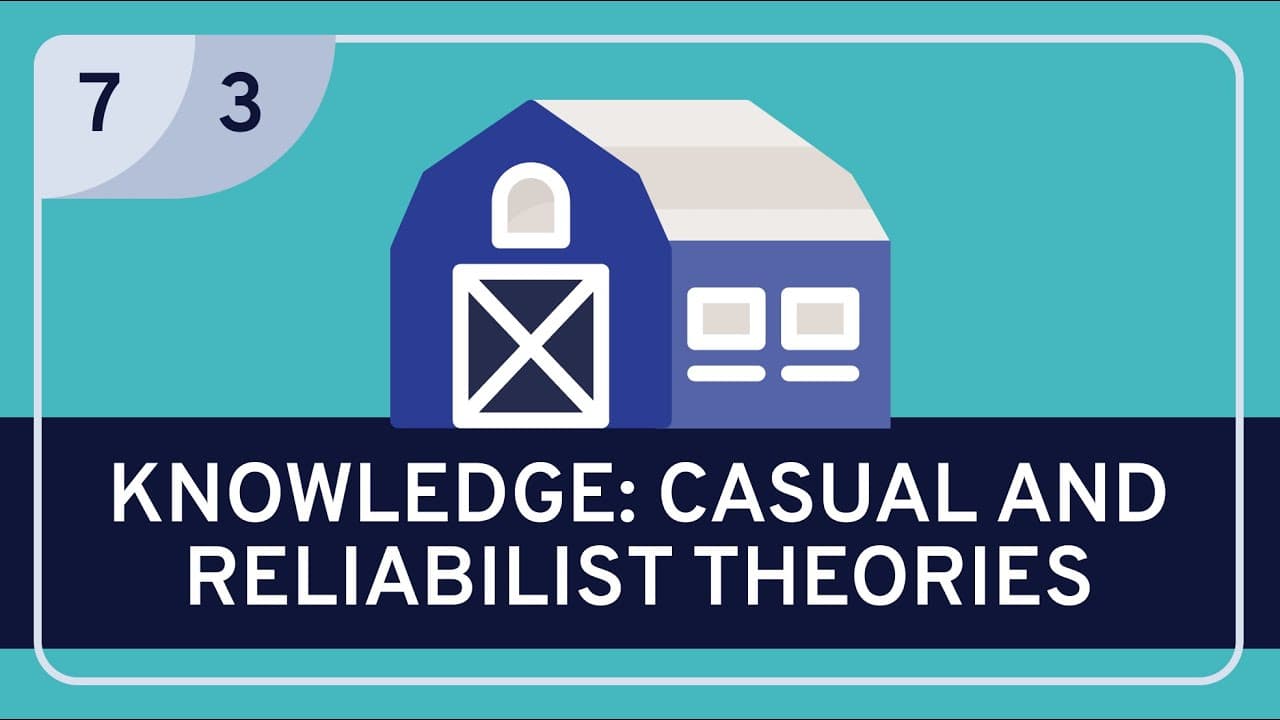
The fake barn scenario involves a person driving through an area with fake barn facades, which look like real barns but are not. When the person sees a real barn, they form a belief that it's a barn. However, due to the deceptive environment, the belief-forming process is unreliable, challenging the idea that the person truly knows it's a barn, despite the causal connection.
Q: What is the generality problem in reliabilism?
The generality problem in reliabilism involves identifying the correct belief-forming mechanism to determine if a belief is reliable. It questions how general or specific the mechanism should be. For instance, in the fake barn scenario, whether to consider the mechanism as general sensory perception or specific barn recognition affects the assessment of reliability and knowledge.
Q: What is the lottery problem in the context of reliabilism?
The lottery problem questions whether high reliability is sufficient for knowledge. In a lottery with millions of tickets, one might believe their ticket has lost due to the long odds, which is highly reliable. However, until the winning ticket is announced, it challenges the notion of knowledge, as the belief lacks certainty despite its reliability, posing a problem for reliabilism.
Q: How does reliabilism differ from the classical Justified True Belief (JTB) analysis?
Reliabilism differs from the classical Justified True Belief (JTB) analysis by removing the justification condition and emphasizing reliable belief-forming processes. While JTB requires a belief to be justified, true, and believed, reliabilism focuses on the reliability of the process that forms the belief, allowing for knowledge without traditional justification, addressing issues seen in Gettier cases.
Q: What are some criticisms of reliabilism?
Criticisms of reliabilism include its handling of the generality problem, where identifying the right belief-forming mechanism is challenging. The lottery problem raises doubts about high reliability equating to knowledge. Additionally, the intuitions behind reliabilism are debated, with differing opinions on whether scenarios like the fake barn provide true knowledge, highlighting complexities in defining knowledge.
Q: Why are intuitions about reliabilism controversial?
Intuitions about reliabilism are controversial because people have differing opinions on whether certain scenarios, like the fake barn, constitute knowledge. Some argue that reliable processes don't always lead to knowledge, while others believe they do. This debate reflects varying interpretations of reliability and the complexities involved in defining what constitutes knowledge, revealing the subjective nature of epistemological theories.
Summary & Key Takeaways
-
Alvin Goldman's causal theory of knowledge suggests that knowing a fact requires a belief caused by that fact. However, this theory faces challenges, such as the fake barn scenario, where reliable processes fail due to environmental deception. This led Goldman to develop reliabilism, which focuses on reliable belief-forming processes rather than justification.
-
Reliabilism addresses issues with the causal theory by emphasizing the reliability of belief-forming processes. However, it introduces new challenges, such as the generality problem, which involves identifying the appropriate mechanism for determining reliability, and the lottery problem, questioning if high reliability alone can constitute knowledge.
-
The intuitions behind reliabilism are debated, with differing opinions on scenarios like the fake barn. Some argue that reliable processes don't always lead to knowledge, while others believe they do. This debate highlights the complexities of defining knowledge and the need for further exploration of epistemological theories.
Read in Other Languages (beta)
Share This Summary 📚
Summarize YouTube Videos and Get Video Transcripts with 1-Click
Try YouTube Summary with ChatGPT & Claude or YouTube Transcript Generator
Explore More Summaries from Wireless Philosophy 📚
Summarize YouTube Videos and Get Video Transcripts with 1-Click
Try YouTube Summary with ChatGPT & Claude or YouTube Transcript Generator