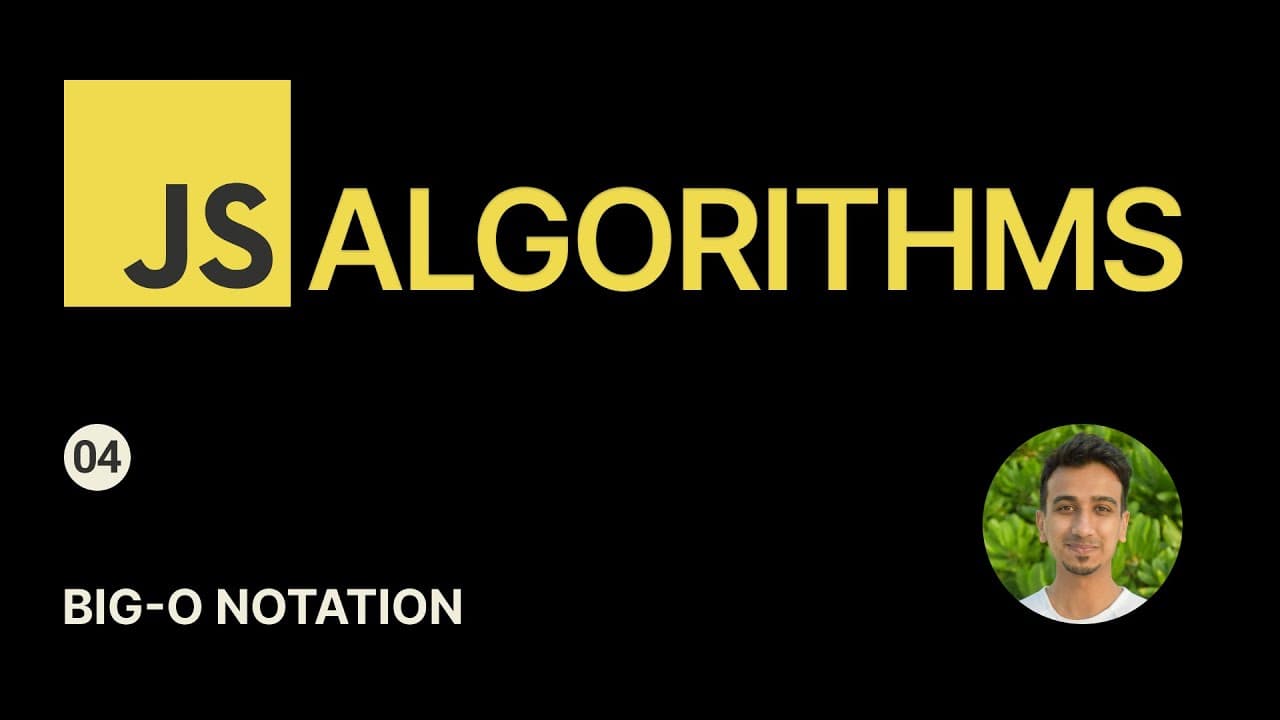
JavaScript Algorithms - 4 - Big-O Notation
TL;DR
Big O notation describes the complexity of an algorithm based on the input size, focusing on the bigger picture without getting caught up in minor details.
Transcript
in the previous video i mentioned that the worst case complexity of an algorithm is represented using the big o notation but what exactly is big o notation let's understand in this video if i have to explain in very simple terms big o notation describes the complexity of an algorithm using algebraic terms the big notation has two important characte... Read More
Key Insights
- 🧩 Big O notation describes the complexity of an algorithm using algebraic terms. It focuses on the input size and the bigger picture without getting caught up in minor details.
- 🕑 Time complexity is calculated by counting the number of times each statement is executed based on the input size. The time complexity of the program to find the sum of first n natural numbers is O(n).
- 🔄 Time complexity calculations can be simplified by considering loops, which typically have at least linear time complexity.
- 💾 Space complexity is constant if the algorithm does not need extra memory or if the memory needed does not depend on the input size.
- 📉 The performance of an algorithm is affected by the input size. Time complexities such as O(log n) and O(1) are good, while O(2^n) and O(n!) are bad and should be avoided.
- 🔍 It is important to understand that there are multiple algorithms for the same problem and there is no one right solution. Different algorithms work well under different constraints.
- 💡 When writing code, prioritize code readability and maintainability over clever optimizations, unless optimizing the code is necessary for high-frequency function calls. ⏩ Understanding the time and space complexity, as well as the big O notation, is fundamental to learning algorithms and solving problems efficiently.
Install to Summarize YouTube Videos and Get Transcripts
Explore YouTube Video Summarizer or Get YouTube Transcript Extractor
Questions & Answers
Q: What does Big O notation represent in the context of algorithm complexity?
Big O notation represents the complexity of an algorithm in terms of its input size, focusing on the bigger picture without getting caught up in minor details. It allows us to understand how the algorithm performs as the input size increases.
Q: How can we calculate the time complexity of an algorithm based on Big O notation?
The time complexity can be calculated by analyzing the number of times statements or loops are executed based on the input size. By counting the statements or loops, we can determine the worst-case time complexity of the algorithm using Big O notation.
Q: Why is it important to understand the time and space complexity of an algorithm?
Understanding the time and space complexity of an algorithm helps in evaluating its efficiency and performance. It allows developers to analyze and compare different solutions for the same problem and make informed decisions about the optimal approach.
Q: Can Big O notation be used to determine the space complexity of an algorithm?
Yes, Big O notation can also be used to determine the space complexity of an algorithm. The space complexity refers to the amount of memory or auxiliary space required by an algorithm as the input size increases. By analyzing the space usage, we can determine the efficiency of an algorithm using Big O notation.
Q: What are the common time complexity categories represented by Big O notation?
Common time complexity categories represented by Big O notation include constant time complexity (O(1)), logarithmic time complexity (O(log n)), linear time complexity (O(n)), quadratic time complexity (O(n^2)), and exponential time complexity (O(2^n)). These categories help in understanding how an algorithm's performance scales with the input size.
Q: Can algorithms with different time complexities solve the same problem effectively?
Yes, multiple algorithms can solve the same problem effectively, but they may have different time complexities. The choice of algorithm depends on the specific constraints and requirements of the problem. It is important to understand the problem statement before determining the most suitable algorithm.
Q: What factors should be considered when writing code to optimize performance?
When writing code to optimize performance, consider factors such as the frequency of function calls, readability, and maintainability. While optimization is important for frequently executed functions, it is also crucial to write code that is easy to understand and maintain in the long run.
Summary & Key Takeaways
-
Big O notation describes algorithm complexity using algebraic terms that focus on input size and the bigger picture.
-
Time complexity can be determined by counting the number of times statements are executed based on the input size.
-
The worst case time complexity of an algorithm can be represented as Big O notation, such as O(n) for linear time complexity.
Read in Other Languages (beta)
Share This Summary 📚
Summarize YouTube Videos and Get Video Transcripts with 1-Click
Try YouTube Summary with ChatGPT & Claude or YouTube Transcript Generator
Explore More Summaries from Codevolution 📚



Summarize YouTube Videos and Get Video Transcripts with 1-Click
Try YouTube Summary with ChatGPT & Claude or YouTube Transcript Generator