What Are the 9 Major Animal Phyla?
TL;DR
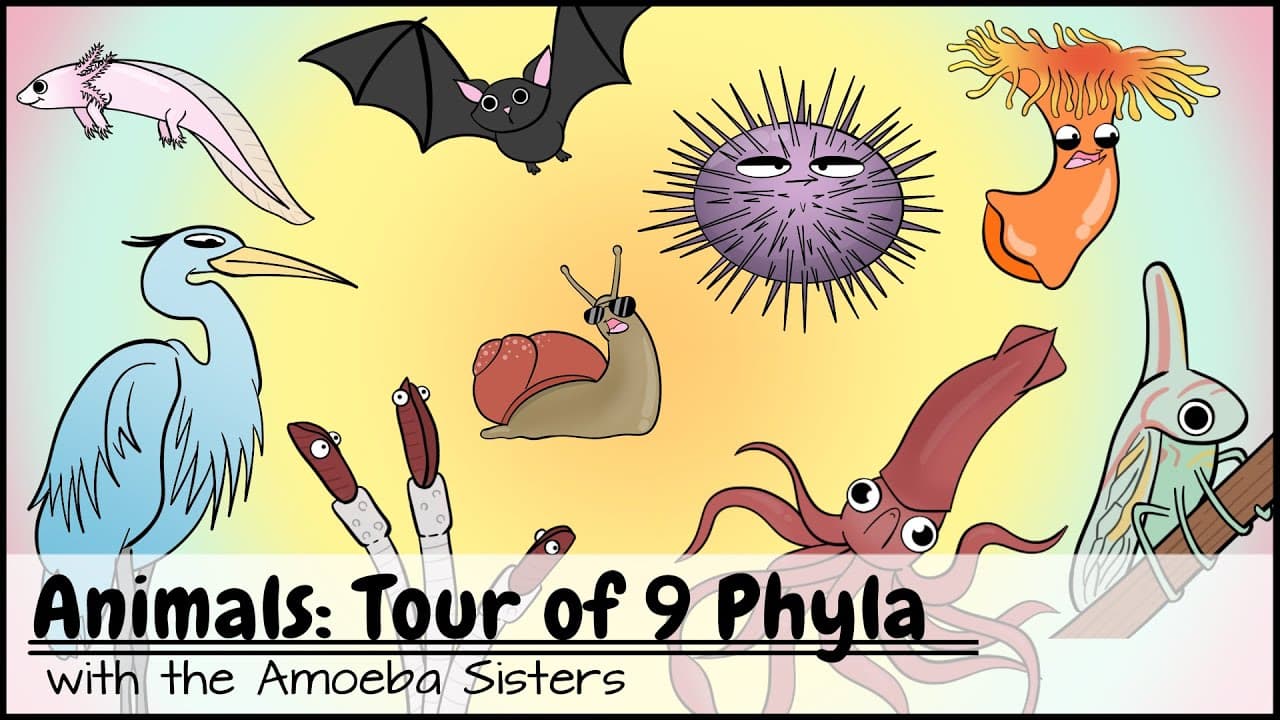
Animals are multicellular, eukaryotic, heterotrophic organisms with specialized cells. They can be classified into 9 major phyla based on characteristics like symmetry, cephalization, and coelom presence. The video explores these phyla, highlighting unique features and differences, such as protostome and deuterostome development, and the presence or absence of a notochord in Chordata.
Transcript
The summer before I was going to take biology in high school, I thought most of biology would be about animals. Or, at least, a pretty big portion of it. Imagine my surprise when biology turned out to be a lot more than animals, and we actually didn’t get to animals until close to the end of the year. I’ve found that to be pretty typical. In fac... Read More
Key Insights
- Animals are multicellular organisms made of eukaryotic cells.
- Animals are heterotrophs, meaning they must consume food.
- Symmetry in animals can be radial or bilateral.
- Cephalization refers to the concentration of nervous tissue in a head region.
- Protostomes and deuterostomes differ in embryonic development.
- A coelom is a fluid-filled body cavity derived from the mesoderm.
- Phylum Porifera includes sponges, which lack true tissues.
- Chordata includes vertebrates, defined by the presence of a notochord.
Install to Summarize YouTube Videos and Get Transcripts
Explore YouTube Video Summarizer or Get YouTube Transcript Extractor
Questions & Answers
Q: What characteristics define an animal?
Animals are defined by being multicellular, having eukaryotic cells, and being heterotrophic, meaning they consume organic material for nutrition. They possess specialized cells for different functions, and most have a nervous system and the ability to move at some point in their life cycle. These characteristics distinguish them from other life forms like plants and fungi.
Q: How are animals classified into phyla?
Animals are classified into phyla based on shared characteristics such as body symmetry, presence of a coelom, type of embryonic development (protostome or deuterostome), and other anatomical and physiological traits. This classification helps in understanding evolutionary relationships and functional adaptations among different animal groups.
Q: What is the significance of symmetry in animals?
Symmetry in animals is significant as it influences their movement and interaction with the environment. Radial symmetry, found in organisms like jellyfish, allows them to interact with the environment from multiple directions. Bilateral symmetry, seen in humans and many other animals, facilitates directional movement and the development of a head region with concentrated sensory and nervous tissues.
Q: What is cephalization and why is it important?
Cephalization is the evolutionary trend of concentrating sensory organs and nervous tissues at the anterior end of the organism, forming a head region. This arrangement is important as it enhances an animal's ability to sense and respond to environmental stimuli, improving its chances of survival by enabling better navigation, food acquisition, and predator avoidance.
Q: How do protostomes and deuterostomes differ?
Protostomes and deuterostomes differ primarily in their embryonic development. In protostomes, the first embryonic opening (blastopore) becomes the mouth, while in deuterostomes, it becomes the anus. This distinction also correlates with differences in cell fate, cleavage patterns, and coelom formation during early development, leading to diverse evolutionary lineages.
Q: What is a coelom and its function?
A coelom is a fluid-filled body cavity derived from the mesoderm that provides space for the development and suspension of internal organs. It acts as a cushion, protecting organs from shock and allowing for independent movement and growth. The coelom also facilitates the transport of nutrients and waste products within the body, contributing to an organism's overall functionality.
Q: What are the characteristics of Phylum Porifera?
Phylum Porifera, commonly known as sponges, are simple aquatic animals characterized by a porous body and lack of true tissues and organs. They primarily perform intracellular digestion and have no gut opening. Most sponges are sessile as adults and lack symmetry, although some can exhibit radial symmetry. They play essential roles in aquatic ecosystems by filtering water and providing habitats.
Q: What defines Phylum Chordata?
Phylum Chordata is defined by the presence of a notochord, a flexible rod-like structure present during some stage of development, which often gets replaced by a vertebral column in vertebrates. Chordates also exhibit a dorsal nerve cord, pharyngeal slits, a postanal tail, and a thyroid or endostyle gland. This phylum includes vertebrates like mammals, birds, reptiles, and some invertebrates such as lancelets.
Summary & Key Takeaways
-
Animals are complex organisms with various characteristics such as multicellularity, heterotrophy, and specialized cells. They are classified into 9 major phyla based on features like symmetry and cephalization. The video provides an overview of these phyla, highlighting unique traits and developmental differences, such as protostome and deuterostome distinctions.
-
Symmetry is an important characteristic in animal classification, with radial symmetry allowing response from multiple directions and bilateral symmetry aiding in forward movement. Cephalization, the concentration of sensory organs and nervous tissue in a head region, provides advantages in environmental interaction.
-
The presence of a coelom, a fluid-filled cavity, is another classification factor. Protostomes have their first embryonic opening develop into the mouth, while in deuterostomes, it becomes the anus. Chordata, the phylum containing vertebrates, is defined by the presence of a notochord, a key structural feature.
Read in Other Languages (beta)
Share This Summary 📚
Summarize YouTube Videos and Get Video Transcripts with 1-Click
Try YouTube Summary with ChatGPT & Claude or YouTube Transcript Generator
Explore More Summaries from Amoeba Sisters 📚
Summarize YouTube Videos and Get Video Transcripts with 1-Click
Try YouTube Summary with ChatGPT & Claude or YouTube Transcript Generator