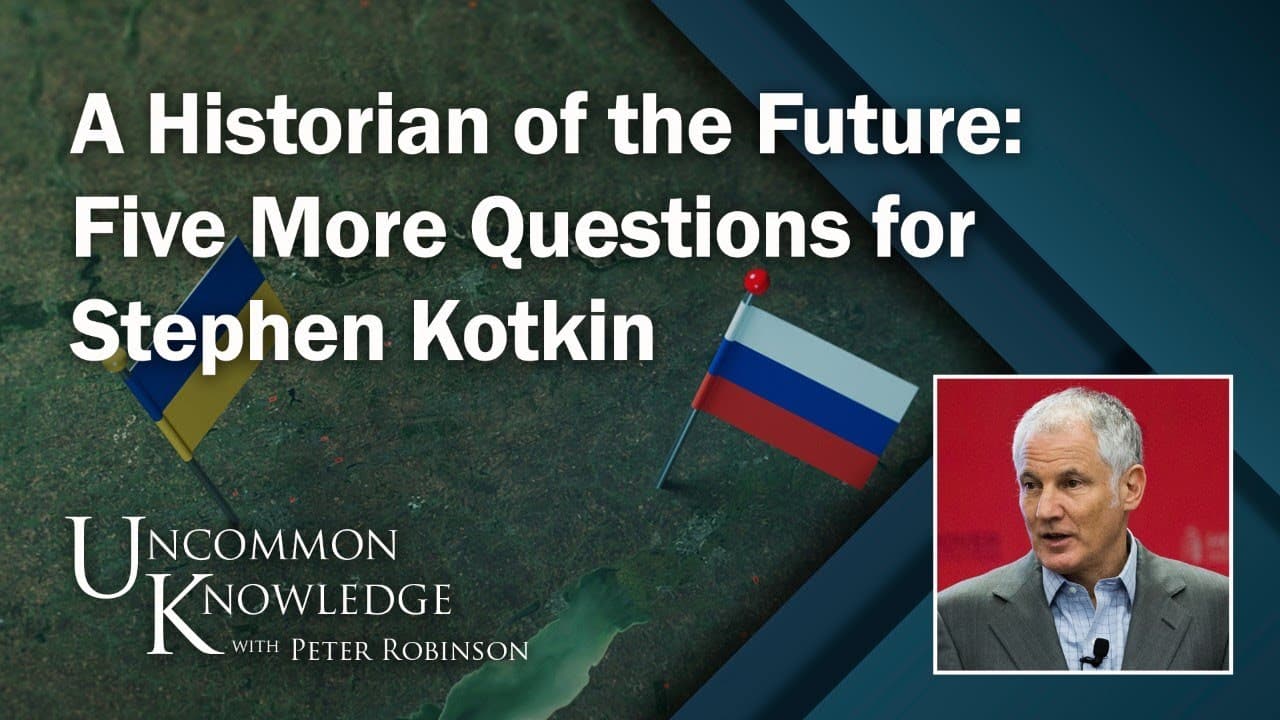
A Historian of the Future: Five More Questions for Stephen Kotkin
TL;DR
Stephen Kotkin discusses history's relevance to current global issues.
Transcript
the study of history may be fascinating it may even be ennobling but does it do any good can history tell us how we need to conduct ourselves today five more questions for historian Stephen cotkin uncommon knowledge now welcome to uncommon knowledge I'm Peter Robinson Stephen Cochin grew up in New York City received his undergraduate degree from th... Read More
Key Insights
- Stephen Kotkin emphasizes the importance of understanding history to navigate current global conflicts, particularly in Ukraine and Taiwan.
- The war in Ukraine is described as a war of attrition, with both sides enduring significant losses and the West needing to reassess its military production capabilities.
- Kotkin argues that the U.S. should focus on strengthening alliances and maintaining global stability, rather than pursuing aggressive military interventions.
- The discussion highlights the complexity of the China-Taiwan situation, with Kotkin suggesting that the status quo benefits the U.S. and should be maintained.
- Kotkin critiques the current state of historical education, urging educators to make history engaging and relevant to students.
- The interview addresses the impact of technology on public knowledge and understanding, with Kotkin noting the dangers of misinformation and the need for critical thinking.
- Kotkin reflects on the adaptability and resilience of democratic systems in the face of technological and geopolitical challenges.
- The conversation touches on the legacy of historical figures like George Kennan and Henry Kissinger, examining their influence on contemporary foreign policy.
Install to Summarize YouTube Videos and Get Transcripts
Explore YouTube Video Summarizer or Get YouTube Transcript Extractor
Questions & Answers
Q: What is Stephen Kotkin's view on the war in Ukraine?
Stephen Kotkin describes the war in Ukraine as a war of attrition, where both sides are enduring significant losses. He emphasizes the need for the West to reassess its military production capabilities and to define victory in realistic terms. Kotkin argues for a diplomatic solution that includes Ukraine's accession to the EU and a security guarantee.
Q: How does Kotkin view the China-Taiwan situation?
Kotkin suggests that the status quo between China and Taiwan benefits the United States and should be maintained. He argues that if China were to take Taiwan militarily, it would destroy the island's economic and strategic value. Therefore, maintaining the current situation, where Taiwan operates independently without declaring formal independence, is advantageous.
Q: What does Kotkin say about the current state of historical education?
Kotkin criticizes the current state of historical education, urging educators to make history engaging and relevant to students. He believes that educators should focus on teaching history that is consequential and helps students understand the complexities of the world, rather than blaming students for their lack of historical knowledge.
Q: How does Kotkin address the impact of technology on public knowledge?
Kotkin acknowledges the challenges posed by technology and misinformation but remains optimistic about the adaptability and resilience of democratic systems. He emphasizes the importance of critical thinking and warns against the dangers of relying on junk history, which can be as harmful as ignorance of history.
Q: What lessons does Kotkin draw from historical figures like George Kennan and Henry Kissinger?
Kotkin reflects on the influence of historical figures like George Kennan and Henry Kissinger on contemporary foreign policy. He notes that while they made significant contributions, their legacies are complex and should be critically examined. Kotkin highlights the importance of understanding history to navigate current global challenges.
Q: What is Kotkin's perspective on the adaptability of democratic systems?
Kotkin is optimistic about the adaptability and resilience of democratic systems in the face of technological and geopolitical challenges. He compares past technological shifts, such as the advent of radio and television, to the current digital age, suggesting that democracy can adapt and thrive despite these challenges.
Q: How does Kotkin view the role of the United States in the 21st century?
Kotkin believes that the United States can continue to play a leading role in the 21st century by understanding its strengths and maintaining strong alliances. He emphasizes the importance of leveraging American power and values to promote global stability and prosperity, while acknowledging the challenges posed by rising powers like China.
Q: What is Kotkin's take on the potential for future American leadership?
Kotkin is optimistic about the potential for future American leadership, provided that the U.S. understands its strengths and continues to cultivate its alliances. He stresses the importance of recognizing what makes the U.S. powerful, including its democratic values and adaptability, and using these strengths to navigate global challenges.
Summary & Key Takeaways
-
Stephen Kotkin discusses the lessons history can offer for understanding current global conflicts, particularly in Ukraine and Taiwan. He emphasizes the importance of historical knowledge in navigating geopolitical challenges.
-
Kotkin critiques the current state of historical education, advocating for engaging teaching methods to instill a lifelong appreciation for history in students. He also addresses the impact of technology on public understanding.
-
The conversation covers the adaptability of democratic systems in the face of technological and geopolitical challenges, with Kotkin reflecting on the legacy of historical figures like George Kennan and Henry Kissinger.
Read in Other Languages (beta)
Share This Summary 📚
Summarize YouTube Videos and Get Video Transcripts with 1-Click
Try YouTube Summary with ChatGPT & Claude or YouTube Transcript Generator
Explore More Summaries from Hoover Institution 📚
Summarize YouTube Videos and Get Video Transcripts with 1-Click
Try YouTube Summary with ChatGPT & Claude or YouTube Transcript Generator