What Are the Key Mathematical Constants?
TL;DR
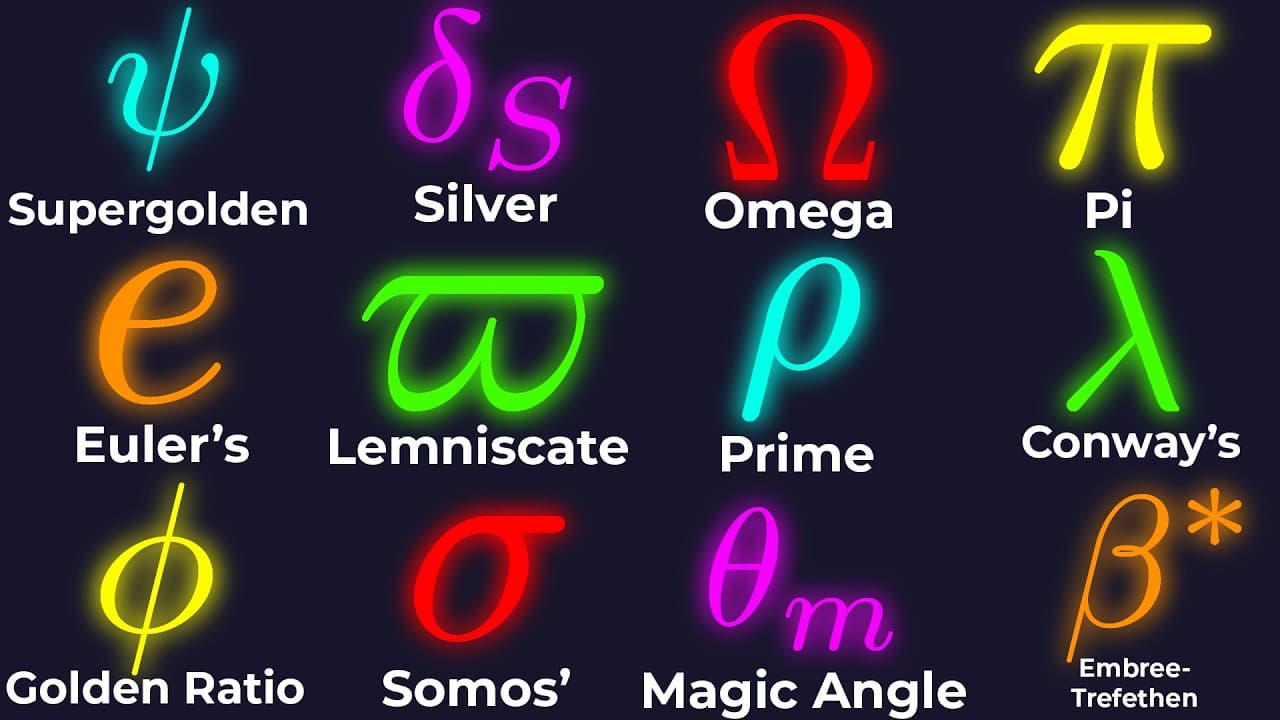
Mathematical constants are key figures in mathematics that have fixed values and often appear in various mathematical equations and contexts. Examples include Pi, Euler’s number, and the golden ratio. Each constant has unique properties and applications, such as defining geometric shapes, solving equations, or representing growth patterns.
Transcript
Pi represents the ratio of a circle’s circumference to its diameter. It is approximately equal to 3.14. Tau represents the ratio of a circle’s circumference to its radius, which is equal to 2π. Euler’s number is another important constant, appearing in many contexts. It is approximately equal to 2.718 and can be defined using this limit or this... Read More
Key Insights
- Pi is the ratio of a circle's circumference to its diameter, approximately 3.14.
- Euler’s number, approximately 2.718, is crucial in exponential growth calculations.
- The golden ratio, around 1.618, appears in art, architecture, and nature.
- The Fibonacci sequence leads to the golden ratio through its consecutive terms.
- The Reciprocal Fibonacci constant, approximately 3.35, arises from summing reciprocals of Fibonacci numbers.
- The Tribonacci constant, around 1.839, emerges from the Tribonacci sequence, a variation of the Fibonacci sequence.
- Viswanath's constant, approximately 1.13, describes the average growth rate of the Random Fibonacci sequence.
- The Pythagoras constant, the square root of 2, is the diagonal of a unit square.
Install to Summarize YouTube Videos and Get Transcripts
Explore YouTube Video Summarizer or Get YouTube Transcript Extractor
Questions & Answers
Q: How is Pi defined in mathematics?
Pi is a mathematical constant representing the ratio of a circle's circumference to its diameter. It is approximately equal to 3.14 and is crucial in geometry, particularly in calculations involving circles. Pi is an irrational number, meaning it cannot be expressed as a simple fraction, and its decimal representation is non-repeating and infinite.
Q: What is Euler's number and its significance?
Euler's number, denoted as e, is approximately 2.718 and is the base of natural logarithms. It is significant in mathematics due to its role in exponential growth and decay processes, compound interest calculations, and its appearance in various mathematical equations, including Euler's identity. Euler's number is an irrational number, with a non-terminating, non-repeating decimal expansion.
Q: What is the golden ratio and where does it appear?
The golden ratio, approximately 1.618, is a mathematical constant that appears in various domains, including art, architecture, and nature. It is defined as the ratio where the sum of two quantities is to the larger quantity as the larger is to the smaller. The golden ratio is associated with aesthetically pleasing proportions and can be observed in the patterns of leaves, flowers, and even galaxies.
Q: How does the Fibonacci sequence relate to the golden ratio?
The Fibonacci sequence is a series of numbers where each number is the sum of the two preceding ones, starting from 0 and 1. As the sequence progresses, the ratio of consecutive Fibonacci numbers converges to the golden ratio, approximately 1.618. This relationship illustrates the occurrence of the golden ratio in natural growth patterns and self-similar structures.
Q: What is the Reciprocal Fibonacci constant?
The Reciprocal Fibonacci constant is the sum of the reciprocals of the Fibonacci sequence. This series converges to a value of approximately 3.35. It highlights the interesting properties of the Fibonacci sequence beyond its numerical growth, demonstrating how summing reciprocals of terms in specific sequences can yield significant mathematical constants.
Q: What is Viswanath's constant and its role in sequences?
Viswanath's constant, approximately 1.13, describes the average growth rate of the Random Fibonacci sequence, where each term is generated by adding or subtracting the previous terms with a 50% chance. Despite the randomness, the absolute values of terms in the sequence grow like powers of Viswanath's constant, showcasing the structured growth amid randomness.
Q: What is the significance of the Pythagoras constant?
The Pythagoras constant, also known as the square root of 2, represents the length of the diagonal of a square with side length 1. It is an irrational number and plays a crucial role in geometry, particularly in the Pythagorean theorem, which relates the sides of right-angled triangles. The constant is fundamental in various mathematical and engineering applications.
Q: What is the golden angle and its mathematical importance?
The golden angle is approximately 137.5 degrees or 2.4 radians and is related to the golden ratio. It is significant in the arrangement of leaves around a stem, the pattern of seeds in a sunflower, and other natural phenomena where optimal packing or distribution is required. The golden angle maximizes efficiency in spatial arrangements, often observed in nature.
Summary & Key Takeaways
-
Mathematical constants such as Pi, Euler’s number, and the golden ratio are fundamental in understanding mathematical principles. Pi is essential in geometry, representing the ratio of a circle's circumference to its diameter. Euler's number is key in growth calculations. The golden ratio is prevalent in art and nature, illustrating aesthetic proportions.
-
Constants like the Fibonacci and Tribonacci constants arise from specific number sequences, providing insights into growth patterns and convergence. The Reciprocal Fibonacci constant results from the sum of reciprocals of Fibonacci numbers. Viswanath's constant describes the growth rate of the Random Fibonacci sequence, highlighting randomness in series.
-
Geometric constants like the Pythagoras constant and the golden angle are essential in defining shapes and angles. The Pythagoras constant, the square root of 2, represents the diagonal of a unit square. The golden angle, related to the golden ratio, is significant in circular arrangements, approximately 137.5 degrees.
Read in Other Languages (beta)
Share This Summary 📚
Summarize YouTube Videos and Get Video Transcripts with 1-Click
Try YouTube Summary with ChatGPT & Claude or YouTube Transcript Generator
Explore More Summaries from Digital Genius 📚
Summarize YouTube Videos and Get Video Transcripts with 1-Click
Try YouTube Summary with ChatGPT & Claude or YouTube Transcript Generator