Easy Data Augmentation for Text Classification
TL;DR
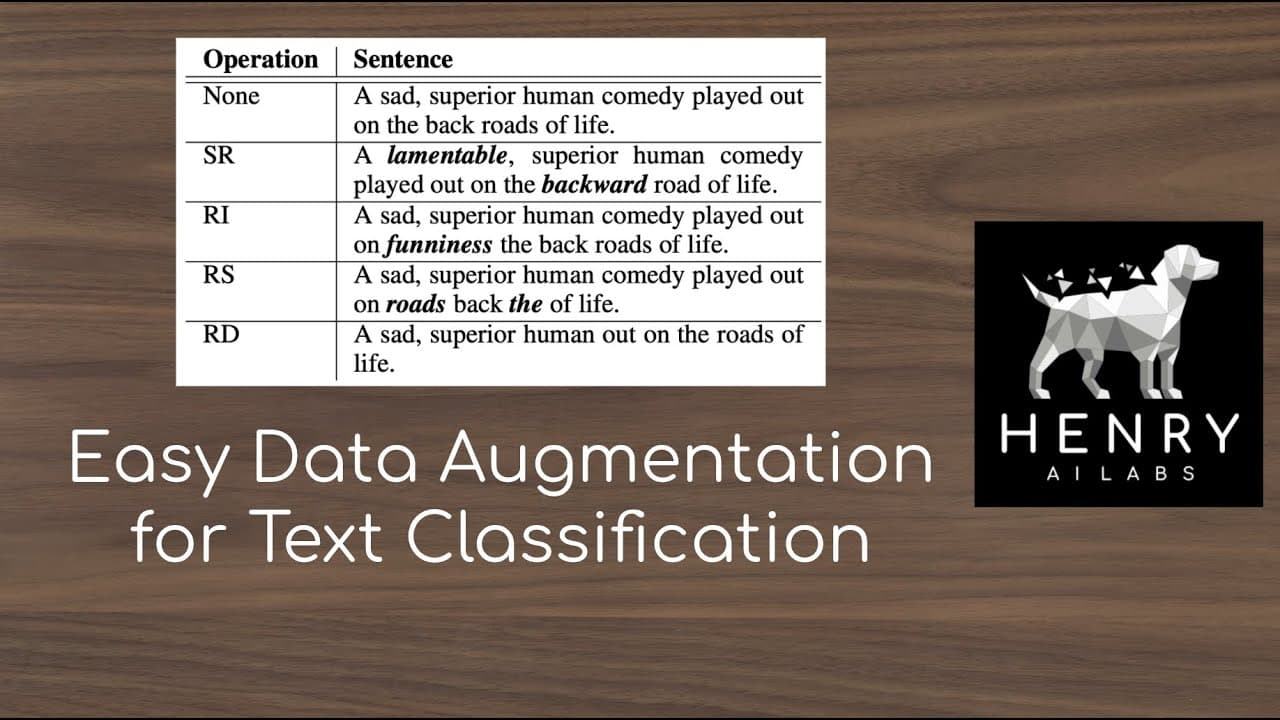
The video discusses simple data augmentation techniques to enhance text classification performance.
Transcript
this video explores easy data augmentation data augmentation describes applying transformations to our original labeled examples to construct new data for the training set this has been extremely successful in images where we can explicitly make a classifier invariant to a rotated cat by rotating an image of a cat and then having the model train on... Read More
Key Insights
- 🏷️ Easy data augmentation techniques are particularly effective for enhancing text classification performance, especially when labeled data is scarce.
- 🉐 The four methods—synonym replacement, random insertion, random swap, and random deletion—are simple to implement and can yield substantial performance gains.
- 🔑 The alpha parameter helps balance the number of words altered, ensuring the integrity of the original sentence's meaning is maintained.
- 🌥️ Performance benefits from these augmentations are most significant in scenarios with less than 1000 labeled examples, as saturation occurs with larger datasets.
- 🏛️ The risk of altering class labels through augmentation can be mitigated with careful parameter tuning and understanding of sentence structure.
- 📔 Data augmentation can help better cover vocabulary in training datasets, providing models with improved generalization capabilities.
- 🧡 Effective implementation requires no complex neural model training, making these techniques accessible for a wide range of practitioners in natural language processing.
Install to Summarize YouTube Videos and Get Transcripts
Explore YouTube Video Summarizer or Get YouTube Transcript Extractor
Questions & Answers
Q: What are the four data augmentation techniques explored in the video?
The four techniques discussed are synonym replacement, random insertion, random swap, and random deletion. Synonym replacement involves swapping words in a sentence with their synonyms, while random insertion adds new words. Random swap exchanges the positions of words, and random deletion removes words from the sentence. These methods specifically target improving text classification tasks.
Q: How do these easy data augmentation methods compare to more complex techniques?
Unlike complex techniques such as back-translation or using conditional models that require additional training and resources, the easy augmentation methods are simply implemented and can produce effective results. Their simplicity allows for quicker application, especially advantageous for those with limited computational resources or smaller datasets.
Q: Why is the alpha parameter important in this context?
The alpha parameter determines the extent of changes made to a sentence during augmentation, based on sentence length. Adjusting alpha is crucial because excessive word modification in short sentences can lead to losing the original message or altering the label, while longer sentences can tolerate more changes without compromising their meaning.
Q: When are these data augmentations most beneficial?
These augmentation techniques are particularly beneficial when working with datasets that have a limited number of labeled examples, such as around 500 or 1000. As the amount of labeled data increases, the performance gains from these simple augmentations tend to saturate and become less significant.
Q: What are potential challenges with data augmentation in NLP?
One of the primary challenges in NLP data augmentation is ensuring that the transformations applied to sentences preserve the original sentiment or meaning. Unlike images, where a rotated image may still depict the same object, text modifications can easily lead to loss of the original label or even change its meaning entirely.
Q: How do the augmentation techniques improve vocabulary coverage?
The introduction of new words through techniques like synonym replacement and random insertion helps models become more robust by covering vocabulary that may not be present in the original training data. This enhanced vocabulary representation can assist in generalization to examples in the test set.
Q: What did the results reveal about the effectiveness of these augmentations?
The results indicated that using these easy data augmentation techniques led to significant performance improvements, particularly in cases with minimal labeled data. Even when the dataset size increased, the augmentations continued to offer gains in model performance, reinforcing their utility in enhancing training outcomes.
Summary & Key Takeaways
-
The video introduces four effective and easily implementable data augmentation techniques for text classification tasks, including synonym replacement, random insertion, random swap, and random deletion, which can help improve model performance, particularly in scenarios with limited labeled data.
-
It highlights how these techniques are less complex than other methods like back-translation or generative models, making them more accessible for practitioners. The augmentation strategies are shown to yield significant performance gains even when using a smaller labeled dataset.
-
The emphasis is on parameter tuning, particularly the alpha parameter, which influences how many words to modify based on sentence length. Results indicate that careful adjustment of augmentation strategies can enhance model robustness without compromising the class label integrity.
Read in Other Languages (beta)
Share This Summary 📚
Summarize YouTube Videos and Get Video Transcripts with 1-Click
Try YouTube Summary with ChatGPT & Claude or YouTube Transcript Generator
Explore More Summaries from Connor Shorten 📚
Summarize YouTube Videos and Get Video Transcripts with 1-Click
Try YouTube Summary with ChatGPT & Claude or YouTube Transcript Generator