What Is the Relationship Between Poisson Processes and Exponential Intervals?
TL;DR
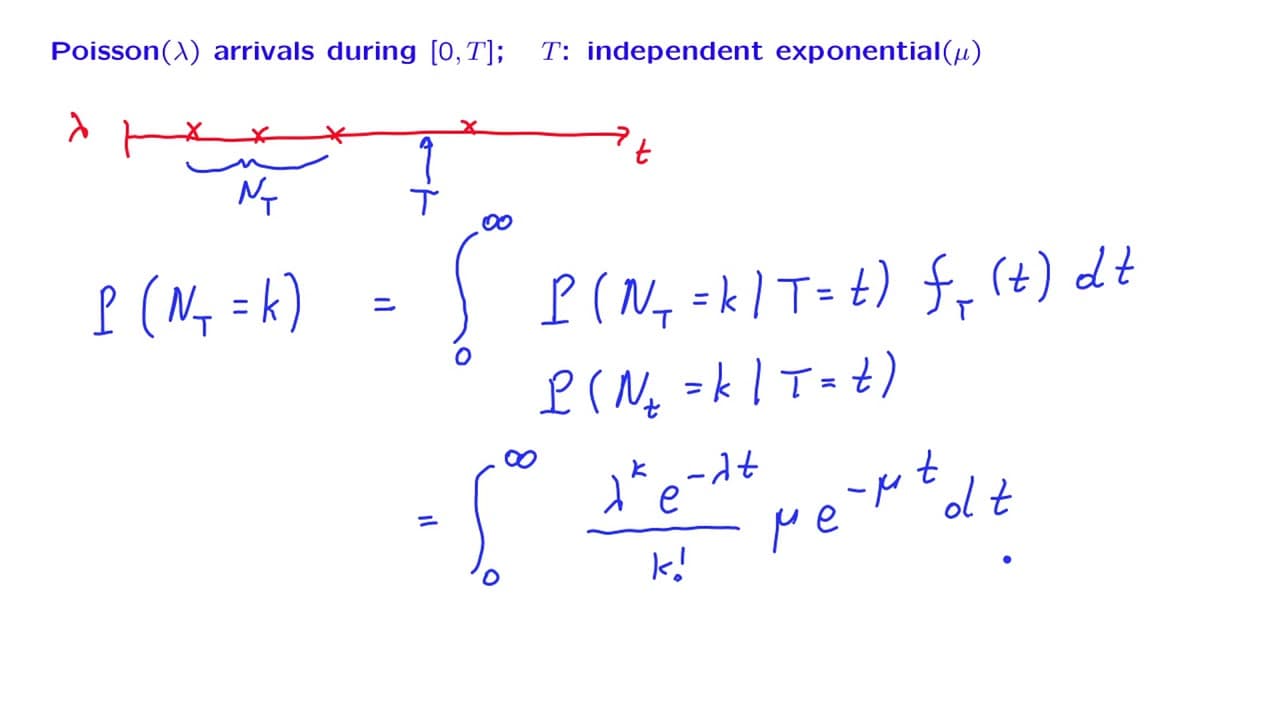
The number of arrivals in a Poisson process during an exponentially distributed time interval follows a shifted geometric distribution. By understanding this relationship, you can analyze probabilistic scenarios more effectively, utilizing concepts like conditional probability and the total probability theorem.
Transcript
In this video, we're going to establish a nice property of the Poisson process. Here is our setting. We have a Poisson process with arrival rate, lambda, and so arrivals keep coming. And we watch this process until a certain random time, T. So T is this time here. Now, T is an exponential random variable with some parameter, and T is independent fr... Read More
Key Insights
- 🛬 Poisson processes involve arrivals over time, while exponential random variables represent time between arrivals.
- 🛬 The number of arrivals during an exponentially distributed time interval follows a geometric distribution shifted by 1.
- 🛬 Conditional probability and the total probability theorem are useful tools in analyzing the distribution of the number of arrivals.
- ❓ The second method, utilizing the geometric distribution, offers a simpler approach to finding the distribution compared to mathematical manipulations.
- 🈸 Independence among trials in the merged process enables the application of the geometric distribution.
- ❓ Understanding the relationship between Poisson processes and exponential random variables provides insights into various probabilistic scenarios.
- 🛬 The arrival rate and parameter of the exponential random variable impact the distribution of the number of arrivals during a given time interval.
Install to Summarize YouTube Videos and Get Transcripts
Explore YouTube Video Summarizer or Get YouTube Transcript Extractor
Questions & Answers
Q: What is the relationship between a Poisson process and an exponential random variable?
The exponential random variable represents the time between arrivals in a Poisson process. It can be thought of as the first arrival in another Poisson process with a different arrival rate.
Q: How can the distribution of the number of arrivals during a specific time interval be determined?
There are two methods. The first involves using formulas and the probability mass function (PMF) of the Poisson process. The second method utilizes the geometric distribution and the probability of success (arrival from the blue process) in the merged Poisson process.
Q: What is the advantage of the second method?
The second method, using the geometric distribution, provides a shortcut to finding the distribution of the number of arrivals. By shifting the geometric PMF by 1, we can obtain the PMF of the number of arrivals during the exponential time interval.
Q: Are the trials in the merged process independent?
Yes, the trials are independent. The origin of each arrival in the merged process is statistically independent of the origin of other arrivals. This independence allows us to apply the geometric distribution.
Summary & Key Takeaways
-
The content explores the relationship between a Poisson process and an exponential random variable.
-
It discusses two methods to determine the distribution of the number of arrivals during a given time interval.
-
The first method involves mathematical manipulations, while the second method utilizes intuition and conditional probability.
Read in Other Languages (beta)
Share This Summary 📚
Summarize YouTube Videos and Get Video Transcripts with 1-Click
Try YouTube Summary with ChatGPT & Claude or YouTube Transcript Generator
Explore More Summaries from MIT OpenCourseWare 📚


Summarize YouTube Videos and Get Video Transcripts with 1-Click
Try YouTube Summary with ChatGPT & Claude or YouTube Transcript Generator