How to Trade Batwing Options for Profit
TL;DR
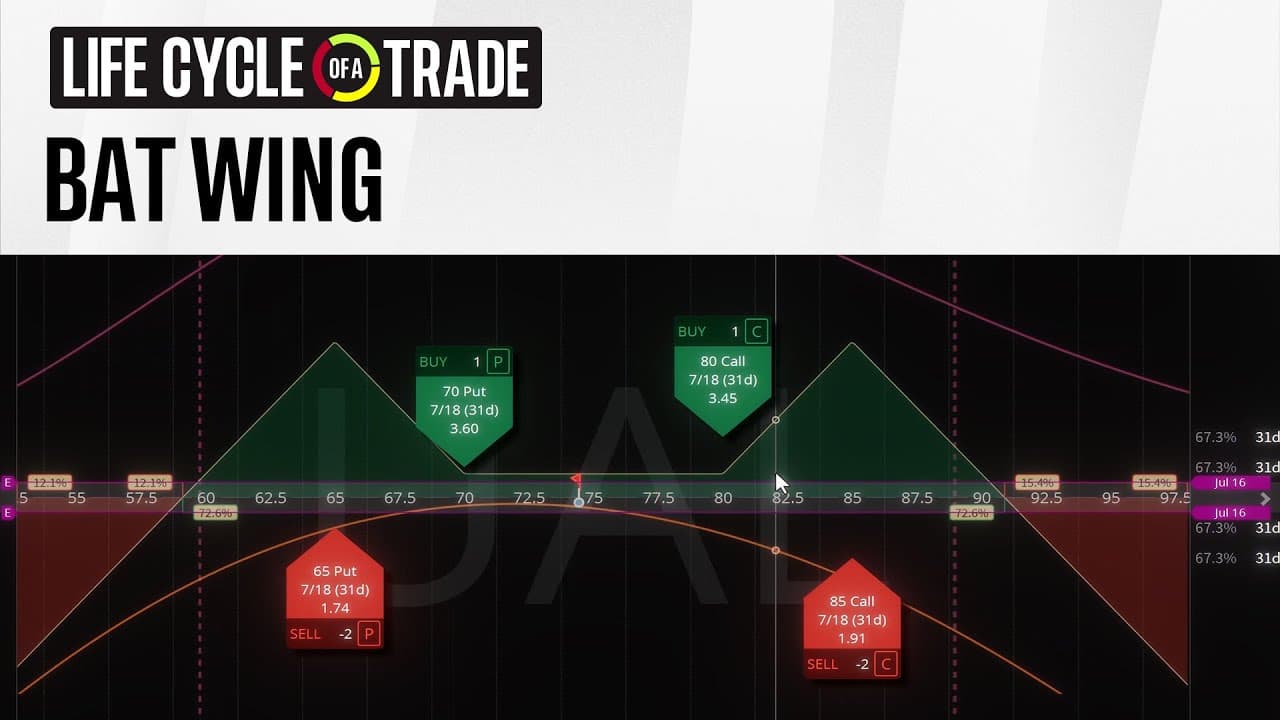
A batwing trade, or double ratio spread, involves using both put and call ratios to create a risk profile with defined profit zones. This strategy capitalizes on market volatility and time decay to manage risk and maximize potential profit. Adjustments, such as purchasing protective options and rolling strategies, are crucial when the underlying asset moves unexpectedly.
Transcript
Welcome to the life cycle of a trade, the series where we break down the thought process behind trade entry, trade adjustments, and closing order. In this video, we're going to cover a batwing trade. All right, so we've got a little bit of a sell-off in the market. E- mini's down 50 here. Uh some tons of news actually happening in Israel and Iran. ... Read More
Key Insights
- A batwing trade is a double ratio spread using both put and call ratios.
- This strategy creates a risk profile with defined profit zones at short strikes.
- Market volatility is a key factor in the timing of trade entry.
- Time decay and volatility contraction significantly impact position profitability.
- Protective options can be purchased to manage risk during earnings.
- Rolling strategies are employed when the underlying asset moves unexpectedly.
- The trade involves a relatively low probability of hitting maximum profit.
- The batwing trade can be adjusted to a straddle or strangle for flexibility.
Install to Summarize YouTube Videos and Get Transcripts
Explore YouTube Video Summarizer or Get YouTube Transcript Extractor
Questions & Answers
Q: What is a batwing trade in options trading?
A batwing trade, also known as a double ratio spread, involves using both put and call ratio spreads on an underlying asset. This strategy creates a wide risk profile and defined profit zones at short strikes. It is similar to a strangle but offers additional profit potential if the asset price pins at one of the short strikes.
Q: How does market volatility affect a batwing trade?
Market volatility plays a significant role in the timing and success of a batwing trade. High volatility can increase the potential profit of the trade by expanding the range in which the underlying asset can move while still remaining profitable. It also affects the pricing of options, impacting the overall risk and reward profile of the trade.
Q: Why is time decay important in a batwing trade?
Time decay, or theta, is crucial in a batwing trade as it erodes the extrinsic value of options over time. This decay benefits the trader if the underlying asset remains within the defined profit zones, as the value of the options sold decreases, potentially leading to a profitable exit before expiration. Effective management of time decay can significantly enhance trade outcomes.
Q: How can protective options be used in a batwing trade?
Protective options can be purchased to manage risk in a batwing trade, especially around earnings or other binary events. By buying options that cap potential losses, traders can mitigate downside risk while maintaining the trade's profit potential. This strategy allows traders to navigate uncertain market conditions while preserving their positions.
Q: What adjustments can be made if the underlying asset moves unexpectedly?
If the underlying asset moves unexpectedly, traders can adjust a batwing trade by rolling positions or converting the trade into a straddle or strangle. Rolling involves moving options to different strikes or expiration dates to adapt to the new market conditions. These adjustments help maintain a favorable risk-reward profile and enhance the trade's flexibility.
Q: What is the probability of hitting maximum profit in a batwing trade?
The probability of hitting maximum profit in a batwing trade is relatively low, typically around 10-20%. This is because the trade requires the underlying asset to pin precisely at one of the short strikes at expiration. However, the trade offers a wide range of profitability, allowing traders to benefit from time decay and volatility contraction even if maximum profit is not achieved.
Q: How does a batwing trade compare to a strangle?
A batwing trade is similar to a strangle in that it involves selling options on both sides of the underlying asset. However, the batwing trade includes additional ratio spreads that provide wider break-even points and higher profit potential if the asset price pins at one of the short strikes. This added complexity offers more strategic flexibility than a traditional strangle.
Q: What role does volatility contraction play in a batwing trade?
Volatility contraction reduces the extrinsic value of options, benefiting a batwing trade by decreasing the value of the options sold. This contraction can enhance the trade's profitability if the underlying asset remains within the defined profit zones. Traders can capitalize on volatility contraction by timing their trade entries and adjustments to coincide with periods of high implied volatility.
Summary & Key Takeaways
-
A batwing trade combines put and call ratio spreads to form a double ratio spread. This strategy offers defined profit zones and a wide risk profile, making it ideal during market volatility. By managing the trade through earnings and adjusting positions, traders can harness time decay and volatility contraction to enhance profitability.
-
The batwing trade, resembling a strangle with added potential, is set up using both put and call ratios. Protective options can be purchased to mitigate risks, especially around earnings. Rolling strategies are essential when the underlying asset price moves, allowing traders to adapt their positions and maintain profitability.
-
Time decay and volatility contraction are crucial in batwing trades. These factors, along with strategic entry and position adjustments, determine the trade's success. By monitoring market conditions and executing timely adjustments, traders can optimize the batwing strategy for favorable outcomes.
Read in Other Languages (beta)
Share This Summary 📚
Summarize YouTube Videos and Get Video Transcripts with 1-Click
Try YouTube Summary with ChatGPT & Claude or YouTube Transcript Generator
Explore More Summaries from tastylive 📚



Summarize YouTube Videos and Get Video Transcripts with 1-Click
Try YouTube Summary with ChatGPT & Claude or YouTube Transcript Generator