Stewart Calculus, Sect 9 4 #21
TL;DR
The video explains how to solve a differential equation using integration and simplification techniques.
Transcript
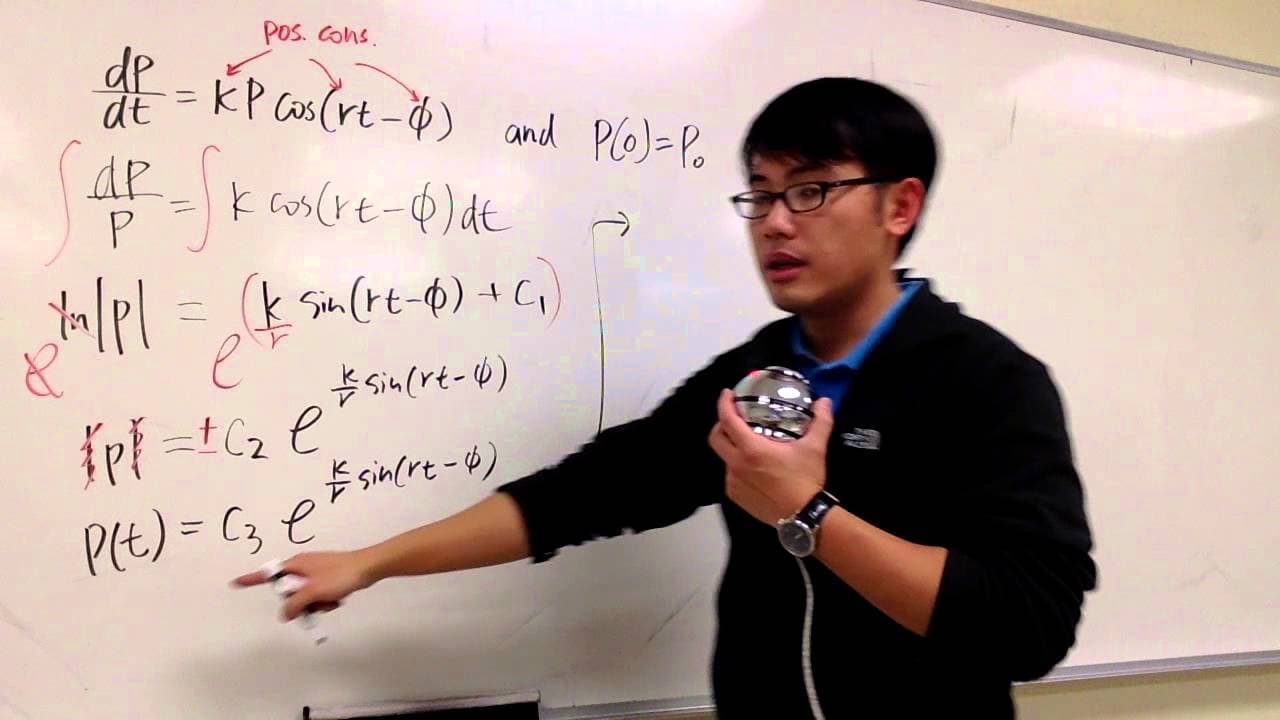
let's solve this differential equation real quick we have dpdt equal to K * P * R of RT minus V and we also have an initial condition P of Z is equal to P so let's divide both side by P multiply DT on both sides so we have DP over P equals to K cine of RT minus V and we have the DT right here and this way we can integrate both sides here and here o... Read More
Key Insights
- ❓ Differential equations can be solved by isolating the variable, integrating, and simplifying the resulting equation.
- ❓ The initial condition must be used to determine the constants in the general solution.
- 🧑🏭 The general solution can be further simplified by factoring out common factors.
Install to Summarize YouTube Videos and Get Transcripts
Explore YouTube Video Summarizer or Get YouTube Transcript Extractor
Questions & Answers
Q: How is the initial value of the differential equation, P(0), plugged into the general solution?
To find the constant C3 in the general solution, we substitute T = 0 into the equation and solve for C3. This involves simplifying the expression and considering the effect of the negative exponent when dealing with the sine function.
Q: Can the general solution be simplified further?
Yes, the general solution can be written in a more compact form by factoring out the common factor K/R. By doing so, the equation becomes P(t) = P * e^(K/R * s(RT - V)) * s(RT - V).
Q: What is the significance of the absolute value in the equation?
The absolute value accounts for the possibility of both positive and negative values for P. However, since the negative value can be represented by multiplying the entire equation by -1, the absolute value can be effectively ignored.
Q: How is the general solution affected by the sign of V?
The sign of V influences the term s(RT - V). If V is positive, the term remains the same. However, if V is negative, the sine term becomes -s(RT + |V|).
Summary & Key Takeaways
-
The video demonstrates the step-by-step process of solving the differential equation dp/dt = K * P * R^RT - V, with the initial condition P(Z) = P.
-
By dividing both sides by P and multiplying by dt, the equation is transformed into DP/P = K * sin(RT - V) * dt.
-
Integrating both sides of the equation results in Ln|P| = K/R * s(RT - V), and by isolating P, the general solution is derived as P(t) = C3 * e^(K/R * s(RT - V)).
Read in Other Languages (beta)
Share This Summary 📚
Summarize YouTube Videos and Get Video Transcripts with 1-Click
Try YouTube Summary with ChatGPT & Claude or YouTube Transcript Generator
Explore More Summaries from blackpenredpen 📚
Summarize YouTube Videos and Get Video Transcripts with 1-Click
Try YouTube Summary with ChatGPT & Claude or YouTube Transcript Generator