What Are Common English Idioms for Giving Advice?
TL;DR
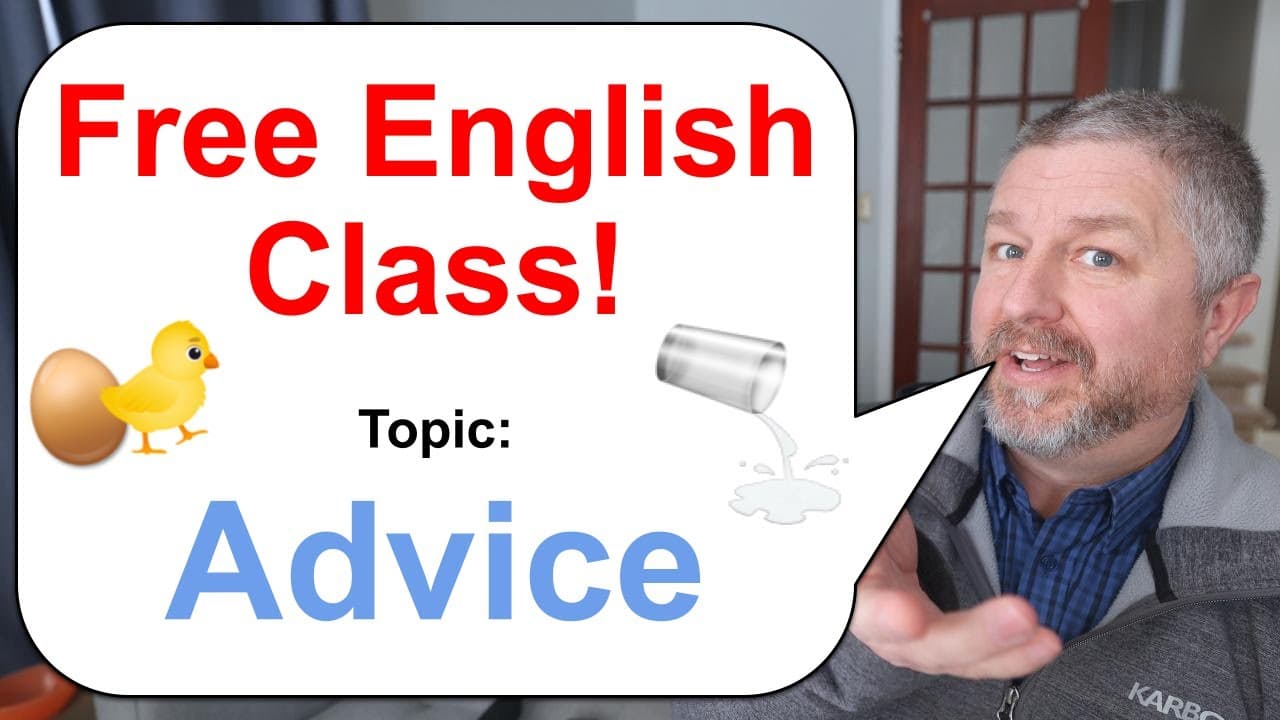
Common English idioms for giving advice include phrases like 'bite off more than you can chew,' which means not to overextend yourself, and 'practice makes perfect,' emphasizing the importance of practice in mastering a skill. These idioms convey wisdom and life lessons, enriching conversations and helping learners express complex ideas succinctly.
Transcript
well hello everybody i hope you're having a really good friday so far i hope you're enjoying the day whether it's cold or warm or snowy or hot or rainy wherever you are i hope that you are having a really really good day as you know i'll be starting in about 23 seconds once i double check everything and make sure everything is working i see todd an... Read More
Key Insights
- 🤑 Learning a language involves both discovering new phrases and revisiting familiar ones for practice and review.
- 😑 Phrases and idioms related to advice cover various topics and commonly express wisdom and lessons about life.
- ⚖️ Offering advice requires tact and consideration, balancing directness with tactfulness.
- 🙊 Many idioms and sayings used in the English language may not be commonly spoken in everyday conversations, but they can still be encountered in books, movies, and TV shows.
- 🫚 Some idioms and sayings are rooted in historical or cultural references that may not be immediately apparent to non-native speakers.
- ❓ Repetition and practice are essential in language learning to improve fluency and accuracy.
- 💦 Advice may differ depending on the context, such as personal life, work, or relationships.
- 👻 Idioms and phrases allow for concise and impactful communication, conveying complex ideas and concepts in a succinct manner.
Install to Summarize YouTube Videos and Get Transcripts
Explore YouTube Video Summarizer or Get YouTube Transcript Extractor
Questions & Answers
Q: What does the phrase "bite off more than you can chew" mean?
This phrase advises against taking on more work or tasks than one can handle effectively. It suggests not attempting something beyond one's capabilities.
Q: How is "practice makes perfect" commonly used in advice?
This phrase emphasizes the importance of repeated practice in achieving proficiency in a particular skill. It encourages individuals to continue practicing in order to improve.
Q: How can the phrase "don't count your chickens before they hatch" be applied in real-life scenarios?
This phrase warns against assuming or expecting certain outcomes before they are confirmed or realized. It advises individuals to wait until they have concrete results before making conclusions or expectations.
Q: What does the saying "actions speak louder than words" mean?
This saying highlights the importance of one's actions, which hold more weight and impact than mere verbal promises or claims. It suggests that true character and intentions are revealed through one's actions rather than their words.
Q: How is the phrase "a penny saved is a penny earned" applicable in daily life?
This phrase encourages individuals to save money rather than spending it. It suggests that saving money is equivalent to earning money and promotes the idea of being financially responsible.
Q: What does it mean to "put all your eggs in one basket"?
This phrase advises against relying solely on one thing or depending on a single source for everything. It suggests diversifying and spreading risks rather than concentrating everything in one place or situation.
Q: How is the saying "don't judge a book by its cover" significant?
This saying encourages individuals not to form assumptions or conclusions based solely on outward appearances or initial impressions. It teaches the importance of getting to know someone or understanding a situation more deeply before making judgments.
Q: What does the phrase "the early bird gets the worm" imply?
This phrase suggests that individuals who wake up early and act promptly are more likely to obtain opportunities or achieve success. It emphasizes the advantage of being proactive and taking action early on.
Summary & Key Takeaways
-
This English lesson focuses on familiar phrases and idioms used in giving advice.
-
The lesson emphasizes the importance of practicing and reviewing known phrases while learning new things.
-
The phrases covered in the lesson include "bite off more than you can chew," "practice makes perfect," "don't count your chickens before they hatch," and more.
Read in Other Languages (beta)
Share This Summary 📚
Summarize YouTube Videos and Get Video Transcripts with 1-Click
Try YouTube Summary with ChatGPT & Claude or YouTube Transcript Generator
Explore More Summaries from Learn English with Bob the Canadian 📚





Summarize YouTube Videos and Get Video Transcripts with 1-Click
Try YouTube Summary with ChatGPT & Claude or YouTube Transcript Generator