God Can't Give a Message to Mankind Through a Man
TL;DR
The discussion centers around the belief that human beings as imperfect conduits can distort the accuracy of divine messages, raising doubts about their authenticity.
Transcript
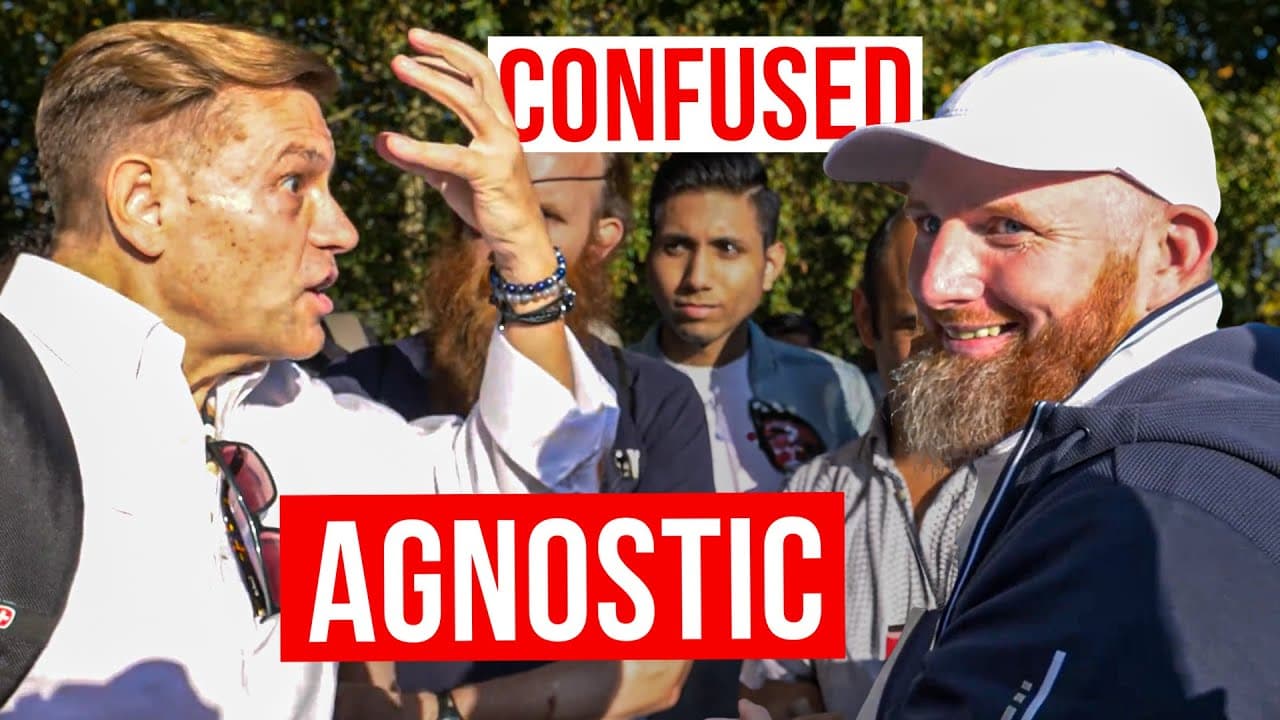
I have a vision and I believe I am a messenger of God the Son of God no why you believe that though because it's my belief based on what based on my inner soul my inner belief I am the so so basically according to your subjective feelings yes you think you're the Son of God yes correct so what would you then say what would your response to me be yo... Read More
Key Insights
- 🤔 Key Insight 1: The speaker believes they are the Son of God based on their inner belief, but acknowledges that it is a subjective feeling without rational evidence.
- 💭 Key Insight 2: The speaker argues that because the Prophet Muhammad and Jesus Christ were human beings, they were imperfect conduits and their messages cannot be completely accurate or pure.
- 💡 Key Insight 3: The speaker highlights the importance of rational evidence in believing something to be true, and questions the validity of belief without proof.
- 😕 Key Insight 4: There is a discussion about the nature of angels and whether they can communicate with humans in their pure form without becoming human themselves.
- 🌟 Key Insight 5: The concept of belief is examined, with one side arguing that belief is accepting something without evidence, while the other side argues that belief is based on reason and evidence.
- 🕌 Key Insight 6: The reliability of the Quran is questioned, with one side arguing that it came through a human being, therefore it cannot be completely pure or accurate.
- ⚖️ Key Insight 7: There is a disagreement about whether an angel verified the Quran, with one side arguing that an angel did confirm it, while the other side doubts the possibility of an angel verifying a message through a human being.
- 🤝 Key Insight 8: The conversation emphasizes the importance of challenging beliefs and providing evidence or reasons for them, leading to a better understanding and possible reconciliation of differing viewpoints.
Install to Summarize YouTube Videos and Get Transcripts
Explore YouTube Video Summarizer or Get YouTube Transcript Extractor
Questions & Answers
Q: Can a belief be considered true even without proof?
Yes, a belief can still be considered true without concrete proof, as beliefs are often based on subjective feelings or reasons that are not easily quantifiable.
Q: How does the imperfection of human beings affect the accuracy of divine messages?
The imperfection of human beings introduces the possibility of distorting or misinterpreting divine messages, making them less reliable and pure.
Q: Can an angel's confirmation validate the accuracy of a divine message?
The role of an angel in confirming the authenticity of a divine message is a matter of belief and faith. However, it does not provide concrete proof and can be subject to interpretation.
Q: Does the belief in a creator play a role in determining the accuracy of divine messages?
The belief in a creator can influence one's perspective on the authenticity of divine messages, but it does not provide empirical evidence or definitive proof.
Q: How can the concept of imperfect human conduits affect the interpretation of religious texts?
The notion of imperfect human conduits can lead to differing interpretations of religious texts, as individuals may question the degree to which human flaws have influenced the content and accuracy of the messages.
Q: Can an imperfect human conduit "filter" a divine message to preserve its purity?
The concept of a human conduit filtering a divine message relies on the belief that a human's imperfections can somehow be overcome to ensure the message remains pure. However, this is subjective and varies depending on individual beliefs.
Q: What role does rational evidence play in shaping beliefs about divine messages?
Rational evidence is not always the primary factor in shaping beliefs about divine messages, as beliefs often stem from subjective feelings, personal experiences, or faith rather than concrete proof or evidence.
Summary & Key Takeaways
-
The conversation revolves around the belief that human beings, including prophets, are imperfect conduits for divine messages.
-
The imperfect nature of humans is cited as a reason why their beliefs and messages cannot be taken as 100% accurate or pure.
-
The notion of an angel confirming the authenticity of the messages and whether the angel is a human or non-human entity is debated.
Read in Other Languages (beta)
Share This Summary 📚
Summarize YouTube Videos and Get Video Transcripts with 1-Click
Try YouTube Summary with ChatGPT & Claude or YouTube Transcript Generator
Explore More Summaries from Hamza's Den 📚



Summarize YouTube Videos and Get Video Transcripts with 1-Click
Try YouTube Summary with ChatGPT & Claude or YouTube Transcript Generator