Pie chart | Car Sales | Data Interpretation | Reasoning | Part - 12 | Bharath Kumar
TL;DR
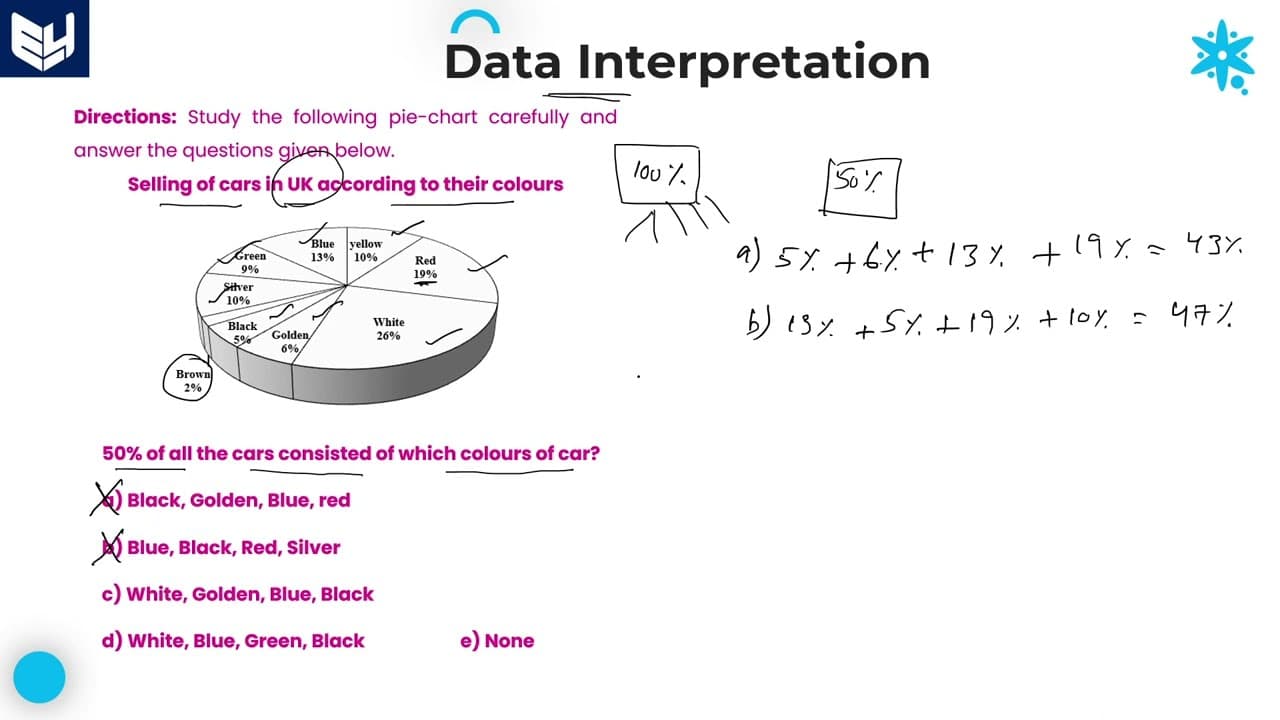
This session analyzes UK car sales data based on color percentages.
Transcript
hi everyone welcome to the session in this session I'm continuing pie chart data interpretation first of all we need to read the information carefully after that according to the information we need to solve the questions first read the information what is the information provided in this pie chart selling of cars in UK according to their colors he... Read More
Key Insights
- 😨 The total car sales pie chart comprises nine colors, with white being the most popular at 26%.
- ⚾ Simple addition techniques are effective for solving percentage-based questions in competitive exams.
- ❓ Understanding the relationships between different colors can simplify complex calculation problems involving percentages.
- 🏆 The approach of validating options by checking combinations provides efficiency in problem-solving during tests.
- 😨 Budgeting knowledge regarding overall car production assists in estimating sales based on percentage shares.
- 🤑 Percentages can be directly translated into tangible production figures for context-rich insights into market trends.
- 🥧 Effective time management during examinations can be achieved by using structured approaches to pie chart data.
Install to Summarize YouTube Videos and Get Transcripts
Explore YouTube Video Summarizer or Get YouTube Transcript Extractor
Questions & Answers
Q: What does the pie chart in the session represent?
The pie chart represents the percentage distribution of car sales colors in the UK, showcasing nine distinct colors and their respective market shares. Each color's percentage combines to form a complete 100%, providing insights into consumer preferences and trends in car purchases.
Q: How is the combination of car colors calculated to reach 50%?
The video demonstrates adding different color percentages to identify combinations that sum to 50%. For example, white (26%), gold (6%), blue (13%), and black (5%) were added to find that their total equaled 50%, thus illustrating effective techniques for interpreting pie chart data.
Q: Which color of cars is 20% less than white, according to the data analysis?
Gold cars, which make up 6% of total sales, are determined to be 20% less than white cars, which account for 26%. The calculation involves subtracting 20% from white's percentage, effectively linking color sales proportions to derive precise data interpretations.
Q: How did the presenter calculate the value difference between blue and green cars?
The presenter calculated the number of blue cars sold by determining their corresponding percentage of total production. By using the total production value and percentages for blue (13%) and green (9%), they established that the sales difference amounted to 3816 more blue cars sold than green, illustrating a comprehensive analytical method.
Summary & Key Takeaways
-
The session explains the distribution of car sales in the UK by color, detailing the percentage shares for each color in a pie chart.
-
Questions are posed regarding combinations of car colors to achieve certain percentage totals, with detailed problem-solving techniques provided for competitive exams.
-
The video culminates in calculations related to total car production and comparisons between varying colors, emphasizing practical applications of percentage calculations.
Read in Other Languages (beta)
Share This Summary 📚
Summarize YouTube Videos and Get Video Transcripts with 1-Click
Try YouTube Summary with ChatGPT & Claude or YouTube Transcript Generator