A2 Biology - Neurones (OCR A Chapter 13.2)
TL;DR
Explores neuron types, structures, and myelin sheath's role in conduction.
Transcript
Read and summarize the transcript of this video on Glasp Reader (beta).
Key Insights
- The nervous system and hormonal system are the two main systems maintaining homeostasis in the body.
- Neurons consist of sensory, relay, and motor types, each with distinct structures and functions.
- The nervous pathway involves receptors, sensory neurons, central nervous system, relay neurons, motor neurons, and effectors.
- Dendrons and dendrites are parts of neurons that transmit impulses to the cell body.
- The axon is a long structure that sends impulses away from the cell body, crucial for neuron function.
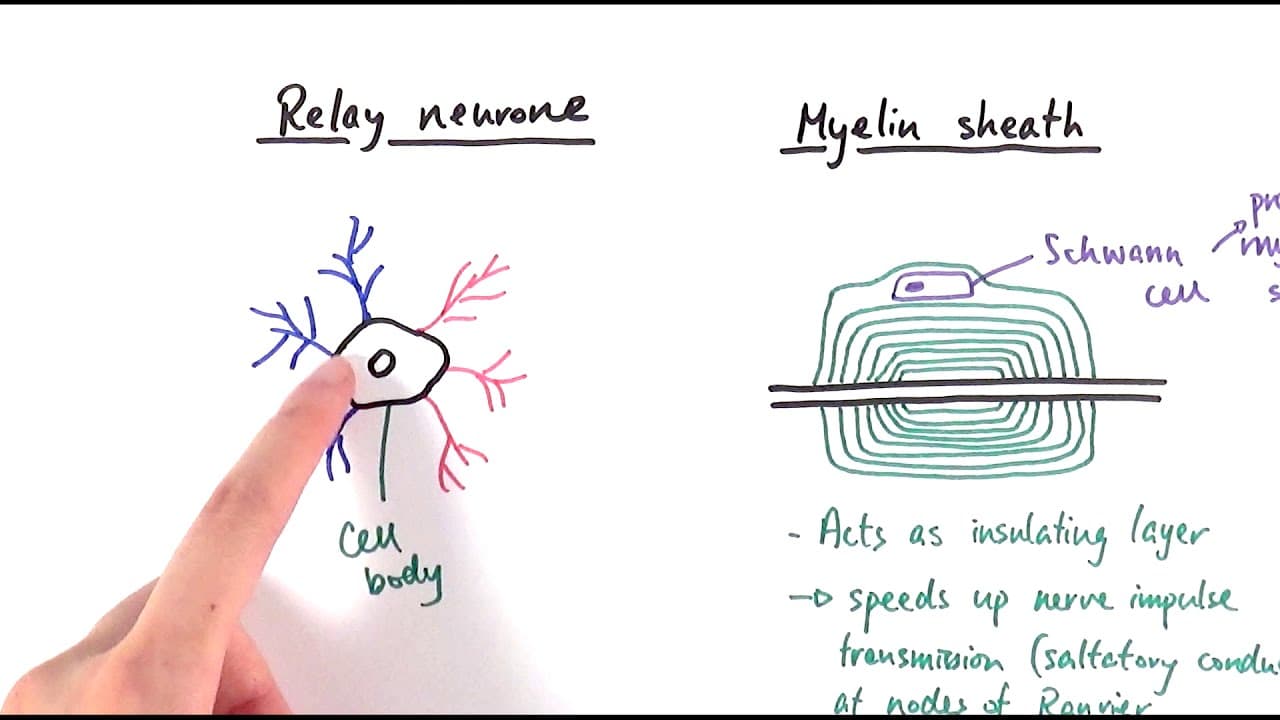
- The myelin sheath, made of glycolipids and cholesterol, insulates neurons and speeds up nerve transmission.
- Nodes of Ranvier are gaps in the myelin sheath where action potentials jump, enabling faster transmission.
- Schwann cells produce the myelin sheath, facilitating saltatory conduction along myelinated neurons.
Install to Summarize YouTube Videos and Get Transcripts
Explore YouTube Video Summarizer or Get YouTube Transcript Extractor
Questions & Answers
Q: What systems are responsible for maintaining homeostasis in the body?
Homeostasis is maintained by the nervous system and the hormonal system. The nervous system involves neurons transmitting impulses to regulate bodily functions, while the hormonal system uses hormones to influence processes. Both systems work together to keep the internal environment stable through mechanisms like negative feedback.
Q: What is the role of the myelin sheath in neurons?
The myelin sheath acts as an insulating layer around neurons, made of glycolipids and cholesterol. It speeds up nerve impulse transmission by allowing action potentials to jump between nodes of Ranvier, a process known as saltatory conduction. This efficient transmission is crucial for rapid communication across the nervous system.
Q: How do sensory neurons differ from motor neurons in structure?
Sensory neurons have their cell bodies located in the middle of the neuron, with dendrites receiving signals from receptors and transmitting them through the dendron to the axon. In contrast, motor neurons have cell bodies at the beginning, with dendrites receiving signals from relay neurons or the central nervous system and transmitting them through the axon to effectors.
Q: What are nodes of Ranvier and their function?
Nodes of Ranvier are gaps in the myelin sheath along a neuron. These nodes are crucial for saltatory conduction, where action potentials jump from one node to the next, bypassing the insulated sections. This jumping mechanism significantly speeds up nerve impulse transmission, enhancing the efficiency of the nervous system.
Q: What is the function of Schwann cells in the nervous system?
Schwann cells are responsible for producing the myelin sheath that surrounds neurons. This sheath insulates the axon, facilitating faster transmission of nerve impulses through saltatory conduction. By enabling efficient impulse propagation, Schwann cells play a vital role in the rapid communication required for nervous system functionality.
Q: How do relay neurons function within the nervous system?
Relay neurons, found within the central nervous system, transmit impulses between sensory and motor neurons. They have cell bodies located centrally, with dendrites receiving signals from sensory neurons and axons transmitting them to motor neurons. Relay neurons ensure smooth communication within the nervous pathway, crucial for coordinated responses.
Q: What is the significance of dendrites in neuron structure?
Dendrites are branched extensions of neurons that receive electrical signals from other neurons or sensory receptors. They play a critical role in transmitting these impulses to the cell body, initiating the process of nerve impulse propagation. Dendrites' ability to receive and integrate signals is essential for neuron communication and overall nervous system function.
Q: What is saltatory conduction, and why is it important?
Saltatory conduction is the process where nerve impulses jump between nodes of Ranvier, bypassing insulated sections of the neuron. This method of transmission is significantly faster than continuous conduction, allowing rapid communication across the nervous system. It is essential for efficient nerve impulse propagation, critical for timely responses to stimuli.
Summary & Key Takeaways
-
The video explores the structure and function of various neuron types, including sensory, relay, and motor neurons, detailing their roles in the nervous system. It emphasizes the importance of the myelin sheath in speeding up nerve transmission through saltatory conduction.
-
Neurons are essential in transmitting impulses across the nervous system. The video describes how sensory neurons receive signals, relay neurons transmit them within the central nervous system, and motor neurons convey them to effectors, highlighting the significance of the myelin sheath.
-
The video provides an in-depth look at neuron anatomy, focusing on dendrites, axons, and myelin sheaths. It explains how these components work together to facilitate rapid nerve impulse transmission, crucial for efficient nervous system functioning.
Read in Other Languages (beta)
Share This Summary 📚
Summarize YouTube Videos and Get Video Transcripts with 1-Click
Try YouTube Summary with ChatGPT & Claude or YouTube Transcript Generator