How Does Locke Define Personal Identity?
TL;DR
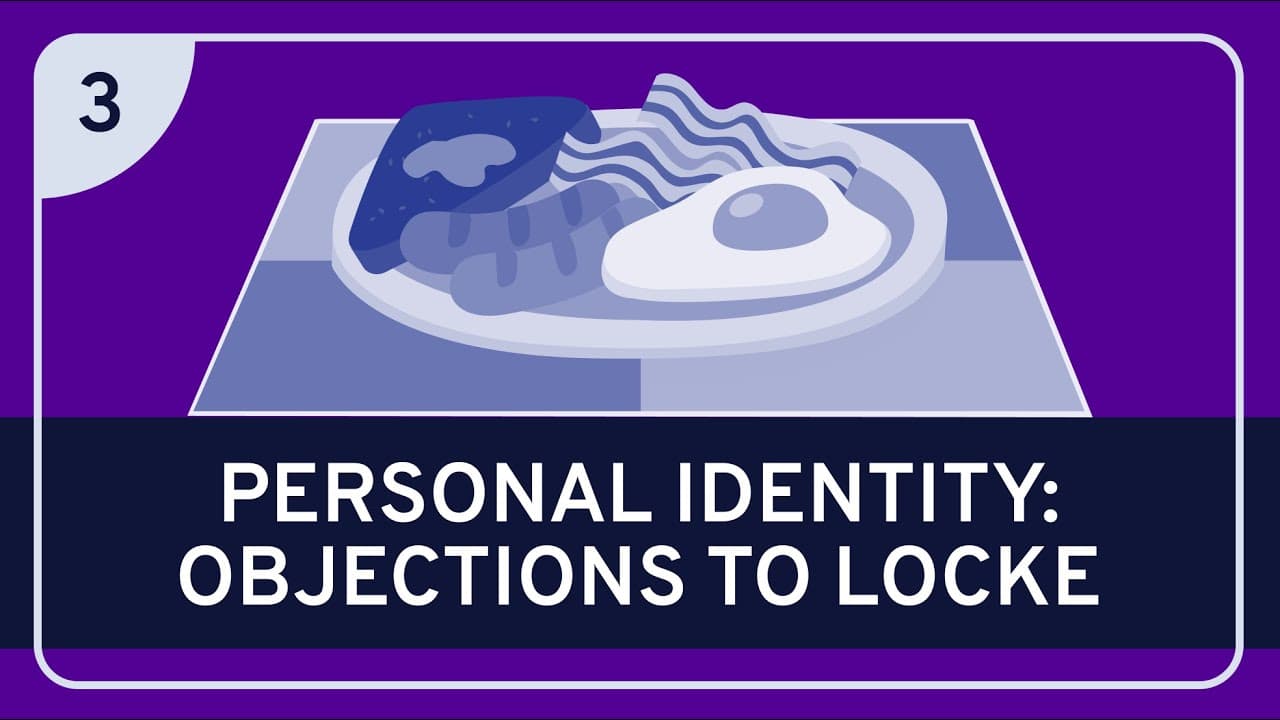
John Locke's view on personal identity focuses on the continuity of consciousness and memory as necessary and sufficient conditions. However, this view faces challenges such as the Breakfast Problem, the Brave Officer Problem, and the Branching Problem, which question the feasibility of memory as the sole criterion for personal identity over time.
Transcript
(intro music) Hi, this is Michael Della Rocca yet again, and still talking to you about the problem with personal identity over time, as it appears in the philosophy of John Locke. At the end of our last segment, we had gotten to the point of discussing what Locke's theory is. He accounts for personal identity over time in terms of the sameness of ... Read More
Key Insights
- Locke's theory of personal identity is based on the continuity of consciousness and memory over time.
- The Breakfast Problem challenges Locke's theory by questioning if forgetting an event implies a change in personal identity.
- Locke distinguishes between a 'man' or 'human being' and a 'person' to address identity issues.
- The Brave Officer Problem highlights contradictions in Locke's theory regarding transitivity and memory-based identity.
- The Branching Problem questions how identity is determined when one person splits into two with shared memories.
- Locke's theory implies that different persons can exist within the same human being if memories are not continuous.
- Philosophers debate whether memory alone can account for personal identity, especially in complex scenarios.
- Despite challenges, Locke's view encourages exploration of deeper understandings of personal identity.
Install to Summarize YouTube Videos and Get Transcripts
Explore YouTube Video Summarizer or Get YouTube Transcript Extractor
Questions & Answers
Q: How does Locke define personal identity?
Locke defines personal identity primarily through the continuity of consciousness or memory over time. For Locke, a later person is identical to an earlier one if the later person can remember the thoughts and actions of the earlier person. This continuity of memory is both necessary and sufficient for maintaining personal identity.
Q: What is the Breakfast Problem in Locke's theory?
The Breakfast Problem highlights a flaw in Locke's theory by questioning whether forgetting an event, such as what one had for breakfast, implies a change in personal identity. Locke addresses this by distinguishing between being the same 'man' or 'human being' and being the same 'person', suggesting that identity can persist without continuous memory.
Q: What is the Brave Officer Problem?
The Brave Officer Problem, raised by Thomas Reid, challenges Locke's theory by presenting a scenario where a person at different times remembers only certain past actions. It questions the transitivity of identity, as a retired general remembers being a brave officer but not a childhood event, suggesting a contradiction in Locke's memory-based identity theory.
Q: What is the Branching Problem related to Locke's view?
The Branching Problem arises when a person splits into two individuals, both retaining memories of the original person. This challenges Locke's memory-based identity theory, as it raises questions about which of the two resulting individuals maintains the original identity, or if neither does, given that identity is not transitive in this case.
Q: How does Locke address issues of memory loss in personal identity?
Locke addresses memory loss by differentiating between the concepts of 'person' and 'man' or 'human being'. He suggests that while memory continuity is necessary for personal identity, the physical continuity of the human being can persist despite gaps in memory, allowing for the same human being to exist without being the same person.
Q: Why is Locke's theory of personal identity significant in philosophy?
Locke's theory is significant because it challenges traditional notions of identity tied to the soul or body, proposing instead that consciousness and memory are central. This view has sparked extensive philosophical debate and exploration, leading to deeper inquiries into the nature of self and identity, despite its unresolved challenges.
Q: What are the limitations of Locke's personal identity theory?
Locke's theory faces limitations such as the inability to account for identity in cases of memory loss, contradictions in transitive identity as highlighted by the Brave Officer Problem, and challenges in determining identity in branching scenarios. These issues suggest that memory alone may not be sufficient to define personal identity comprehensively.
Q: How do contemporary philosophers view Locke's theory?
Contemporary philosophers recognize Locke's theory as a foundational yet incomplete view of personal identity. While it has been influential in shifting focus to psychological continuity, philosophers continue to debate and seek solutions to its challenges, such as those posed by memory gaps and branching, to develop a more robust understanding of identity.
Summary & Key Takeaways
-
Locke's personal identity theory hinges on memory continuity, suggesting that identity over time is maintained through recollection of past thoughts and actions. However, the Breakfast Problem challenges this by questioning if forgetting an event means a change in identity, leading Locke to differentiate between 'man' and 'person'.
-
The Brave Officer Problem presents a contradiction in Locke's theory, as it suggests that a person cannot be the same as their past self if they lack memory of certain events, despite transitive identity. This highlights the limitations of relying solely on memory for personal identity.
-
The Branching Problem questions Locke's theory when a person divides into two with shared memories, challenging the idea that identity can be maintained through memory alone. Philosophers argue whether memory continuity is sufficient for personal identity in complex scenarios.
Read in Other Languages (beta)
Share This Summary 📚
Summarize YouTube Videos and Get Video Transcripts with 1-Click
Try YouTube Summary with ChatGPT & Claude or YouTube Transcript Generator
Explore More Summaries from Wireless Philosophy 📚
Summarize YouTube Videos and Get Video Transcripts with 1-Click
Try YouTube Summary with ChatGPT & Claude or YouTube Transcript Generator