IoT Chapter 4 - Connected Data - Data Stream Processing
TL;DR
Data stream processing involves managing continuous data from sensors using queries.
Transcript
Read and summarize the transcript of this video on Glasp Reader (beta).
Key Insights
- Data stream management systems (DSMS) connect to sensors and data sources, managing continuous sequences of timestamped data items.
- Publish-subscribe (pub-sub) is a general interaction pattern, while MQTT is a specific protocol using pub-sub in IoT systems.
- Data streams are unbounded sequences, continuously receiving data items, which are timestamped for order tracking.
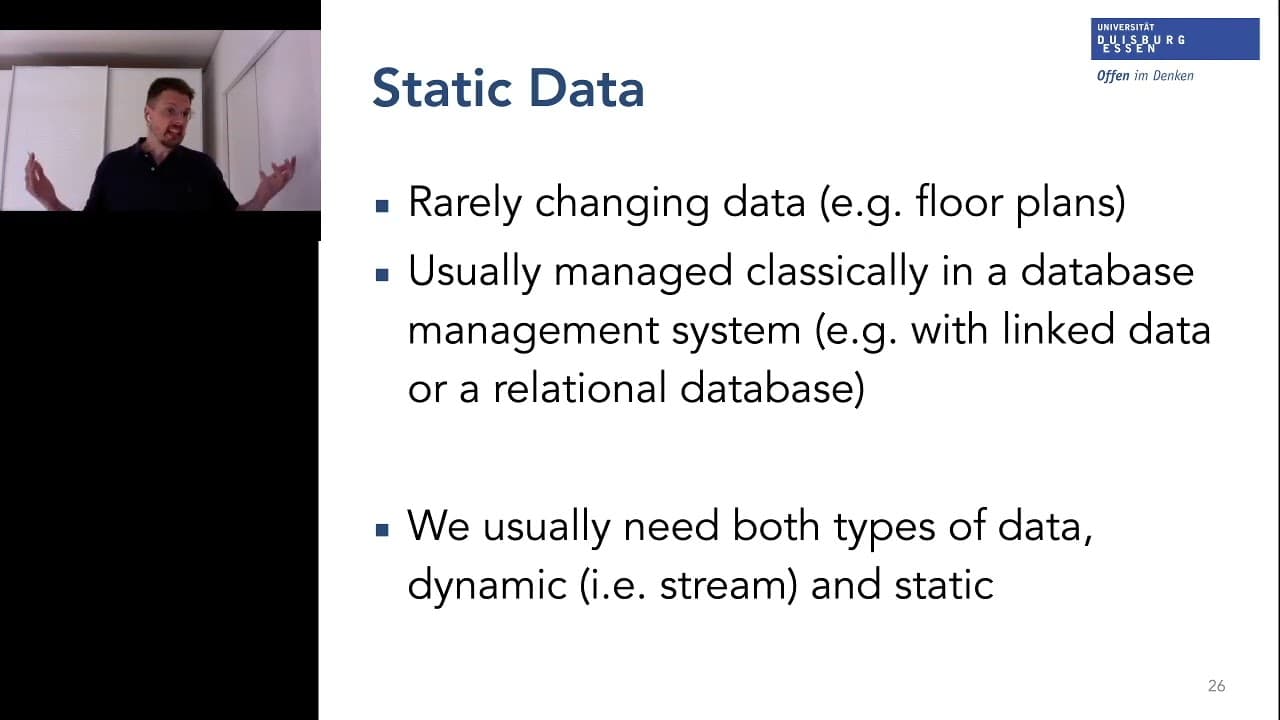
- Static data, though rarely changing, is crucial in data stream systems and is often managed in classic databases.
- DSMS can handle both one-time and continuous queries, the latter requiring constant re-evaluation as new data arrives.
- Window concepts (sliding, stepped, tumbling) help manage data stream queries by defining data subsets for analysis.
- Query evaluation techniques (eager, periodic) balance between immediate reactivity and workload management.
- SQLs integrates data streams with linked data, optimizing query execution through a combination of pre-processing, optimization, and execution phases.
Install to Summarize YouTube Videos and Get Transcripts
Explore YouTube Video Summarizer or Get YouTube Transcript Extractor
Questions & Answers
Q: What is the core function of a data stream management system?
A data stream management system (DSMS) is responsible for managing continuous flows of data from various sensors and sources. It processes these data streams by executing queries, either one-time or continuous, to provide meaningful insights and information. The DSMS handles both dynamic data streams and static data, ensuring efficient data processing and management.
Q: How does the publish-subscribe model relate to MQTT in IoT?
The publish-subscribe (pub-sub) model is a general interaction pattern used to facilitate communication between data producers and consumers. MQTT is a specific protocol that implements the pub-sub model, commonly used in IoT systems. While pub-sub is a broad concept, MQTT provides a standardized way to use this model in IoT applications, though the two are not synonymous.
Q: What challenges are associated with timestamping in data streams?
Timestamping in data streams presents challenges as it involves assigning a time to each data item to maintain order. Some sensors may lack clocks, complicating accurate timestamping. One solution is timestamping data upon arrival at the DSMS, but this can introduce issues like latency or incorrect ordering, affecting the reliability of the data stream.
Q: Why is static data important in data stream systems?
Static data is important in data stream systems as it provides context and additional information that complements dynamic data streams. Although static data changes infrequently, it is essential for tasks like merging with dynamic data to provide comprehensive insights. This data is managed in databases, allowing for efficient querying and integration with real-time data.
Q: What are the differences between one-time and continuous queries?
One-time queries are executed once, providing a snapshot of current data, while continuous queries are stored indefinitely and re-evaluated as new data arrives. Continuous queries generate ongoing results, updating applications with real-time information. This requires the DSMS to handle potentially infinite data, ensuring continuous query accuracy and relevance.
Q: How do window concepts aid in data stream management?
Window concepts, such as sliding, stepped, and tumbling windows, help manage data stream queries by defining finite data subsets for analysis. Sliding windows continuously update with new data, stepped windows progress in defined intervals, and tumbling windows have non-overlapping intervals. These techniques ensure efficient data processing and reduce workload on the DSMS.
Q: What techniques are used to evaluate queries in DSMS?
Query evaluation techniques in DSMS include eager and periodic evaluations. Eager evaluation re-evaluates queries with each new data item, providing low delay but high workload. Periodic evaluation processes queries at fixed intervals, reducing workload but potentially missing brief events. These techniques balance reactivity and scalability in managing data streams.
Q: How does SQLs optimize query execution in data streams?
SQLs optimizes query execution in data streams by integrating static and dynamic data using pre-processing, optimization, and execution phases. The optimizer dynamically adjusts the order of operator execution to minimize workload and maximize efficiency. Caching intermediate results further enhances performance by reusing computations when data remains unchanged.
Summary & Key Takeaways
-
Data stream processing involves managing continuous data flows from sensors through a data stream management system (DSMS). It handles both dynamic data streams and static data, providing interfaces for executing queries. The system supports both one-time and continuous queries, which require constant re-evaluation.
-
The publish-subscribe model is a general interaction pattern, while MQTT is a specific protocol implementing it in IoT contexts. Data streams are unbounded sequences of timestamped data items, crucial for maintaining order. Static data, though rarely changing, is essential in DSMS and managed in databases.
-
Windowing techniques (sliding, stepped, tumbling) are used to manage data subsets for queries. SQLs integrates data streams with linked data, optimizing query execution through pre-processing, optimization, and execution phases, adjusting dynamically to ensure efficient data processing.
Read in Other Languages (beta)
Share This Summary 📚
Summarize YouTube Videos and Get Video Transcripts with 1-Click
Try YouTube Summary with ChatGPT & Claude or YouTube Transcript Generator