Multiplexer | Boolean logic function | Examples | Part-1/2 | STLD | Lec-97
TL;DR
This video explains how to implement logic functions using multiplexers.
Transcript
hi everyone in this video I'm going to explain about the implementation of a combinational logic function using multiplexer in the previous videos as I discussed the implementation of a combination logic function using decoder the similar way we are going to implement any type of logical function or Boolean expression that we can Implement using mu... Read More
Key Insights
- 🚰 Implementing logic functions with multiplexers involves understanding the input-output relationship defined by the truth table.
- 🔢 The number of selection lines for a multiplexer determines its size, which directly relates to the number of inputs it can handle.
- 🔠 Minterms are crucial for determining how to connect multiplexer's inputs to achieve the desired logical output.
- 🎮 The video emphasizes practical examples to effectively illustrate multiplexer logic design.
- 🍵 Knowing how to handle cases where a specific multiplexer size is mandated is essential for successful circuit implementation.
- 🔠 The XOR function can be efficiently implemented using multiplexers by defining how each input affects the output in a systematic manner.
- 🔡 Each multiplexer’s input should be connected to either logic high or low based on the truth table for the logic expression.
Install to Summarize YouTube Videos and Get Transcripts
Explore YouTube Video Summarizer or Get YouTube Transcript Extractor
Questions & Answers
Q: What is the primary focus of the video?
The video primarily focuses on the implementation of combinational logic functions using multiplexers, explaining in detail the logic expression f = a XOR b XOR c and demonstrating how to construct and connect the multiplexer to achieve this logic function.
Q: How do you determine the size of the multiplexer needed for a logic function?
The size of the multiplexer is determined by the number of selection lines needed for the inputs. For example, with three selection lines (a, b, c), an 8-to-1 multiplexer is required since 2^3 equals 8, thereby allowing for all combinations of inputs to be selected.
Q: What method does the video suggest for constructing a truth table?
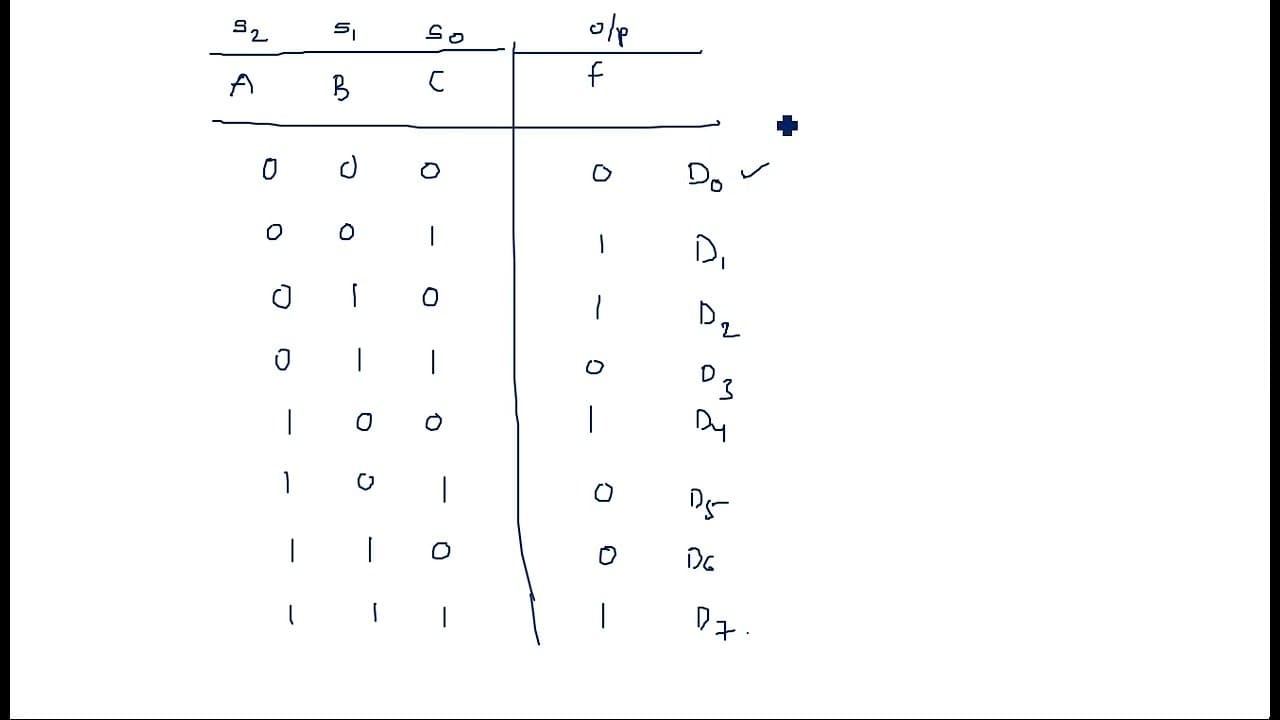
The video suggests constructing a truth table by evaluating the logic function for all combinations of input values. For f = a XOR b XOR c, the truth table is created by systematically inputting values for a, b, and c to observe when the output is true, thereby identifying the minterms connected to logic high.
Q: How does one implement a logic function using a multiplexer when its size is given?
If the multiplexer size is specified, you should use the given size for input selection lines. For example, if a 4-to-1 multiplexer is required, select two of the inputs as selection lines, and the third input will determine the output logic based on the truth table for the input combinations.
Summary & Key Takeaways
-
The content focuses on implementing combinational logic functions using multiplexers, specifically explaining the expression f = a XOR b XOR c with three inputs.
-
It highlights the importance of determining the multiplexer size based on the number of selection lines and inputs required for proper implementation.
-
The video describes constructing truth tables and provides detailed examples to help viewers understand how to connect multiplexer inputs based on logical operations.
Read in Other Languages (beta)
Share This Summary 📚
Summarize YouTube Videos and Get Video Transcripts with 1-Click
Try YouTube Summary with ChatGPT & Claude or YouTube Transcript Generator