Properties of Water
TL;DR
Water's unique properties are vital for biological processes.
Transcript
Captions are on! Click CC at bottom right to turn off. Follow us on Twitter (@AmoebaSisters) and Facebook! We have a riddle for you. Ok, not really a riddle. We’re bad at riddles. More like clues about our favorite molecule. It’s polar. It’s shaped like an outstretched V. Its properties are awesome. We have a riddle for you. Ok, not really a riddle... Read More
Key Insights
- Water's polarity and V-shaped structure contribute to its unique properties, essential for life and biological processes.
- Hydrogen bonds between water molecules enable phenomena like cohesion, adhesion, and surface tension, crucial for various biological functions.
- Cohesion allows water to move against gravity in plants, facilitating essential nutrient transport through structures like the xylem.
- Water's surface tension, due to cohesion, enables certain insects and animals to move on water surfaces without sinking.
- As a polar solvent, water dissolves many molecules, playing a critical role in bodily functions like kidney filtration and other metabolic processes.
- Water expands and becomes less dense upon freezing, creating an insulating ice layer beneficial for aquatic life survival in cold climates.
- High specific heat of water stabilizes temperatures in aquatic environments, absorbing heat in summer and releasing it in winter.
- Evaporative cooling through water molecules helps regulate temperature in plants and animals, preventing damage from excessive heat.
Install to Summarize YouTube Videos and Get Transcripts
Explore YouTube Video Summarizer or Get YouTube Transcript Extractor
Questions & Answers
Q: How does water's polarity affect its properties?
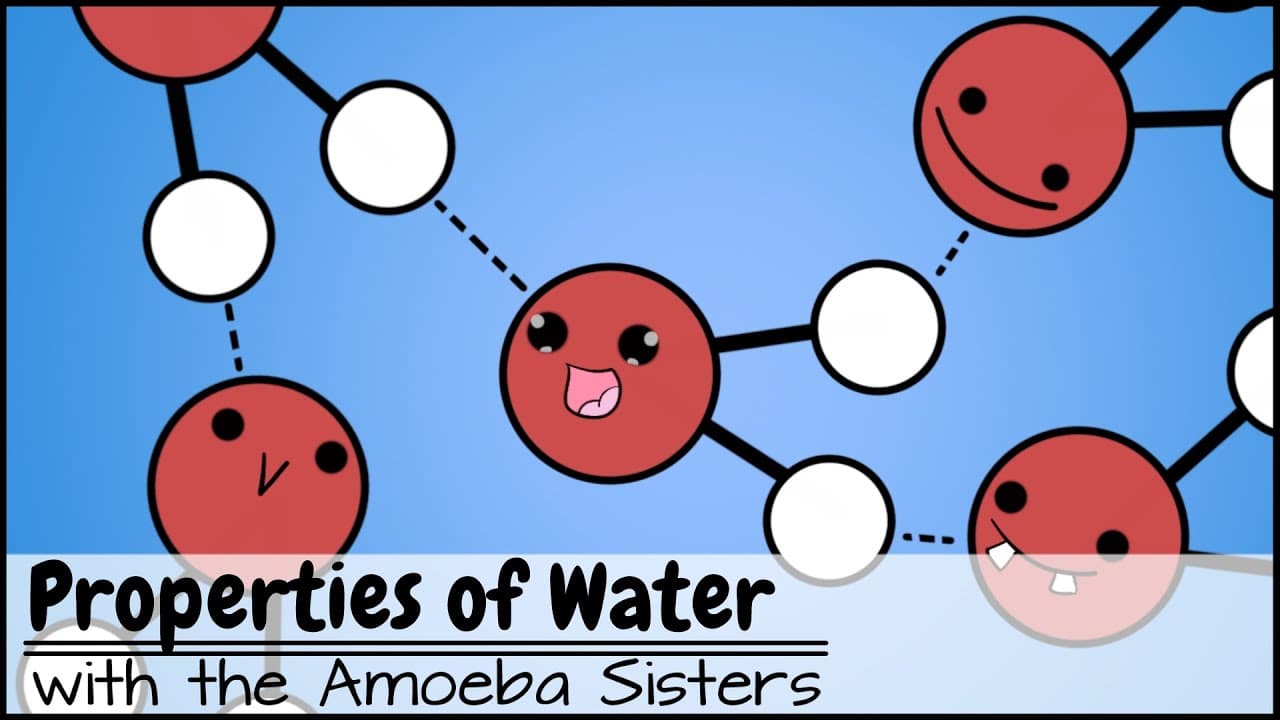
Water's polarity, due to its V-shaped structure and electronegative oxygen, creates a slightly negative charge on oxygen and a positive charge on hydrogen. This allows water molecules to form hydrogen bonds with each other, leading to properties like cohesion, adhesion, and surface tension, which are vital for biological processes.
Q: What role do hydrogen bonds play in water's properties?
Hydrogen bonds, formed between the slightly positive hydrogen of one water molecule and the slightly negative oxygen of another, are crucial for water's properties. They enable cohesion and adhesion, allowing water to move against gravity in plants and contribute to surface tension, enabling certain insects to walk on water.
Q: How does water move against gravity in plants?
Water moves against gravity in plants through cohesion and adhesion. Cohesion allows water molecules to stick together, forming a continuous column in the xylem. Adhesion helps water molecules stick to the xylem walls. As water evaporates from leaves, cohesion pulls the next molecule upward, facilitating nutrient transport.
Q: Why is water's surface tension important?
Water's surface tension, resulting from cohesion, is important because it allows certain insects and animals to move on water surfaces without sinking. This property is due to the hydrogen bonds between water molecules, creating a 'skin' on the water surface that can support small weights.
Q: How does water function as a solvent?
Water functions as a powerful solvent due to its polarity, allowing it to dissolve many polar molecules and ionic compounds. This property is essential for metabolic processes, such as nutrient transport and waste removal in organisms, as seen in the kidneys' filtration of blood and other bodily fluids.
Q: Why does ice float on water, and why is this important?
Ice floats on water because it is less dense than liquid water. When water freezes, hydrogen bonds form a lattice, spacing molecules apart. This floating ice creates an insulating layer on bodies of water, protecting aquatic life from freezing temperatures and maintaining stable environments for survival.
Q: What is the significance of water's high specific heat?
Water's high specific heat means it can absorb or release significant heat without a large temperature change. This property stabilizes aquatic environments, protecting organisms from rapid temperature fluctuations. In summer, water absorbs heat, and in winter, it releases heat, moderating climate effects on ecosystems.
Q: How does evaporative cooling benefit organisms?
Evaporative cooling benefits organisms by regulating body temperature. As water molecules evaporate, they take heat away, cooling the surface. This process is crucial for animals, including humans, to prevent overheating, and for plants, which use it to maintain enzyme function and prevent damage from excessive heat.
Summary & Key Takeaways
-
Water's unique properties, due to its polarity and hydrogen bonding, are crucial for biological processes. These properties include cohesion, adhesion, surface tension, and its role as a solvent.
-
Cohesion and adhesion allow water to move against gravity in plants, while surface tension enables some animals to walk on water. Water's solvent capabilities are vital for metabolic processes.
-
Water's expansion upon freezing creates an insulating layer, high specific heat stabilizes temperatures in aquatic environments, and evaporative cooling helps regulate temperature in organisms.
Read in Other Languages (beta)
Share This Summary 📚
Summarize YouTube Videos and Get Video Transcripts with 1-Click
Try YouTube Summary with ChatGPT & Claude or YouTube Transcript Generator
Explore More Summaries from Amoeba Sisters 📚






Summarize YouTube Videos and Get Video Transcripts with 1-Click
Try YouTube Summary with ChatGPT & Claude or YouTube Transcript Generator