Creating our Own Kubernetes & Docker to Run Our Data Infrastructure | Modal
TL;DR
The founder of Modal Labs discusses the challenges in building better tools for data engineers and data scientists and the importance of optimizing container startup times and file system caching for improved productivity.
Transcript
I'm the founder of a company called modal we provide data infrastructure in the cloud and I'm going to talk about a very deep Rabbit Hole I went down where I started wanting to build a better set of tools for data engineers and data scientists and then realized I had to do a lot of infrastructure to to get there but but real quick and Taylor alread... Read More
Key Insights
- ☁️ It started with a desire to build better tools for data engineers and data scientists, but led to the realization that infrastructure improvements were necessary to achieve that goal.
- 💡 Productivity for developers can be measured by the efficiency of their workflow, which is often characterized by nested loops of code writing, testing, waiting, and deploying.
- 💻 Front-end engineers have achieved fast feedback loops by using tools that enable immediate gratification, while data teams struggle with slow feedback loops due to infrastructure constraints.
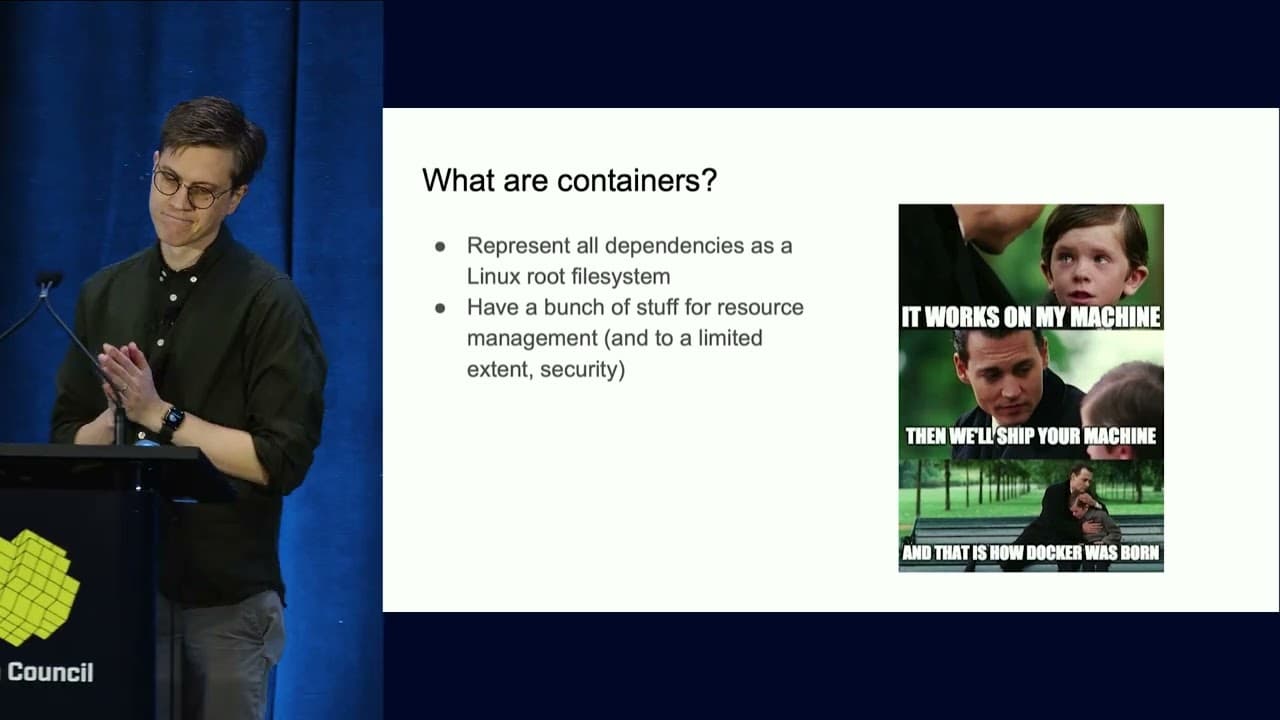
- ⚙️ Containers, such as Docker, can be used to run code locally and in the cloud, but the process of pulling down container images can be slow and inefficient.
- 🔄 Caching files locally on workers improves latency and allows for faster container startup times. ⏬ By using content addressing and file system caching, containers can be started in the cloud in about a second, creating a more efficient workflow for developers.
- 💼 The technology developed here is not limited to building faster containers, but can also be used to build a function as a service platform, particularly useful for GPU workloads.
- 🌐 Building a custom file system in Rust and implementing a Docker file parser was necessary to optimize the process of building container images.
- ⚡️ The result is a system that allows for faster container startups, efficient resource utilization, and scalability for various workloads.
Install to Summarize YouTube Videos and Get Transcripts
Explore YouTube Video Summarizer or Get YouTube Transcript Extractor
Questions & Answers
Q: How did the speaker initially approach the challenge of improving tools for data engineers and data scientists?
The speaker began by wanting to build better tools for themselves, focusing on improving productivity when writing code and scheduling tasks, and reducing overall feedback loop times.
Q: What issues did the speaker identify with the current feedback loop process for data teams?
The speaker highlighted the long feedback loop times in the outermost loops, such as waiting for code to be reviewed or deployed to production, which can hinder productivity and the enjoyment of writing code.
Q: How did the speaker optimize container startup times and improve file system caching?
By leveraging content addressing and local SSD caching techniques, the speaker was able to reduce container startup times by caching frequently accessed files and only fetching new files when necessary, resulting in significant latency reductions.
Q: What additional challenges did the company address in creating their platform?
The company developed a scheduling mechanism for managing worker instances in the cloud to improve resource utilization and scalability. They also focused on optimizing GPU-intensive tasks by effectively loading and executing large models efficiently.
Summary & Key Takeaways
-
The speaker wanted to build better tools for data engineers and data scientists, focusing on optimizing productivity and reducing feedback loop times.
-
Containers were found to be a key component, but pulling down images was slow, so a file system caching approach was developed to improve startup times.
-
The company also built a scheduling mechanism for managing worker instances in the cloud and leveraged the technology to create a function as a service platform for running GPU-intensive tasks.
Read in Other Languages (beta)
Share This Summary 📚
Summarize YouTube Videos and Get Video Transcripts with 1-Click
Try YouTube Summary with ChatGPT & Claude or YouTube Transcript Generator