Acoustics1
TL;DR
Reverberation is the persistence of sound after a speaker stops.
Transcript
Read and summarize the transcript of this video on Glasp Reader (beta).
Key Insights
- Reverberation differs from echo as it is the persistence of sound after the source stops, while echo is a distinct repetition of sound due to reflection off distant surfaces.
- Reverberation time is the duration for which sound persists in a room after the source has stopped, measured until the sound decays to one-millionth of its original intensity.
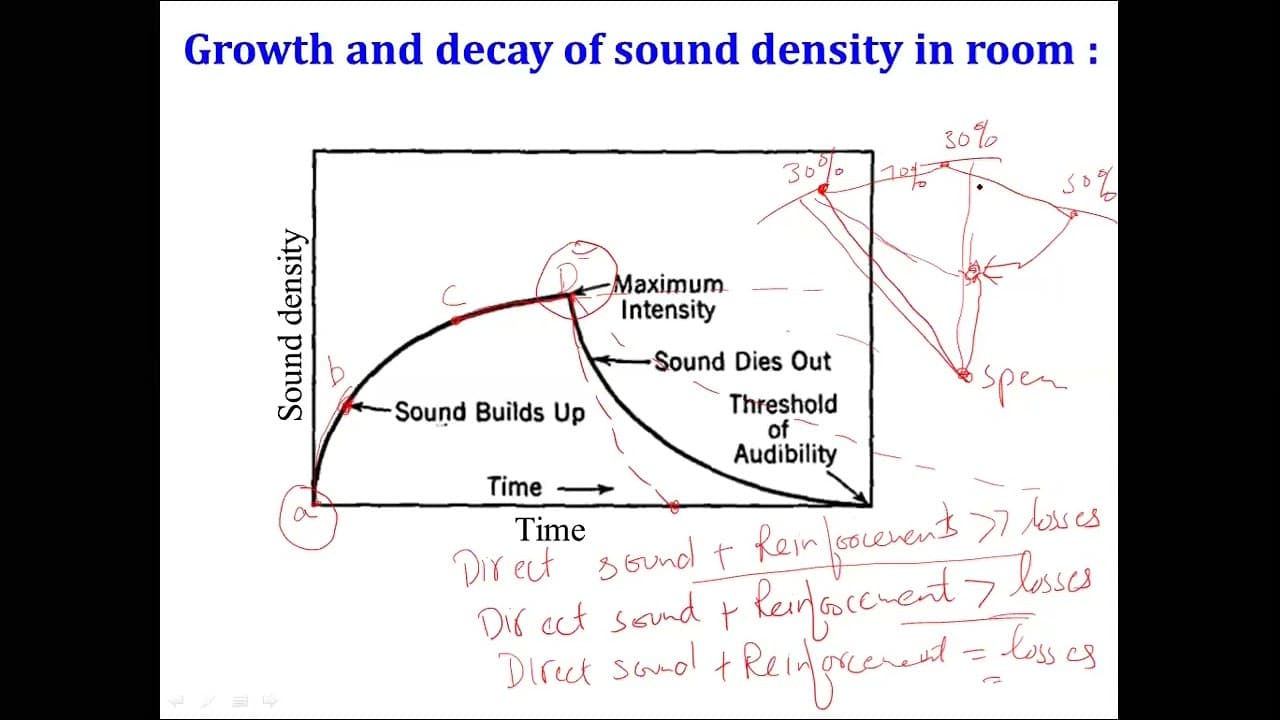
- Sound intensity in a room initially rises due to direct sound and reflections, then decays as sound is absorbed by surfaces.
- The design of a room, including materials used, affects its reverberation time, which can be adjusted by altering the room's surfaces to control sound absorption.
- Different environments require varying reverberation times; for instance, studios need shorter times for clarity, while auditoriums require longer times for sound continuity.
- An open window is used as a reference for defining absorption coefficients, with a coefficient of 1, meaning it absorbs all incident sound energy.
- Average absorption coefficient is calculated by considering the absorption coefficients and surface areas of all objects in a room.
- Sound absorption occurs through conversion into heat energy, often in porous materials or by inducing vibrations in objects.
Install to Summarize YouTube Videos and Get Transcripts
Explore YouTube Video Summarizer or Get YouTube Transcript Extractor
Questions & Answers
Q: What is the difference between reverberation and echo?
Reverberation is the persistence of sound after the sound source has stopped, caused by multiple reflections that blend together, making it hard to distinguish individual sounds. Echo, on the other hand, is a distinct repetition of sound that occurs when sound waves reflect off distant surfaces and return to the listener with a noticeable delay.
Q: How is reverberation time measured?
Reverberation time is measured from the moment the sound source stops until the sound intensity decays to one-millionth of its original intensity. This measurement is crucial in acoustics as it helps determine how long sound persists in a room, influencing the clarity and quality of audio heard in that space.
Q: Why is controlling reverberation time important in room design?
Controlling reverberation time is essential for achieving the desired acoustic environment in a room. Different spaces, such as recording studios, auditoriums, and classrooms, require specific reverberation times to ensure sound clarity, intelligibility, and continuity. Proper control prevents excessive reverberation or echo, enhancing the audio experience.
Q: What role do materials play in sound absorption?
Materials play a significant role in sound absorption by converting sound energy into heat. Porous materials, like carpets and curtains, absorb sound by allowing it to enter and dissipate within their structure. Additionally, materials that can vibrate, such as hanging objects, can absorb sound energy through flexural vibrations, reducing sound persistence in a room.
Q: How is an absorption coefficient determined?
An absorption coefficient is determined by comparing the sound energy absorbed by a material to the sound energy absorbed by a perfect absorber, such as an open window, with the same area. An open window is assigned an absorption coefficient of 1, meaning it absorbs all incident sound energy. The coefficient helps assess a material's effectiveness in sound absorption.
Q: What is the significance of an open window in measuring absorption coefficients?
An open window serves as a reference point with an absorption coefficient of 1, meaning it absorbs all incident sound energy without reflection. This standard allows for consistent comparison and measurement of the absorption capabilities of different materials, helping to quantify their effectiveness in controlling sound within a space.
Q: How does sound intensity change in a room over time?
Sound intensity in a room initially increases as direct sound from the source and reflections from surfaces combine, reinforcing the sound. Over time, as sound is absorbed by surfaces, the intensity decreases. This change is influenced by the room's design, materials, and the absorption properties of objects within the space.
Q: What are the two primary methods of sound absorption?
The two primary methods of sound absorption are through porous materials and flexural vibrations. Porous materials allow sound to enter and dissipate within their structure, converting sound energy into heat. Flexural vibrations occur when sound waves cause objects to vibrate, dissipating sound energy and reducing sound persistence in the environment.
Summary & Key Takeaways
-
Reverberation is the persistence of sound in a room after the source has stopped, differing from echo, which is a distinct repetition due to sound reflection. Reverberation time is crucial for room acoustics, influencing clarity and sound quality.
-
Sound intensity in a room initially increases due to direct sound and reflections, then decreases as sound is absorbed by surfaces. Reverberation time depends on the room's design, materials, and usage, affecting sound clarity and continuity.
-
Absorption coefficients are used to measure how well materials absorb sound, with an open window as a reference. Sound absorption converts sound energy into heat, often in porous materials or through inducing vibrations in objects.
Read in Other Languages (beta)
Share This Summary 📚
Summarize YouTube Videos and Get Video Transcripts with 1-Click
Try YouTube Summary with ChatGPT & Claude or YouTube Transcript Generator
Explore More Summaries from SUNIL DEVI 📚

Summarize YouTube Videos and Get Video Transcripts with 1-Click
Try YouTube Summary with ChatGPT & Claude or YouTube Transcript Generator